Reviewing a Musée d’Orsay exhibition about the male body, James Polchin considers the aesthetics of nudity:
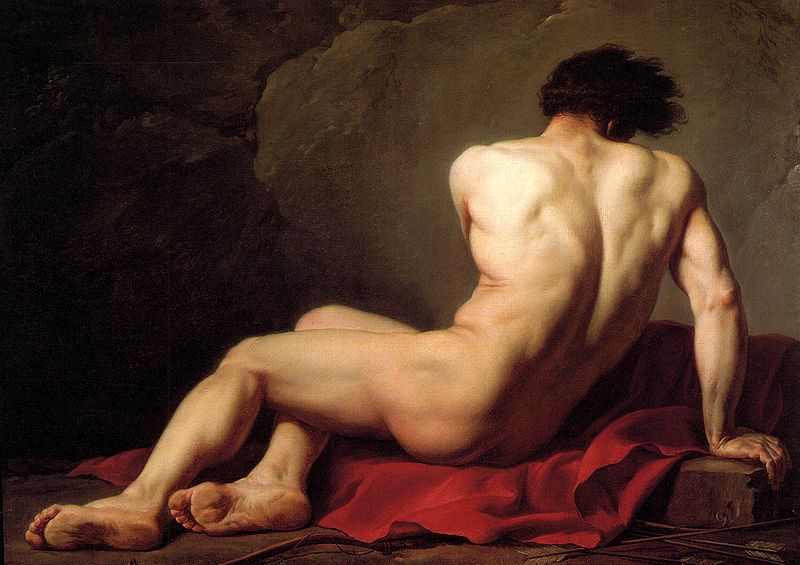
In the 18th and early 19th centuries, the male body was crucial to academic painting, anchoring the ideals of ancient Greek and Roman aesthetics. One of the more compelling works early in this show is Jacques-Louis David’s Patroclus (1780). David, the icon of early 19th century Neoclassical painting, used heroic, naked males in many of his historical paintings, composing large canvases filled with muscled subjects, their crotches often covered in subtle ways, all rendered with realist precision. Unlike David’s more crowded historical scenes, this work offers a quiet intimacy between viewer and the subject sitting on the ground in a weakened state, his torso twisted away from us, leaving us gazing at him from behind. In Homer’s Iliad Patroclus was the comrade of Achilles fighting alongside him in the Trojan Wars where he was killed. Their relationship has often been considered a romantic one. The painting conjures the beauty of Patroclus’ body as something idealized, as if David is asking us to gaze upon the defeated warrior in the same loving way as Achilles himself might have done. But beauty and nakedness here serves another purpose as well: a heroic ideal that captures not just our attraction but also our empathy.
(Image of Jacques-Louis David’s Patroclus, 1780, via Wikimedia Commons)
 The Dish
