Nick Paumgarten dives deep into the forces driving up the prices of fine art:
You meet a lot of people in the art world who are exhausted and dismayed by the focus on money, and by its dominance. It distracts from the work, they say. It distorts curatorial instincts, critical appraisals, and young artists’ careers. It scares away civilians, who begin to lump art in with other symptoms of excess and dismiss it as another garish plaything of the rich. Of course, many of those who complain—dealers, artists, curators—are complicit. The culture industry, which supports them in one way or another, and which hardly existed a generation ago, subsists on all that money—mostly on the largesse and folly of wealthy art lovers, whether their motivations are lofty or base.
Since the doldrums of the early nineties, the market for contemporary art, which has various definitions (work created after the Second World War, or during “our” lifetime, or post-1960, or post-1970), has rocketed up, year after year, flattening out briefly amid the financial crisis and global recession of 2008-09, before resuming its climb. Big annual returns have attracted more people to buying art, which has raised prices further. It is no coincidence that this steep rise, in recent decades, coincides with the increasing financialization of the world economy. The accumulation of greater wealth in the hands of a smaller percentage of the world’s population has created immense fortunes with a limitless capacity to pursue a limited supply of art work. The globalization of the art market—the interest in contemporary art among newly wealthy Asians, Latin Americans, Arabs, and Russians—has furnished it with scores of new buyers, and perhaps fresh supplies of greater fools. Once you have hundreds of millions of dollars, it’s hard to know where to put it all. Art is transportable, unregulated, glamorous, arcane, beautiful, difficult. It is easier to store than oil, more esoteric than diamonds, more durable than political influence. Its elusive valuation makes it conducive to extremely creative tax accounting.
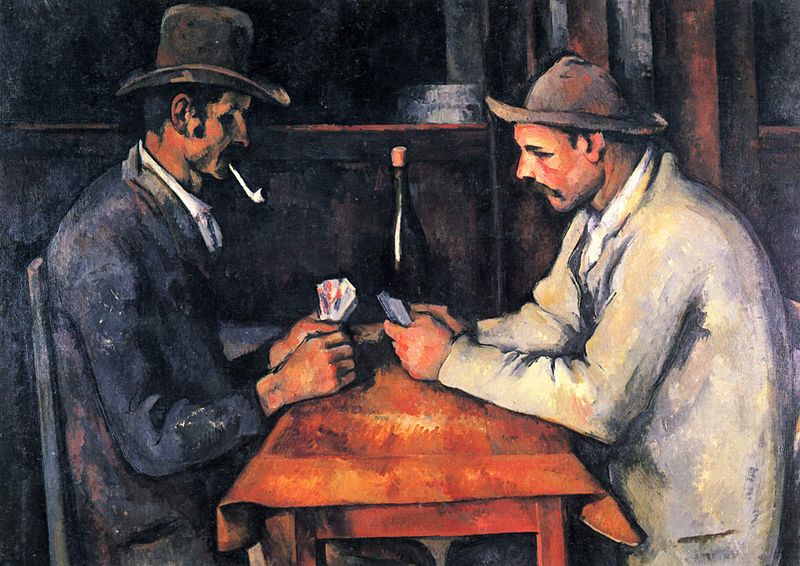
(Painting: The Card Players by Paul Cézanne, purchased for more than $250 million in 2011, making it the most expensive painting ever sold. A list here.)
 The Dish