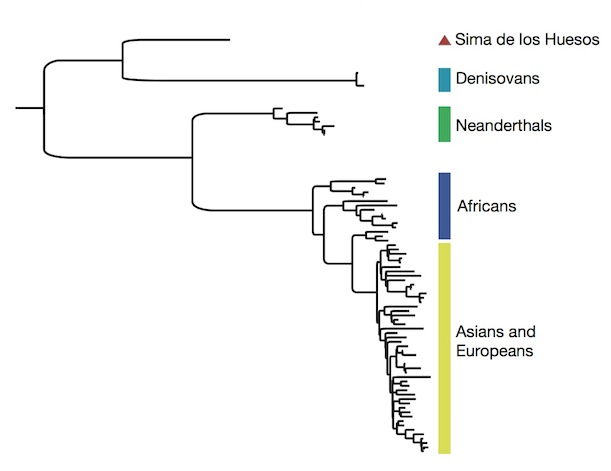
A DNA analysis of a 400,000-year-old femur from the Sima de los Huesos excavation site in northern Spain revealed an evolutionary surprise. Carl Zimmer explains (NYT) :
In a paper in the journal Nature, scientists reported Wednesday that they had retrieved ancient human DNA from a fossil dating back about 400,000 years, shattering the previous record of 100,000 years. The fossil, a thigh bone found in Spain, had previously seemed to many experts to belong to a forerunner of Neanderthals. But its DNA tells a very different story. It most closely resembles DNA from an enigmatic lineage of humans known as Denisovans. Until now, Denisovans were known only from DNA retrieved from 80,000-year-old remains in Siberia, 4,000 miles east of where the new DNA was found. The mismatch between the anatomical and genetic evidence surprised the scientists, who are now rethinking human evolution over the past few hundred thousand years.
Joseph Stromberg runs through various theories:
To explain how a Neanderthal-looking individual could come to have Denisovan mtDNA during this time period, the scientists present several different hypothetical scenarios. It’s possible, for instance, that the fossil in question belongs to a lineage that served as ancestors of both Neanderthals and Denisovans, or more likely, one that came after the split between the two groups (estimated to be around 1 million years ago) and was closely related to the latter but not the former. It’s also a possibility that the femur belongs to a third, different group, and that its similarities to Denisovan mtDNA are explained by either interbreeding with the Denisovans or the existence of yet another hominin lineage that bred with both Denisovans and the La Sima de los Huesos population and introduced the same mtDNA to both groups. …
For now, the researchers believe the most plausible scenario (illustrated [above]) is the femur belongs to a lineage that split off from Denisovans sometime after they diverged from the common ancestor of both Neanderthals and modern humans.
In a follow-up post, Zimmer unpacks that finding:
The combined evidence from fossils and DNA suggests that Neanderthals, Denisovans, and Homo sapiens share an ancestor that lived in Africa about 500,000 years ago. Our ancestors stayed in Africa while the ancestors of Denisovans and Neanderthals moved out to Europe and Asia. Homo sapiens evolved in Africa about 200,000 years ago, and then humans expanded out of Africa 60,000 years ago, after which they interbred with Neanderthals and Denisovans. So, yes, many people on Earth today are have direct ancestors that were Neanderthals. Some have direct ancestors that were Denisovans. But in both cases, most of these people’s ancestors were Homo sapiens.
Ewen Callaway passes along other speculation:
“I’ve got my own twist on it,” says [Chris Stringer, a palaeoanthropologist at London’s Natural History Museum], who has previously argued that the Sima de los Huesos hominins are indeed early Neanderthals (C. Stringer Evol. Anthropol. 21, 101–107; 2012). He thinks that the newly decoded mitochondrial genome may have come from another distinct group of hominins. Not far from the caves, researchers have discovered hominin bones from about 800,000 years ago that have been attributed to an archaic hominin called Homo antecessor, thought to be a European descendant of Homo erectus. Stringer proposes that this species interbred with a population that was ancestral to both Denisovans and Sima de los Huesos hominins, introducing the newly decoded mitochondrial lineage to both populations (see ‘Family mystery’).
This scenario, Stringer says, explains another oddity thrown up by the sequencing of ancient hominin DNA. As part of a widely discussed and soon-to-be-released analysis of high-quality Denisovan and Neanderthal nuclear genomes, Pääbo’s team suggests that Denisovans seem to have interbred with a mysterious hominin group (see Nature http://doi.org/p9t; 2013).
The situation will become clearer if Pääbo’s team can eke nuclear DNA out of the bones from the Sima de los Huesos hominins, which his team hopes to achieve within a year or so.
 The Dish