Eve Fairbanks sizes up Mandela’s successors:
People are deeply, deeply disillusioned with the leaders who’ve followed Mandela, both official African National Congress politicians and emotional leaders like Mandela’s offspring. Mandela’s relatives seem to have bucked his example entirely; some have banked millions in mining, an industry against which the apartheid-era ANC railed against as the heart of South Africa’s satanic injustice, while others have cashed in with a reality TV show.
The allegations against the politicians in actual office are more troubling. The country’s second democratically-elected president, Thabo Mbeki, was bitterly criticized for denying South Africa’s AIDS epidemic. Mbeki’s successor, President Jacob Zuma, was prosecuted for both rape and racketeering; he was acquitted of the former, and the latter charges were dropped on technicalities, but recently a huge scandal around taxpayer-funded upgrades to his massive home dominated the papers until Mandela’s—for Zuma, very propitiously timed—death. Daily, the whole black political class is accused in the media of corruption in the awarding of government contracts and greed in treating itself to swanky vacations and flashy vehicles.
“They were heroes,” one of the students standing beside me on the police line mused grimly, “but then they started buying cars.” As they buy cars, economic growth has slowed, basic education has fallen into disrepair, and inequality has deepened. This fall, The Economist concluded in a cover package pessimistically titled “Cry, the Beloved Country” that South Africa “is on the slide both economically and politically” and that the ANC’s “incompetence and outright corruption are the main causes.”
Applebaum argues that Mandela’s death should “should cause South Africans to look critically at the state he helped create and, above all, at the ANC, the party he led”:
There are reasons why the ANC continues to win elections, legitimately, even while failing to deliver much in the way of economic growth to its supporters. So far, rival parties have failed to capture the national imagination, even if some have done well in some regions. So far, the ANC has persuaded black voters that they would be “outsiders,” even traitors, if they voted for others. But Mandela’s aura—the patina of history and glamour he lent to the party—were also part of the explanation. During its last elections, in 2009, one South African journalist wrote that it felt as though the ANC were still “overseen by a pantheon of deities, including Mandela.” …
If South Africans really want to honor Mandela’s memory, they should deepen South Africa’s democracy, and vote for somebody else.
Reihan examines South Africa’s economy:
One of the key reasons for South Africa’s weak performance is that while high-growth countries saw large numbers of workers shift from low-productivity sectors, like subsistence farming, into high-productivity sectors like export-oriented manufacturing, South Africa’s high-productivity sectors have seen little growth. There are many theories as to why this has been the case. Some will attribute this to the rigidity of South Africa’s formal labor market while others will attribute it to a failure on the part of South Africa’s government to pursue a more ambitious industrial policy. Regardless of the answer, what is striking is that despite South Africa’s economic woes, the same political party keeps winning election after election.
He follows up in a later post:
[T]he ANC has made expansive commitments to its poorest citizens, which have often been cast in terms of racial justice. South Africa’s weak economic performance has thus engendered a great deal of bitterness, and a political and social climate that has led large numbers of educated young South Africans of all ethnicities to emigrate. The tragedy is that the South African economy had many advantages relative to other countries in its economic weight class, including a relative large English-speaking minority well-suited to thriving in a knowledge-intensive economy and relatively good infrastructure. Despite the ANC’s economic policy failures, it has not faced a serious political challenge, at least not yet.
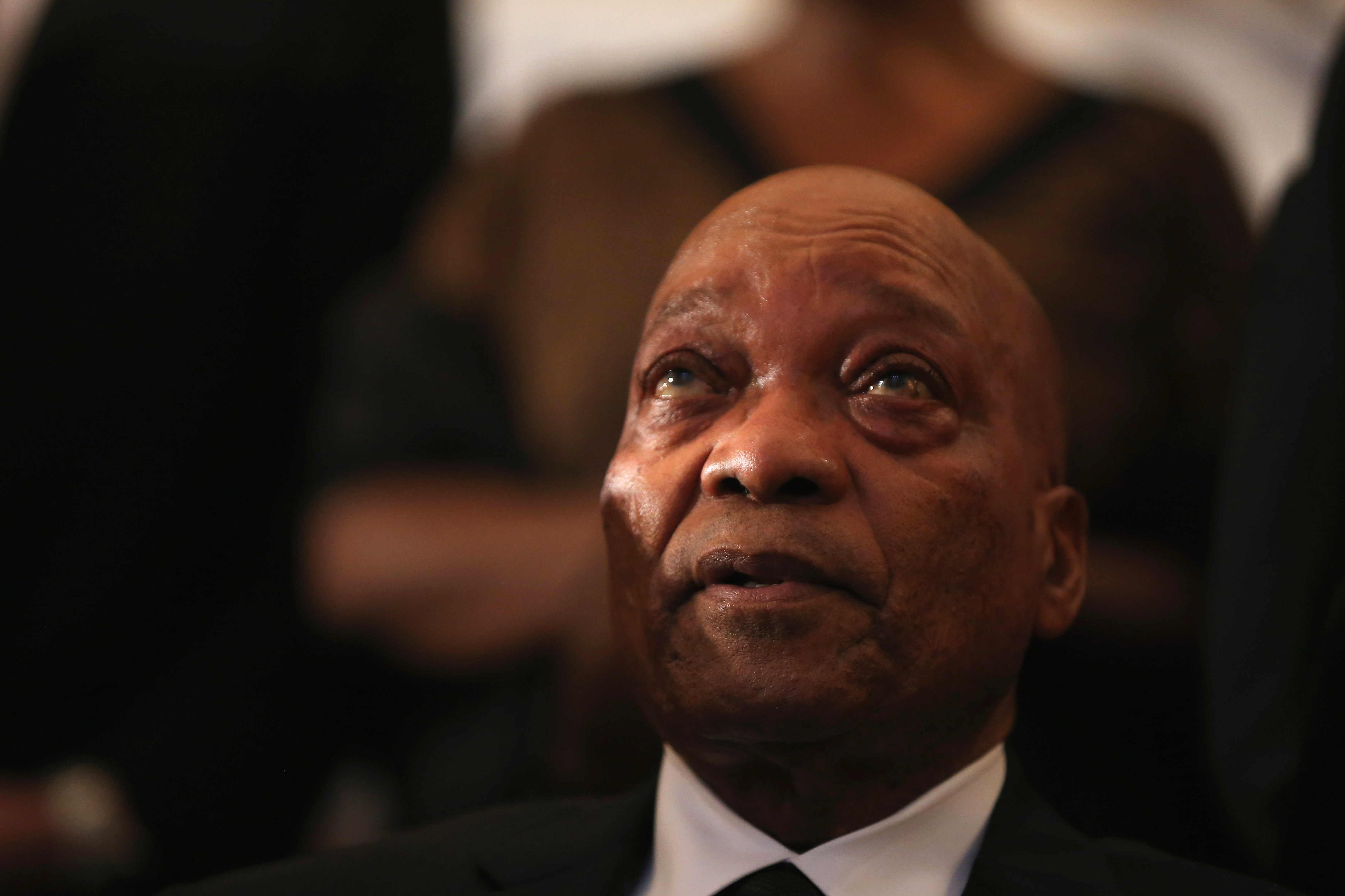
(Photo: South African President Jacob Zuma attends a service at Bryanston Methodist Church during a national day of prayer, on December 8, 2013 in Johannesburg, South Africa. Mandela passed away on the evening of December 5th, 2013 at his home in Houghton at the age of 95. By Christopher Furlong/Getty)
 The Dish