Morgan Meis turns his attention from Michelangelo’s David to his unfinished Slave sculptures, originally intended for the tomb of Pope Julius II:
Without knowledge of Michelangelo’s career, it would be impossible to know that David and The Slaves were created by the same man. The Slaves writhe and twist. It is often
said that The Slaves are trying to escape from the stone in which they are trapped. Partly this is true. Michelangelo never finished the work that would have freed them. But even in finished form they would squirm and struggle against their fetters. What are these fetters? Probably they are the fetters of matter itself. Or worse. They are trying to escape from what they are. They are trying to escape from what is inside. Or not even trying to escape. Just struggling. Locked in a struggle that cannot be won. It is simply endured.
The Slaves twist and torque. The bodies do not stand up, as David does. They turn over on themselves. David glared out at the world, defiant in his self-regard. The Slaves collapse under the strain of regarding the self. The Slaves do not meet anyone’s gaze. There is no need to do so. There is no one to look at. The enemies are not out there. The Slaves twist around on their own axes.
This is the beginning of the infamous figura serpentinata, the “snake pose” of later Mannerist art. Artists after Michelangelo will contort the body, in sculpture and painting, into all manner of grotesque poses. It became a fad of sorts, the figura serpentinata. Looking at Michelangelo’s Slaves, however, we can only assume that he achieved the serpentinata by honest means. That’s to say, Michelangelo had his own serpent, turning and twisting, collapsing within. Not a fad, but a genuine spiritual struggle, the results of which are left to us in stone.
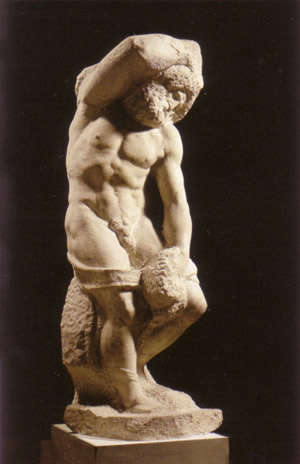
(Photo of The Bearded Slave by Michelangelo, 1525-1530, via Flickr user FLORENCEandTUSCANYtours)
 The Dish