Your LinkedIn password could be making the rounds in European galleries:
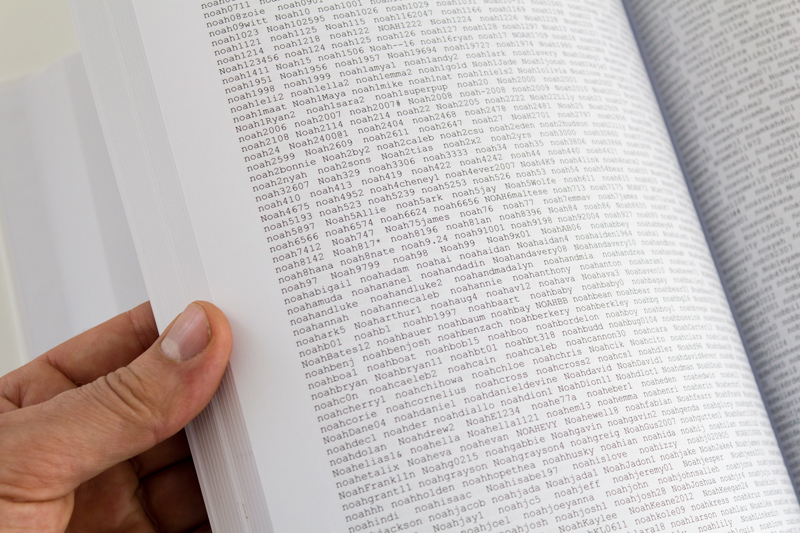
Forgot Your Password is a set of eight books containing some 4.7 million passwords that were leaked in June 2012. Visitors to the exhibit, which has toured Europe and is currently residing in [artist Aram] Bartholl’s native Germany, are invited to look through the volumes to see if their password is inside. Each password is arranged alphabetically and presented without its linked username(s).
Brian Merchant admits that his own password is probably on view:
I have an account on LinkedIn that I access a couple times a month to click the big yellow Accept button when prompted by all kinds of people I’ve never met nor will likely ever hear from again. If I lost my password, or got signed out somehow, it’d probably be months before I bothered to request a new one. As such, I certainly never changed my password in the wake of last year’s hacking event. This is kind of Bartholl’s point:
we maintain a half-ignorant, mostly cavalier attitude towards things like social media profile security – we just assume hackers and stolen passwords won’t effect us, and usually, they don’t. Your LinkedIn password is probably in this guy’s binder, after all, and nothing’s happened to you yet.
Or maybe it has. Two million more accounts were just hacked this week, and the media wants you to be sure yours wasn’t one of them. And that’s an interesting question reared here: what does it mean, exactly, that your personal information has been open to the public for over a year now? After all, we’re outraged that the NSA might have it stored somewhere too – we’re not wrong to be, either – but the dissonance between that anger and our lack of interest in where our passwords and data are at any given time is worth exploring.
(Photo by Aram Bartholl)
 The Dish