Artists don’t always see eye-to-eye with their patrons, but when the patron is NASA and the artwork is the first sculpture on the moon, things get especially tricky:
At 12:18 a.m. Greenwich Mean Time on Aug. 2, 1971, Commander David Scott of Apollo 15 placed a 3 1/2-inch-tall aluminum sculpture [by artist Paul Van Hoeydonck] onto the dusty surface of a small crater near his parked lunar rover. At that moment the moon transformed from an airless ball of rock into the largest exhibition
space in the known universe. Scott regarded the moment as tribute to the heroic astronauts and cosmonauts who had given their lives in the space race. Van Hoeydonck was thrilled that his art was pointing the way to a human destiny beyond Earth and expected that he would soon be “bigger than Picasso.”
In reality, van Hoeydonck’s lunar sculpture, called Fallen Astronaut, inspired not celebration but scandal. Within three years, Waddell’s gallery had gone bankrupt. Scott was hounded by a congressional investigation and left NASA on shaky terms. Van Hoeydonck, accused of profiteering from the public space program, retreated to a modest career in his native Belgium. Now both in their 80s, Scott and van Hoeydonck still see themselves unfairly maligned in blogs and Wikipedia pages – to the extent that Fallen Astronaut is remembered at all.
And yet, the spirit of Fallen Astronaut is more relevant today than ever. Google is promoting a $30 million prize for private adventurers to send robots to the moon in the next few years; companies such as SpaceX and Virgin Galactic are creating a new for-profit infrastructure of human spaceflight; and David Scott is grooming Brown University undergrads to become the next generation of cosmic adventurers. Governments come and go, public sentiment waxes and wanes, but the dream of reaching to the stars lives on. Fallen Astronaut does, too, hanging eternally 238,000 miles above our heads.
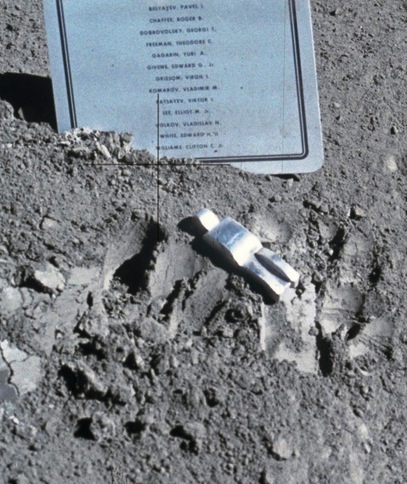
About that plaque next to the tiny sculpture:
On August 1, 1971, Fallen Astronaut was placed on the Moon by the crew of Apollo 15, along with a plaque bearing the names of eight American astronauts and six Soviet cosmonauts who had died:
- Theodore Freeman (October 31, 1964, aircraft accident)
- Charles Bassett (February 28, 1966, aircraft accident)
- Elliot See (February 28, 1966, aircraft accident)
- Gus Grissom (January 27, 1967, Apollo 1 fire)
- Roger B. Chaffee (January 27, 1967, Apollo 1 fire)
- Edward White (January 27, 1967, Apollo 1 fire)
- Vladimir Komarov (April 24, 1967, Soyuz 1 re-entry parachute failure)
- Edward Givens (June 6, 1967 automobile accident)
- Clifton Williams (October 5, 1967, aircraft accident)
- Yuri Gagarin (March 27, 1968, aircraft accident)
- Pavel Belyayev (January 10, 1970, disease)
- Georgy Dobrovolsky (June 30, 1971, Soyuz 11 re-entry pressurization failure)
- Viktor Patsayev (June 30, 1971, Soyuz 11 re-entry pressurization failure)
- Vladislav Volkov (June 30, 1971, Soyuz 11 re-entry pressurization failure)
Scott, Commander of the Apollo 15 mission, noted that “Sadly, two names are missing (from the plaque), those of Valentin Bondarenko and Grigori Nelyubov.” He explained that because of the secrecy surrounding the Soviet space program at the time, they were unaware of their deaths. Also not on the plaque are two US Air Force astronauts who died in 1967, Michael James Adams, in an X-15 accident and Robert Henry Lawrence, Jr., the first African American astronaut and part of the Manned Orbiting Laboratory Program, in a training accident. They are remembered on the Space Mirror Memorial.
 The Dish