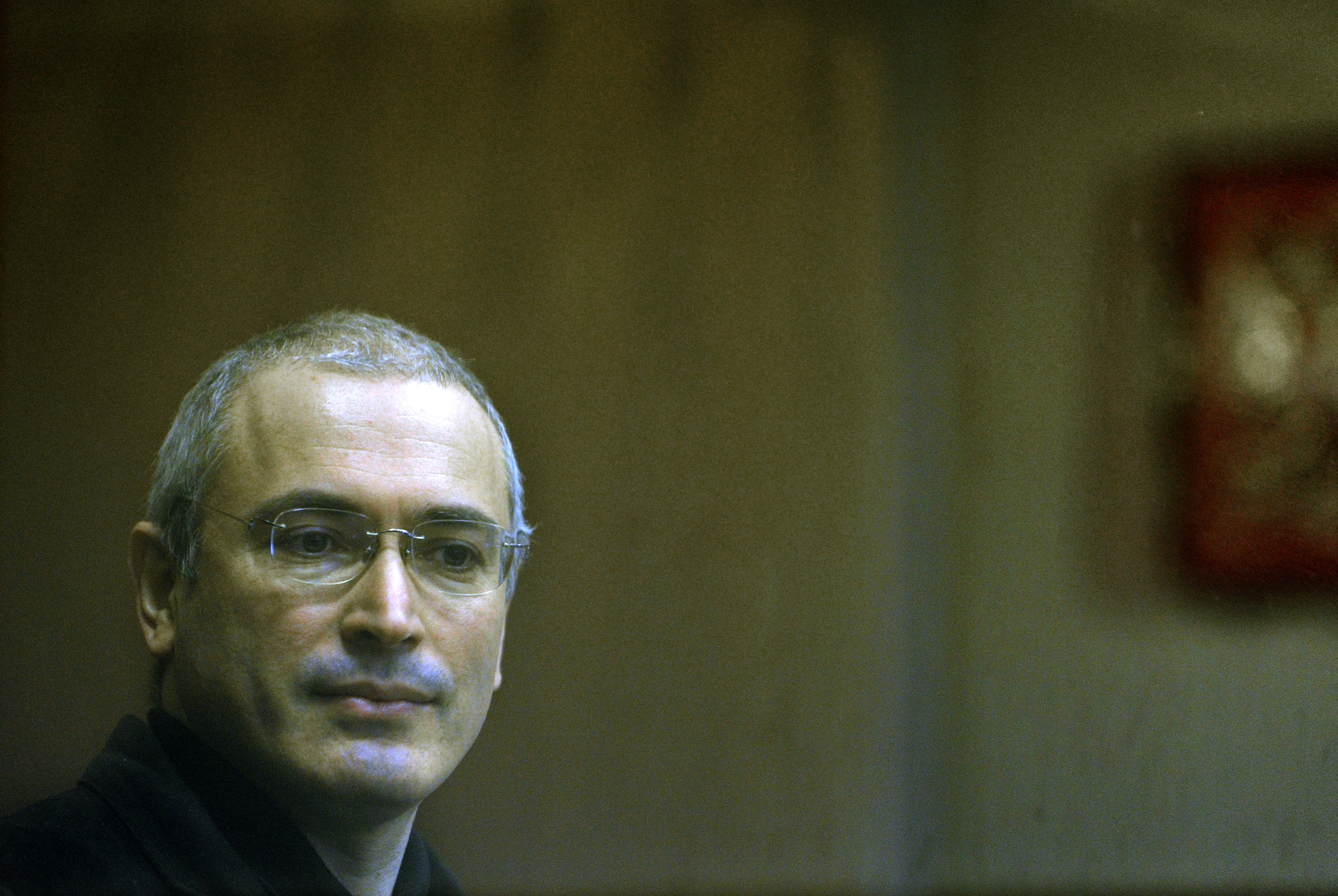
After granting amnesty to Pussy Riot and 30 jailed Greenpeace activists, Vladimir Putin ordered the release of former oligarch Mikhail Khodorkovsky, who has been imprisoned for a decade. Masha Gessen credits Obama’s decision to skip the Olympics and send a delegation of openly gay athletes:
The delegation he announced included no high-level politicians, something that has not happened in almost two decades. At the opening ceremony, the Americans will be led by University of California President Janet Napolitano, and at the closing, by Deputy Secretary of State William Burns. And in a clear reference to the Kremlin’s anti-gay campaign, Obama included openly gay athletes: Billie Jean King, Brian Boitano (who came out shortly after the delegation was annoucned), and Caitlin Cahow, an ice hockey Olympian. Obama issued no comments about his choice of delegates: When one snubs, one does not engage.
Putin panicked. On Wednesday he allowed his own version of an amnesty bill, which came before parliament that day, to be amended to cover the Greenpeace activists. The following day, he said he intended to pardon Khodorkovsky. There is every indication that this was unplanned. He made the annoucnement after the end of his annual press conference, during an informal chat with journalists. He made reference to a clemency request that Khodorkovsky had supposedly written but of which neither his family nor his lawyers were aware. Not even the clemency officials who would have processed such a request had ever heard of it.
She expects that “Putin’s ongoing crackdown on civil society will likely intensify significantly after the Olympic closing ceremony is over” but argues that “is no reason not to do the right thing, like refusing to stand next to a dictator as he puts on the show of his dreams.” Leonid Bershidsky comments:
The image Putin wants to project to the world is not that of a dictator who steals elections, stifles dissent and jails political opponents, but that of a mainstream conservative statesman who respects his country’s traditions and rules in the interest of the moral majority. That show may still get an audience of dignitaries in Sochi: There are still plenty of global leaders who have not pleaded schedule conflicts. The U.K. Prime Minister David Cameron, who famously rebuffed [Stephen] Fry by saying, “We could better challenge prejudice as we attend,” has not yet made his plans known. Neither has German Chancellor Angela Merkel.
Fisher mulls Putin’s political calculations:
So why is Putin doing it? Well, let’s look at what these pardoned prisoners have in common: they are all pretty famous and are well-known particularly in the West. This might sound obvious, but it’s worth noting that Putin may be pardoning Khodorkovsky et al. for the sake of appearances and not because he is actually interested in softening Russia’s treatment of political prisoners.
It’s not clear that Putin actually stands to lose very much with these pardons. After all, if the primary purpose of political arrests is to shape Russian politics, then the imprisonments of Khodorkovsky and the Pussy Riot members have likely served their purpose. Russia’s oligarchs got the warning loud and clear: don’t cross Putin, don’t go into politics. Russian civil society has a sense, from the Pussy Riot arrests, where the red lines lie. The political purpose of the Greenpeace arrests was never as obvious to me – a warning to foreign NGOs, perhaps – but it’s hard to imagine that the message was lost on its intended targets, if there were any.
The upside for Putin here is considerably clearer.
Eleanor Margolis applauds Obama’s Olympic snub:
In making one of the world’s most famous lesbians a US representative in legally homophobic country, Obama is breaking the relative silence of world leaders when it comes to condemning Russia’s new legislation. The “we’re here, we’re queer”-ness of the US Olympic delegation may not be groundbreaking, but it certainly draws attention to where it’s needed. Post-Cold War, some of America’s intercontinental ballistic missiles are lesbian-shaped.
Keating thinks releasing Khodorkovsky is a risk:
To put it bluntly, while the international community has been pushing for Khodorkovsky’s release for a long time, this looks a lot more like a czarist decree than anything resembling the rule of law. It seems like a high-stakes gamble for the Kremlin, however. His years in prison have transformed Khodorkovsky’s image from just another post-Soviet robber baron living off the ill-gotten gains of the 1990s into a prisoner of conscience and eloquent regime critic. He’s Russia’s best-known political prisoner by a long shot, only 13 percent of Russians believe the charges against him are real, and in the capital at least, the majority of people favor his release.
Putin has managed to consistently outfox and divide his opponents in the past, but this releases raises the stakes significantly. It seems like a risky move for some good pre-Olympic PR.
Simon Shuster, however, sees the move as a sign of strength:
Putin’s latest victories seem to have strengthened his stomach for risk. In the course of this year, he has beat out the West in a diplomatic duel over Syria, whose regime he has successfully defended against a U.S.-led military intervention. Just this week, he pulled Ukraine away from its integration deal with the E.U. and purchased the loyalty of Ukraine’s leadership with an economic bailout. His vision of rivaling the West with a new “Eurasian Union” of former Soviet states has turned from a political pipe dream into a reality, as Armenia, Kyrgyzstan and Ukraine drew closer this year to joining Russia’s budding trade bloc with Belarus and Kazakhstan. In February, Putin will see the greatest validation of his rule – the Winter Olympics in his beloved resort town of Sochi – and he has been getting prepared with a bit of political house cleaning. His aim was to avoid any Western boycott from soiling the mood of the Games, a risk that began to seem very real as U.S. President Barack Obama and several European statesmen announced this month that they would not be going to Sochi. So Russia has moved to preempt their criticism by cleansing its record on human rights.
The Guardian’s editors see through the publicity stunt:
The Russian government’s readiness to throw people into prison when they get in its way, bending the legal system to do so, has a long history, but has been a particular characteristic of Mr Putin’s rule since the detention of Mikhail Khodorkovsky and the confiscation of his Yukos empire in 2003 – the foundation act of the Putin era. The beauty of this strategy is that you are able to dispose of opponents and critics under cover of the law, but you can then get credit later for a measured clemency, as with Mr Putin’s indication yesterday that a pardon for Mr Khodorkovsky is on the way. Murmuring that Mr Khodorkovsky has served 10 years and that his mother is ill, makes Putin seem humane.But it was not humane to put him there in the first place. In lesser key, Mr Putin sought praise for the release of the Greenpeace and Pussy Riot detainees, but not without a final swipe at Greenpeace as an agent of foreign powers and at Pussy Riot as desecrators of Russian womanhood.
Christian Neef and Matthias Schepp link Khodorkovsky’s clemency to Russia’s other international image problem:
The timing of Putin’s announcement of the Khodorkovsky pardon is clever. For weeks now, he has been criticized for his handling of the situation with Ukraine. The United States and the European Union allege that the Russian leader exerted massive pressure on Kiev to reject an association agreement with the EU — all in a bid to pull the neighboring country back into Russia’s sphere of power. Critics say Putin’s actions disregard the nearly 50 percent of Ukrainians who favor closer relations with Europe. With his decision to release Khodorkovsky, Putin intends to show that he knows how to use not only the stick, but also the carrot — and that the West’s allegations that Russia is a profoundly undemocratic country do not line up with reality. Given this situation, it’s not surprising that Putin has explicitly pointed out that he was moved to issue the pardon by humanitarian concerns: In his speech, he cited the critical condition of Khodorkovsky’s 78-year-old mother.
Fred Weir stresses that Khodorkovsky requested and was granted clemency, not a pardon.
Mr. Putin told a scrum of reporters outside that Khodorkovsky had written an appeal for clemency – though not a request for pardon – and that the necessary arrangements for his release will soon be made. “In line with the law, Mikhail Borisovich [Khodorkovsky] should have written [a pardon request], which he didn’t do, but just recently he wrote this document and addressed me with an appeal for clemency,” Putin said. Khodorkovsky “has already spent more than 10 years in prison. That is a serious punishment. In his letter he makes reference to humanitarian circumstances. He has a sick mother. I believe that we can soon make the decision and sign a decree granting him amnesty,” he said. The difference between “pardon” and “clemency” is a crucial distinction for Khodorkovksky, since in legal terms the first would be tantamount to an admission of guilt, while the second is merely a plea for mercy.
Anna Kordunsky says the oligarch turned freedom fighter is still politically relevant:
How much does Khodorkovsky still matter? Short answer: a lot. Otherwise, the announcement of his release would not have happened so close to the Olympics, when Russia finds itself more battered in international opinion polls than it had hoped to be so close to the Games. The longer answer is more complex, depending in large part on what exactly Khodorkovsky told Putin in his appeal letter, and whether he submitted one at all. A straightforward request for pardon – as opposed to a more nuanced plea for clemency – would be tantamount to an admission of guilt, harming his credibility once he’s free.
That’s the outcome the Kremlin wants. “The fact that he [Khodorkovsky] is appealing for clemency means that he’s admitting his guilt,” spokesman Dmitry Peskov told Interfax earlier today. Yet the sheer force of Khodorkovsky’s story – of standing up to the Kremlin at such dire personal cost – could lend him a unifying power over Russia’s beleaguered and fractured opposition. And that’s the outcome the Kremlin will seek to avoid at all costs.
(Photo: Former Yukos oil company chief executive officer Mikhail Khodorkovsky, once Russia’s richest man, stands in the defendant’s glass cage in a Moscow courtroom on November 2, 2010. By Dmitry Kostyukov/AFP/Getty)
 The Dish