Kenan Malik breaks down what monotheists inherited from their Greek forebears:
In redrawing the line between humanity and God, monotheism both adopted and discarded major themes in Greek philosophy. Greek philosophers had recognized human
moral frailties, but had also believed that through reason and education some individuals at least could overcome the lure of the baser aspects of the soul. It was in the use of reason to accommodate life to the exigencies of fate that human dignity lay. At the same time, there was a strand within Greek philosophy that helped make more profound the distinction between Man and God. The distaste for the idea of capricious gods, and the desire for naturalistic explanations, evident from the Presocratics onwards, led some, like Democritus, to dismiss the very idea of gods and to insist on a purely materialist universe. Others redefined the nature of godliness. …
Xenophanes (c 570-476 BCE), one of the earliest of the Presocratics, savaged Homer and Hesiod for ‘attributing to the gods everything that men find shameful and reprehensible – stealing, adultery and deceiving one another.’
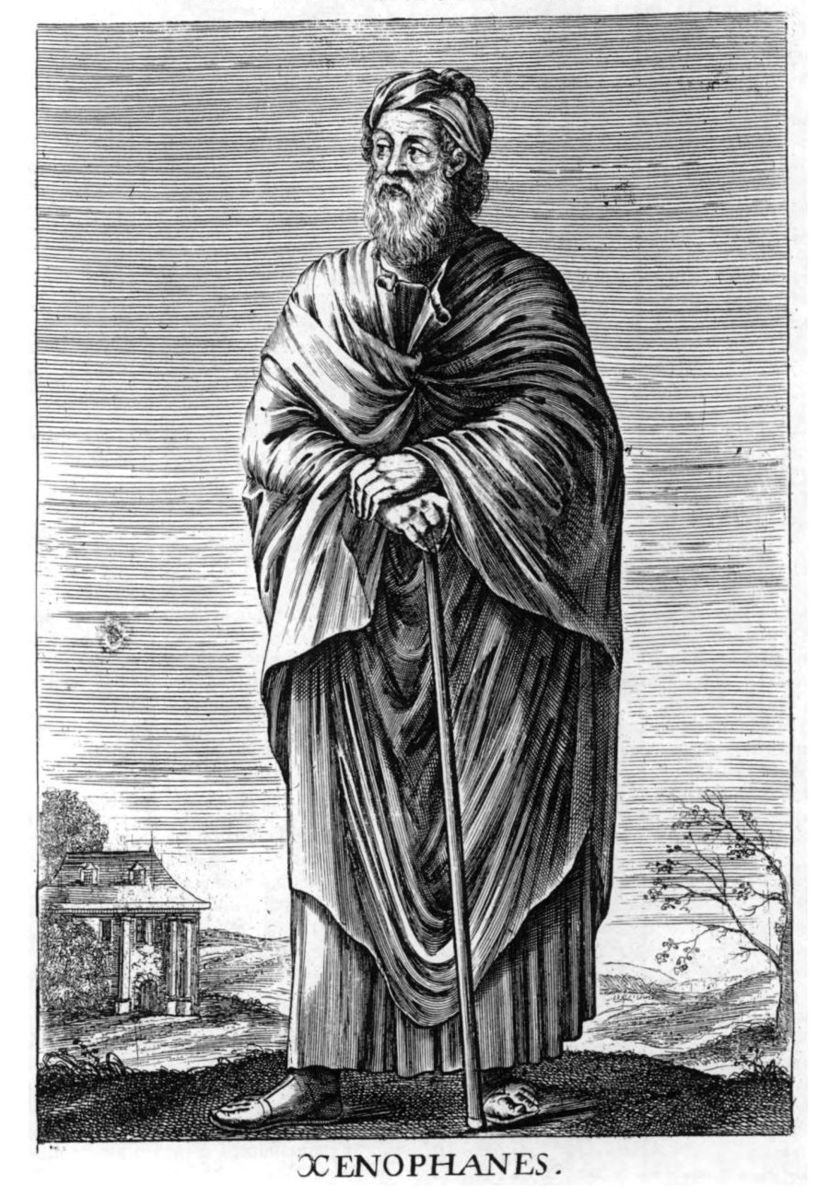
Humans possessed false ideas of gods because they fashioned them in their own image. So, ‘Ethiopians say their gods are flat-nosed and black, and Thracians that theirs have blue eyes and red hair.’ And if horses and cows possessed gods, they would undoubtedly be ‘horse-like gods, cow-like gods’.
There could only be one God, Xenophanes insisted, ‘since it is sacrilege for any of the gods to have a master’. This God could be ‘in no way similar to mortal men in body or in thought’. God must have always existed, for there is nothing superior that could have created Him, and He could not have been created by an inferior being. He is a living being but unlike like organic beings there are no parts in Him. He has no physical contact with anything in the world but ‘remains for ever in the same place, entirely motionless’ and ‘effortlessly, he shakes all things by thinking with his mind.’ This notion of a wholly simple God came to be important in both Islam and Christianity.
(Image of Xenophanes from Thomas Stanley’s The History of Philosophy, c. 1655, via Wikimedia Commons)
 The Dish
