“If you are struggling over whether or not to tell Santa’s story,” offers Laura Lewis Brown, “you may take comfort in the notion that it doesn’t really harm children to imagine”:
“Kids up to four, five, six, seven live in what we call fantasy life magic years,” says Dr. Benjamin Siegel, Professor of Pediatrics and Psychiatry at the Boston University School of Medicine. “They are influenced by what they see and hear around them. They get very excited about characters in their life that have special meaning for them.” Those characters include superheroes, monsters, animals and even Santa. …
Parents worry that they will have to break the news to their children and shatter their whole vision of Christmas. However, many children come to this realization on their own around age seven or eight, Siegel says. And when they do, they are basically unscathed. Siegel cites a study that revealed that children who learned the truth may have been upset, but not nearly as upset as the parents.
Alice Robb elaborates on that last point:
For a 1994 paper in the journal Child Psychiatry and Human Development, Carl Anderson and Norman Prentice, psychologists at the University of Texas at Austin, recruited 52 families with elementary school-aged children and interviewed both parents and kids about the family’s experience of Santa Claus. What they found was surprising:
“Children reported predominantly positive reactions on learning the truth. Parents, however, described themselves as predominantly sad in reaction to their child’s discovery … While children experience distressful reactions such as sadness, disappointment and anger, the degree of such reactions are generally minimal and short-lived.” In fact, they were so unperturbed that 58 percent said they pretended to believe in Santa after realizing the truth—so as not to disappoint their parents.
Sarah Sloat sums up:
Letting children use their imaginations to conjure this image is healthy, psychologists argue, saying that the practice is what will later help them dream up inventions and other big ideas. Similarly, fairy tales have been shown to be an effective and more meaningful way to teach children morals; the naughty-or-nice list becomes a guide to growing up to be a decent person. Even if your goodness is derived from a fear of not receiving a Furby.
Dish readers recently weighed in on whether it’s ever okay to lie to children, including about whether Santa is real.
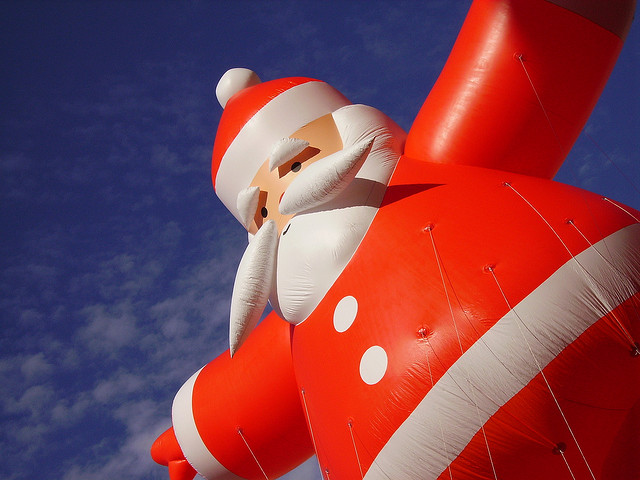
(Photo of a Santa float from a 2006 Christmas parade in Dallas, Texas by Bart Fields)
 The Dish