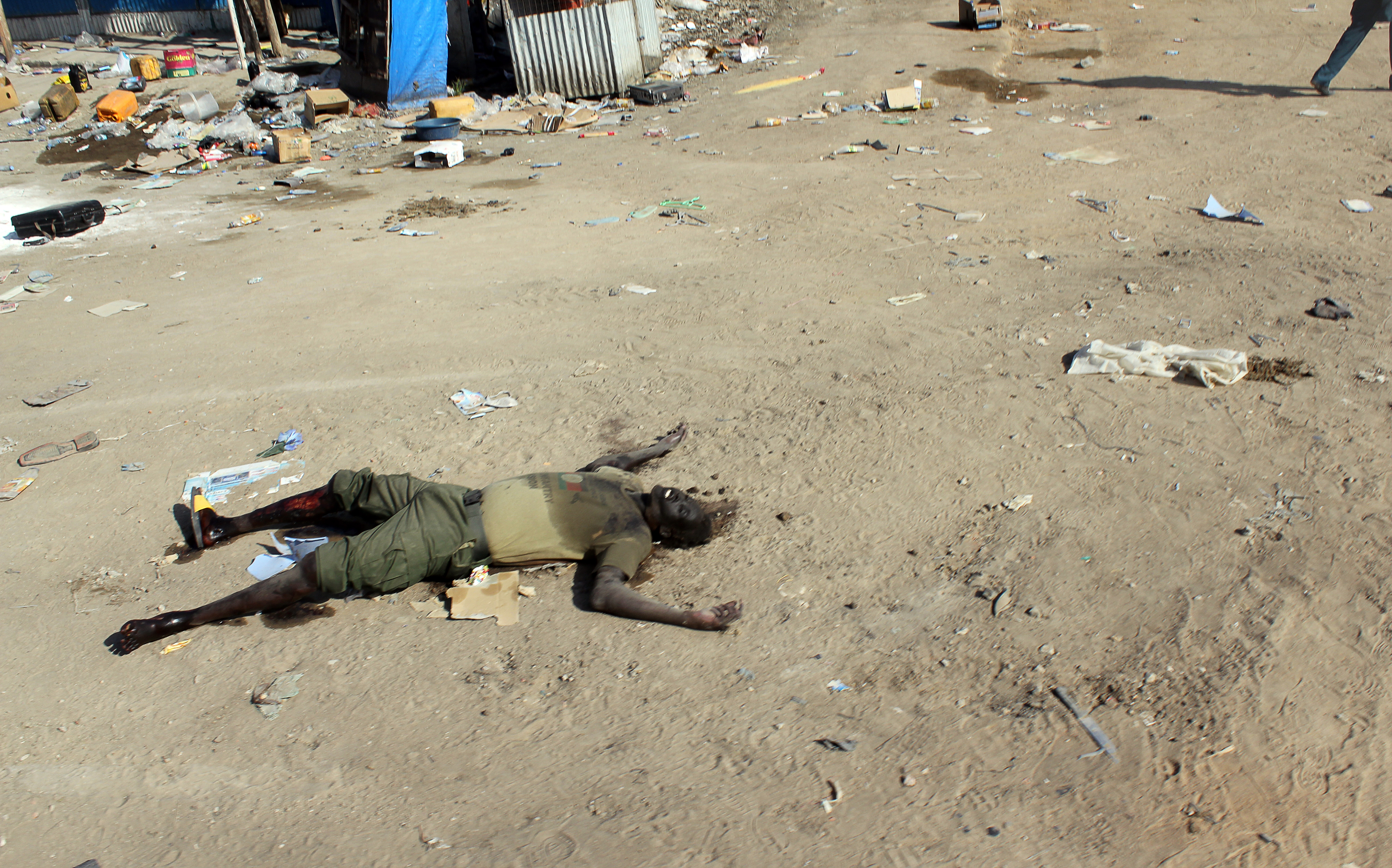
Over the past two weeks, South Sudan has come to the brink of civil war, with as many as 1,000 dead in fighting between forces loyal to President Salva Kiir and rebels led by former vice president Riek Machar. John Prendergast and Akshaya Kumar set the scene:
Tensions within the ruling Sudan People’s Liberation Movement have been simmering for years. That political power struggle among Juba’s elites has now shifted into open violence across the country. It is clear that there can be no purely military solution to this conflict. Neither forces aligned to sitting President Salva Kiir nor those aligned to former Vice President Riek Machar can seize control of the entire country. More importantly, continued violence undermines both men’s credibility. As a consequence, the initiation of an open and inclusive dialogue focused on negotiating a political settlement is essential. South Sudan’s President Kiir has already evidenced a willingness to talk by sitting down with leading critic Rebecca Nyandeng de Mabior. Unfortunately, Riek Machar has been much more elusive, indicating that nothing short of President Kiir’s dismissal was acceptable.
Max Fisher explains how South Sudan got to this point just two and a half years after its creation:
The country’s path to independence was also a path to internal conflict. The decades before South Sudan’s independence are complicated but, in the simplest terms, it was defined by a half-century of fighting between the politically dominant, ethnically Arab north and the politically weaker, ethnically sub-Saharan south. Rebel groups in the south wanted more autonomy from the north. They had to fight very hard to get it (although they owe a lot to the north, which behaved so terribly that it galvanized world opinion in favor of the south).
The thing, though, is that South Sudan is actually pretty ethnically diverse. South Sudan, like a number of other countries in sub-Saharan Africa and particularly this region of it, is articulated by borders that have very little to do with the actual people there. The earlier, unified version of Sudan had been carved out, in part, by European and especially British colonialism. The long-running conflict between the country’s north and its south was, like many wars in post-colonial Africa, partly a consequence of European cartographers having forced disparate groups into artificial borders. Splitting Sudan in two helped to ease the tension created by these borders but didn’t solve it. The southern ethnic groups had been united by a common enemy — the north — but that’s no longer bringing them together.
Colum Lynch looks at the role of the US:
The stakes are high for the United States, as fighting threatens to upend one of the most important foreign policy initiatives of the last two decades in sub-Saharan Africa — one that unified Republicans, Democrats, African Americans, human rights advocates, and Christians. On Saturday, four U.S. troops were wounded when their V-22 Osprey came under fire during an aborted operation to evacuate U.S. nationals from the town of Bor. An additional 150 Marines have been sent to the region to prep for possible future evacuations. It’s an extraordinary and painful development, given America’s major role in securing independence for South Sudan. But the toughest part for Americans to swallow may be that it’s the U.S.-backed leaders of South Sudan — the supposed good guys — that are responsible for plunging the country into chaos and threatening to wreck America’s signature achievement in the region.
Larison is not surprised:
The “supposed good guys” happened to be the people in charge of the armed insurgency that the U.S. chose to support. Like many other insurgent groups over the years, their “goodness” was defined by their opposition to the government they were rebelling against. Like other cases of separatism gone awry, the new state that the U.S. helped to bring into being was plagued by so many political ills that its turn to authoritarianism, corruption, and internal conflict was practically guaranteed from the start. Given our recent experiences with ill-advised foreign interventions and the constant pleas to support “good” rebels in one conflict after another, Americans will have no trouble believing that the people that Washington anointed as “good guys” proved to be much less than that. They may begin wondering why our government thinks that it knows what it’s doing when it supports the creation of new states that always seemed almost doomed to fail.
Philip Roessler calls this an example of the “coup-civil war trap,” a common cause of state failure in post-colonial Africa:
The coup-civil war trap arises when political institutions are weak and ethnic groups are strong. Violence is dispersed among powerful Big Men who are embedded in and supported by different ethnic groups. And economic benefits are primarily derived from controlling the central government. Under such conditions, peace is often contingent upon power-sharing, in which the ruler strikes alliances with rival Big Men. These alliances allow the ruler to mobilize support and collect information from outside his own ethnic group, which in turn helps to secure peace and prevent civil war. But the potential danger is that in sharing real power with ethnic rivals, the ruler leaves himself vulnerable to a coup d’état. And there’s the rub: the policy solution to civil war in these weak states increases a rival group’s capabilities to win power in a coup. In more technical terms, ethnic power-sharing in the shadow of the coup d’état gives rise to a commitment problem, in which the ruler fears that rivals are supporting him only to better position themselves to take power in the future.
This commitment problem is a key source of bargaining failure and conflict in weak states because it prevents rulers from fully committing to peaceful power-sharing. Reluctant to strengthen their rivals, rulers don’t share enough power. Fundamentally mistrustful, they pursue defensive safeguards, such as stacking the military and security organs with members of their ethnic group and other loyalists, in a bid to neutralize their rivals’ coup-making capabilities. But this only undermines confidence in the ruler. Regime partners question the ruler’s commitment to power-sharing and, even worse, fear that, having used his comrades to get to power, he is ready to dispose of them by purge or execution.
(Photo: The body of a man claimed to be a rebel lies on the ground in the market in the centre of Bor, on December 25, 2013. By Waakhe Simon Wudu/AFP/Getty Images.)
 The Dish