Our Thirsty Species

WaterStressbyCountry

Brian Merchant introduces a study finding that the number of people facing “absolute water scarcity” may double within the next few decades:

In other words, when global temperatures rise another 2˚C—they’re well on track to do so—there could be anywhere between 40 percent and 100 percent more people living in places—places like Yemen, Pakistan, India, Australia, the American Midwest—subjected to extreme water scarcity. Climatologists believe we may hit 2 ˚C rise—or more—by midcentury. As in, less than 40 years from now. The EPA, meanwhile projects at least a 4˚C rise by 2100. Which will really bring the thirst. …

The UN fears that conflicts over water-rich territory and transportation infrastructure could deepen or break out as the resource grows even scarcer. Analysts like Lester R. Brown has said that “it is now commonly said that future wars in the Middle East are more likely to be fought over water than over oil.”

Matt Ferner looks at another study mapping water insecurity around the world:

Researchers with the Aqueduct project looked at water risks in 100 river basins and 181 nations around the globe — the first such country-level water assessment of its kind. By taking a close look at regional baseline water stress, flood and drought occurrence over several years time, inter-annual variability and seasonal variability as well as the amount of water available to a particular region every year from rivers, streams and shallow aquifers, WRI was able to give each country a score 0 to 5, with a 5 being the greatest level of water risk.

Walter Russell Mead says we have nothing to worry about now that scientists have found an abundance of freshwater underneath the ocean floor:

Some of these reserves will be fresh enough that they won’t need to go through the energy-intensive desalinization process, while some of them will be only slightly brackish, and will be easier and, importantly, cheaper to desalinate. In fact, this kind of offshore drilling for water is already happening; NPR notes that there are already operations in places like Cape May, NJ to drill for and eventually desalinate low-salinity water.

Water scarcity has been a favorite topic for the Chicken Littles of the world. Just 18 years ago the vice president of the World Bank was ominously warning that “the wars of the next century will be fought over water.” It’s easy to drum up fears of “water wars” some undetermined time in the future, but studies like this one, and discoveries of new water sources like this one in Kenya, or this one under the Sahara, suggest that these fears that have gripped Malthusians—and that Malthusians have in turn used to push through otherwise unworkable policy recommendations—are a lot less serious.

Scientists, however, are not yet ready to declare drilling for freshwater a feasible solution:

[T]here are two ways to get to the water: “Build a platform out at sea and drill into the seabed, or drill from the mainland or islands close to the aquifers.” That’s not likely to come cheap. While places such as Cape May, N.J., are already drilling and desalinating freshwater underground for use, getting to freshwater reserves under the oceans will probably be more expensive, says Kenneth Miller, professor of earth and planetary sciences at Rutgers University.

Miller’s research has involved drilling into freshwater reserves offshore, and he says drilling three holes about 2,500 feet down cost around $13 million. And some reserves will be saltier – and need more processing — than others, depending on what kinds of sediment surrounds them. Finer grains seal in fresher water while coarser grains hold saltier water, Miller says. “[Tapping the freshwater reserves] represents a potential alternative that may be economic,” says [Mark] Person, the study co-author. He notes, however, that the scientists have not yet tapped into one of these reserves and that this is a non-renewable resource.

Keeping An Eye On India, Ctd

A reader responds to a recent post:

As someone who has spent a long time living in, watching, and studying China and it’s rise, I certainly see Oliver Turner’s point on China. But I think he is perhaps overstating the case a bit. The reason that the US is more concerned with China’s rise than India’s – and I would argue that it is actually most concerned with the rise of all military competition in Asia (or at least it should be) – is that the US has major security guarantees with many of China’s neighbors: South Korea, Japan, Taiwan. Any conflict started between China and any of those countries would necessarily be met with some kind of US response. If India were to become entangled with any of it’s neighbors (another conflict with Pakistan for example), it would certainly be a cause for concern, but the US would not be immediately required to join the conflict.

From a reader born in India:

Oliver Turner has really no idea what he is talking about.  He is comparing India and China based on percentage of GDP spent on military expenditures.  He must be wetting his bed worrying about South Sudan which spends over 10% (the highest, according to the source he quotes). In absolute numbers there is no comparison:

India $43 billion USD vs China $164.5 USD!  And if you closely follow Indian military matters, you know that about 25% of their allocated capital budget is returned to the treasury every year due chronic procurement delays. (2012 GDP: $1,825 billion USD, 2.4% of that is $43 billion USD) vs China (2012 GDP: $8,227 billion USD, 2% of that is $164.5 billion USD.  My source for the 2012 GDP figures is here.)

This sort of the deliberate hocus-pocus by an apparently smart person like Turner leads me to believe that he wants to make a point that is not supported by the numbers.  So he massages it till it looks like something else. But the crux of the reason that China’s spending is scary and India’s is not, is alluded to in Turner piece.  China throws it money and military capability around, and it makes its neighbors nervous.  And its military has a very prominent role in its government, economy and policy affairs.  None of which are true for India’s military where the democratic government keeps a very tight control over it.

Are Storms Gaining Speed?

dish_hurricane

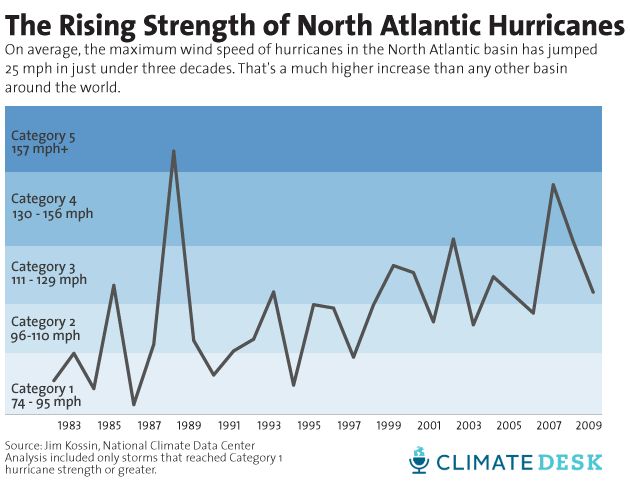
Chris Mooney flags a new report from hurricane expert Jim Kossin of the National Climatic Data Center:

Kossin and his colleagues at NCDC created a 28-year record of storm images across the world’s seven hurricane basins, from 1982 to 2009. Then they used a computer algorithm to compute each storm’s maximum strength, removing human error and unpredictability from the equation. The result? The scientists found that globally, hurricane wind speeds are increasing at a rate of a little more than two miles per hour per decade, or just faster than six miles per hour over the entire period.

There are some key caveats, though, the biggest being that the trend they found was not statistically significant at usually accepted levels. (For nerds: the p value was 0.1). But there were strong and significant trends in some hurricane basins of the world, especially the North Atlantic (the region encompassing the Caribbean, Gulf of Mexico, and open Atlantic north of the equator), where storms have been strengthening at the rate of nearly nine miles per hour per decade (see chart above). But other basins offset that, including the western North Pacific, which showed a negative trend.

The punch line, then, could hardly be called overwhelming. But as Kossin explains, that may be precisely what you expect to see once you’re finally analyzing the troublesome hurricane data reliably. These results, after all, are quite consistent with the idea that the signal of hurricane intensification might be just now emerging from the “noise” of natural climate variability. “What we’re observing could very easily fit into an assumption of this greenhouse gas forced trend in the tropics and the effect that it has on tropical cyclone intensity,” says Kossin.

Tension in Tibet

Anastasia Corell checks in on the capital city of Lhasa, where Chinese authorities are keeping a worried eye on separatist sentiment:

The conventional Chinese belief toward Tibet is that the Communist Party liberated Tibetan people from an oppressive, feudal government under the Lamas and, through development, have improved their material welfare and provided them with opportunities in the modern world. Beijing’s investments in the territory are substantial: In 2011, China announced a five-year plan that includes $21.4 billion in infrastructure projects such as road, rail, and hydropower. Tibetans argue that these improvements have come at a great cost to their culture and way of life, and that the migration of Han Chinese settlers—lured by government incentives—is turning once-traditional Lhasa into an ordinary Chinese city.

Tibet’s strategic importance to China is great. The territory is the source of Asia’s most important waterways, including the Yangtze, Yellow, and Mekong Rivers, which irrigate China’s fertile central plain and most of Southeast Asia. It also serves as a buffer between the country and an emerging rival, India. Beijing feels that any compromise with Tibetans would encourage separatist movements elsewhere, particularly among the Uighur population in China’s far-west Xinjiang region. It is essential to China’s domestic security that Tibetans come, eventually, to regard themselves as Chinese.

Meanwhile, the Tibetans have grown increasingly desperate.

Over the last two years, tensions have led to a spike in self-immolations, resulting in over 120 deaths, and the possibility that people may set themselves on fire explains Lhasa’s tense police presence. In Jokhang Square, the physical center of ancient Lhasa and a holy Buddhist pilgrimage site, soldiers carry fire extinguishers instead of guns. At gas stations, everyone must register and report exactly how much gasoline they take, and to which destinations. The government monitors siphoning—after all, it may be a possible prelude to self-immolation.

Fisher says Tibet is now less accessible to foreign journalists than North Korea:

[Tibet scholar Carole] McGranahan discusses one of the major challenges facing an anthropologist like herself who wants to study Tibet: simply getting information. She can’t go herself unless she sneaks in, which is risky; she can’t “call up friends in Tibet” without “putting them at risk,” she says; Tibetans living in exile face the same problem. And she can’t read journalistic reports because, with the exception of the “very brave” Chinese-Tibetan journalist Woeser, they are almost never allowed to go.

The comparison to North Korea is not an invalid one. The Chinese government, by and large, has not been anywhere near as severe or restrictive as North Korea’s since leader Mao Zedong died in 1977. The two countries are just on very different paths, and being a journalist in most of China is much freer than being a journalist in North Korea. But within Tibet, some of China’s old, totalitarian-tinged habits can still come through. The irony is that, in recent years, North Korea has been opening itself up to foreign journalists – albeit under extremely tight restrictions – as China has closed them off from Tibet.

The Associated Press even has a tiny bureau in Pyongyang; a deal with the devil, some critics charge, but if nothing else it produces an awful lot of very good photos of life in North Korea. There is nothing close to an analogous foreign media presence in Tibet. Sometimes the best we can do is satellite images, taken from thousands of miles away in space.

The Best Of The Dish Today

The Israel Lobby showed its hand today with a new sanctions bill against Iran clearly designed to ensure that no detente is ever reached with that country. AIPAC’s bill – shepherded by Chuck Schumer and Mark Kirk, two of Israel’s most devoted supporters in Congress – would rule out any final deal that allows Iran to enrich any uranium at all. That means, as Schumer knows full well, no deal at all. Then the bill goes even further. It includes

a non-binding provision that states that if Israel takes ‘military action in legitimate self-defense against Iran’s nuclear weapons program,’  the U.S. ‘should stand with Israel and provide, in accordance with the law of the United States and the constitutional responsibility of Congress to authorize the use of military force, diplomatic, military, and economic support to the Government of Israel in its defense of its territory, people, and existence.’

As usual, English is the first casualty in propaganda. Any act of “self-defense” against a mere “program” is not an act of legitimate self-defense. In international law, you are allowed to defend yourself if attacked; you do not have a right to attack another country just because you don’t like one of their military programs (which the Iranian regime has, in any case, sworn it would never use). That would be a license to shred international law and any concept of just warfare. For the US Senate to proactively bless future aggressive military action by a foreign government when it is not justified by self-defense is an appalling new low in the Israeli government’s grip on the US Congress.

But to proactively commit the United States as well to whatever the Netanyahu government might want to do in a war of choice against Iran is more staggering. Yes, this is non-binding language. But it’s basically endorsing the principle of handing over American foreign policy on a matter as grave as war and peace to a foreign government, acting against international law, thousands of miles away. George Washington would be turning at a rather high velocity in his grave.

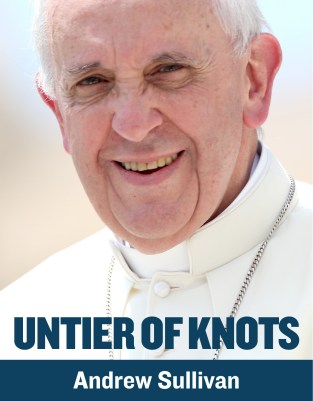
Today, we launched the second issue of Deep Dish, with a podcast with my old friend, Dan Savage, and a long essay on the meaning of Pope Francis, “Untier Of Knots.” We took a moment to note the bursting of the law school bubble – an ominous sign in increasingly unequal societies; I parsed the premises of a formulaic Beltway piece; I noted how tweeting is the next frontier of new media to become indistinguishable from advertizing; and applauded a Vatican re-shuffle.

The most popular item of the day was the essay, Untier of Knots, followed by Fournier Digs In.

See you in the morning.

(Video: from a new Netflix documentary on the campaign of Mitt Romney in 2012)

Deep Dish #2: Why Francis Matters

[Re-posted from earlier today]

Subscribers are already digging into the latest Deep Dish offering, Untier Of Knots, my essay on Pope Francis released last night:

Thank you. Sublime. Beautiful. A gobsmacking refutation of fundamentalism and affirmation of what remains the best of Christianity.

Another:

This is a very fine essay on Pope Francis, I believe. Raised as a pastor’s son and steeped in the Protestant tradition, I am fairly ignorant of Catholic tradition, but I learned an awful lot here. I’m not one to kiss ass, and I’m an obsessively critical nit-picker, but this essay was profound and Untier-Of-Knots-Cover-Imagearticulate and intellectual without being elitist. This is a hard thing to craft. I appreciate your context on his Argentine history and the connection to St. Francis. I am very agnostic and not practicing these days, and am certainly not about to convert to Catholicism, but I have found some meaning and comfort in the humble tradition of discernment in the past year or so. I truly admire this man for humbly living out the Gospel, rather than perpetuating dogma and disconnection from the poor and the planet.
Isn’t it also something of an absurd blessing that a man such as this came into the Papacy, an institution encrusted with privilege, authoritarianism, and hypocrisy, as you and others have documented? By that I mean, in what other institution could such a man have this sort of platform and power today? We have a habit of ignoring, slandering, imprisoning, or killing off those who truly seek, speak, and act out this modus vivendi. I know he’s a man like you and me, and I don’t mean to elevate him to sainthood (something I’m deeply skeptical of), but I can’t think of any other way he could achieve this sort of stature without being dismissed as a crazy person, a phony intent on his 15 minutes of fame with serving-others publicity stunts, or a political ideologue.

I may only be restating your own arguments here, but anyway, I thank you for this essay and look forward to much more from Deep Dish! Keep up the good work.

Subscribers can read the Francis essay – and listen to my long, bawdy conversation with Dan Savage in the same issue – here. On the Dan podcast, another reader writes this morning:

Well, I loved it. The frankness, the fun, the openness, the charm, the filth … wonderful.

savage-podcastYou want me and Dan unplugged? It’s all here – on sex, love, gay history, lefties, marriage. Recording a podcast with someone who’s been a real friend for a long time – as opposed to someone, like Mikey Piro, whom I’d just met – was an eye-opener. It’s so easy to forget the microphone, because in so many chats over the years, there has never been one. Which is to say that there are probably passages in the podcast I really should regret. But it’s too late now.

A spot-on take from a subscriber:

I could listen to Dan Savage forever. He’s so fucking smart and clear-eyed. I’ve been reading him since I was a 20-something in Seattle when he first started his column. Like a lot of my peers, I was a reflexively homophobic straight guy. Not crazy, just more like, “I need to make sure nobody thinks I’m gay.” Through his column Dan stripped that shit right out of me. He even taught me how to eat pussy. Now I take pride in him as a representative of our generation. He is an American hero, embodying the best of this country: self determination, rebellion and humanity.

If you want access to the podcast and the essay, but haven’t yet subscribed to the Dish, you can do so [tinypass_offer text=”here”] for just $1.99/month. Another subscriber writes:

I don’t know if I’m approaching a spiritual crossroad, but the more I read your religious views, the more I feel something stir in me that wants what you describe. Maybe Pope Francis was what you’ve been waiting for, and I was waiting for you to find someone to share with me that I could relate to in a way other than as a representative of a cold, indifferent defender of authority. I had enough of that rammed down my throat for being gay in a fundamentalist Christian home and community.

The Advocate just named Pope Francis as their Person Of The Year, and in the past I would have objected on the grounds of Benedict’s legacy alone that such a selection was insane. But I could not do that with Francis. Like you said, Francis became very popular very fast and I just happened to be tuned in and watching, so I know the man is the genuine article. The doctrine hasn’t changed, but the emphasis of the Church certainly has.

And he’s the kind of guy you feel like patiently waiting on to untie all the knots. You can’t imagine him any other way than for his goodness. I try not to get emotionally wrapped up in people like him. When I do and then they stumble, I usually hit the pavement harder than they do. So I’m watching him like kids watch a scary movie; sort of peeping between my fingers during the scary parts and hoping for something good to happen.

I’ll try to be patient. I think he’s worth it.

I think he is too. Update from a few more readers:

I’m one of those non-Catholics who have been following Pope Francis with increasing astonishment and joy since I first saw him wash the feet of the prisoners at Casal de Marmo. I subscribed as soon as you announced the new Dish, and UNTIER OF KNOTS instantiates why I will be resubscribing. My hand is already aching a bit from copying long portions out into my notebook. I’m still living with this latest piece, re-reading it and savoring it, but want to take a moment to call attention to the earbud metaphor, which struck me as odd at the start of the paragraph but had won me over entirely, emotionally, by the time I got to the word “practice.” It’s really such a lovely thing you did there. Thank you.

Another:

As a lapsed Catholic and atheist, I was moved by your piece. It reminded me of the church I attended as a young boy with a dynamic young priest (Father Baxter) who attracted us with sports and made us love his church and become altar boys and thoughtful people. He was the first adult (after my father) to really have an impact, as he taught us about the love of Jesus and the tolerant message of the church of John XXIII. Yes, this was the Sixties and the talk of love was everywhere, but the atmosphere that pervaded was pretty darn close to what you described in your piece.

It wasn’t the god of the Old Testament, the judgmental god, but rather the God of Love, the Jesus God that loved me warts and all. Not the protestant god by any means, not the god of Robertson and Falwell et al. No fire and brimstone for us. Our God was a patient and understanding one, a God that deserves the capital G. We rarely heard talk of Hell or damnation, though we were surrounded by the French Catholic clergy of Quebec that practised that approach! Ours was an English Catholic parish serving mostly Italian immigrant children going to English Catholic schools in French speaking Quebec – talk about confusion!

What does this have to do with your piece on the pope? Well, obviously this is where your Deep Dish dive has brought me back to the future, I hope. Not that I am about to believe in god any time soon, but it did clarify for me the reason I have trouble listening to proselytizing atheists of the Dawkins type. No Grace, as you put it so well. No forgiveness, no understanding, no love – just pure materialism, pure ideology and condescension. They can only point to the evils of the church, none of which were practised at my church.

In fact, that teaching carried over to my later experience in college where I met my first full-blooded homosexual. He was one of my teachers, an American having fled the draft and attracted to Montreal’s gay culture. He made me think about homosexuality and conditioning that I, as an Italian immigrant’s child coming from a fairly macho culture, had never really confronted. We were not peculiarly cruel, and we didn’t use words like “fag” or “sissy” all that much, but we had the usual prejudices and attitudes. However, it seems that the teachings of Father Baxter had an effect, and I never felt threatened by my teacher and learned quite a lot from him. He took a few of us to a gay bar and introduced us to gay culture (well, a certain gay culture that you and Savage talked about in your podcast).

Face Of The Day

Penguins Dress As Santa Claus At Everland

A helper dressed as Santa Claus holds a Fennec fox at Everland, South Korea’s largest amusement park on December 18, 2013 in Yongin, South Korea. Many Christian and non-Christian Koreans celebrate the holiday by exchanging gifts, caroling and participating in church services. South Korea is the only east Asian nation that recognises Christmas as a national holiday. By Chung Sung-Jun/Getty Images. Update from a reader:

The Republic of China on Taiwan also recognizes Christmas, though it’s officially “Constitution Day” there. Madam Chiang Kai-shek was Christian and wanted to ensure that 12/25 was a holiday, so had it declared constitution day early in the history of the Republic, and it’s stuck. The oddest thing I found (I lived in Taiwan in the early ’90s) was that Christmas Eve was a huge night for dates – flowers were all sold out that day, and there was no way to get into a restaurant of any quality that night.

Will The Obamacare Fight Ever End?

Bernstein thinks so:

I still believe, by the way, that “Obamacare” will eventually disappear, at least assuming it’s reasonably successful. Of course, the fiasco in October wasn’t good for making “Obamacare” disappear; I’ve always said that it disappears if it succeeds. It’s possible, too, that the conservative information bubble is so obsessed with the law that they’ll still be blaming everything up to and including the common cold on Obamacare decades from now. On the other hand, sooner or later there will be another Democratic president, and once that happens Fox News and all are sure to compare the radical socialist leftism of that new president to the reasonable moderation of Obama. Will “Obamacare” survive that? Hard to guess.

Eric Patashnik and Julian Zelizer disagree:

Political conflict over a program can last for decades.

Congress passed the Voting Rights Act in 1965, and opponents continued to attack the legislation through 2013, when the Supreme Court invalidated one of its central components. The potential for conflicts over existing laws to persist has only increased as a result of partisan polarization. While both the Social Security Act of 1935 and the Medicare Act of 1965 had some bipartisan support on final passage, the ACA was passed on a party-line vote. Forrest Maltzman of George Washington University and Charles Shipan of University of Michigan have shown that the greater the roll call opposition when a bill is passed, the more likely the law is to be amended by a future Congress. An open question is whether partisanship exacerbates the problem of divisive enactment. While systematic research has not been done, there are good reasons to think it might. AsDavid R. Mayhew of Yale argues, while a cross-party opposition to a policy might fade, “a party that loses on a congressional issue and stays angry may have an  incentive to keep the conflict going.”

Weigel examines upcoming hazards for the law, such as Halbig v. Sebelius:

Conservatives can argue about the most effective Obamacare-killer—and that’s the point. Progressives (and insurers) who thought they’d settled all this need to strap in for another year of challenges and end-runs. If Halbig gets to the D.C. circuit and fails, conservatives have pre-blamed the new judges Barack Obama placed on the bench after last month’s filibuster reform. If Halbig doesn’t get to SCOTUS, maybe one of the other versions of the case will, or maybe a state will succeed with one of the new Health Care Freedom Acts.

Bodies Of Work

Lauren Rosewarne reflects on Christian Bale’s latest transformation – gaining 43 pounds for his role in American Hustle:

Bale’s fattening prompted the same question one might ask of Robert De Niro’s weight gain in Raging Bull (1980), Toni Colette’s in Muriel’s Wedding (1994), Renée Zellweger’s in Bridget Jones’s Diary (2001), Charlize Theron’s in Monster (2003), Jared Leto’s in Chapter 27 (2007) and Chris Pratt’s in Delivery Man (2013): Why? Couldn’t producers find plumper actors?

The obvious answer is that big budget films only get green-lit if big names are attached. The biggest names are invariably the thinnest. Yadda yadda, insert doughnut consumption. There are, of course, other explanations worth pondering. … In a world where fatsuits – as witnessed in the deplorable Shallow Hal (2001) – or special effects could offer weight gain far quicker than a junk-tastic diet, going the distance and actually fattening-up apparently separates the artistes from the poseurs. And time and time again, such gimmicky madness gets validated. Theron took home an Oscar for her fattening; Collette snared an AFI. Cinemas inevitably get filled because audiences have an unquenchable curiosity for make-overs and bodily transformation.

Update from a rant-filled reader:

“Theron took home an Oscar for her fattening; Collette snared an AFI.” Um. What?  Has Ms. Rosewarne SEEN Monster?

Charlize Theron didn’t take home an Oscar for her fattening, for fuck’s sake!  She took it home by portraying one of the most despicable, loathsome and vicious women ever born – in a tragic, human and sympathetic way, all while distinctly not looking like Charlize Theron! In fact, I constantly had to remind myself, while watching the film, that it even WAS Charlize Theron in there somewhere. Is the author seriously suggesting that the Academy voters watched this grueling, emotionally punishing, heartbreaking film and said, “Well. I was going to vote for Naomi Watts, but LORD did Theron pack on those pounds! I’m voting for the fat!”

And wasn’t Muriel’s Wedding Toni Colette’s first feature film EVER?  I’d never heard of her before that delightful little film, and the LAST thing I thought after thoroughly enjoying it was, “God I hope that Toni Colette, whom I’ve never seen before, can drop all those pounds I didn’t know she put on!”  Ugh.

I’m not discounting or belittling the massive Method madness inherent in these transformations – quite the opposite; these are actors so committed to Craft and Character that they are willing to put themselves through hell in order to wear their own bodies like alien costumes. (I am, however, put in mind of Sir Laurence Olivier’s advice to Dustin Hoffman on the set of Marathon Man, when the latter was complaining about his Method-inspired sleep deprivation and exhaustion: “My dear boy, why don’t you try acting?”) But it seems to me that if you have the time, the medical advice and the cash necessary to treat your body like an inflatable/deflatable costume, why wouldn’t you do absolutely everything you could to become the thing you portray?

Why Do So Many Go Hungry?

Pope Francis recently commented on world hunger:

With all the food that is left over and thrown away we could feed so many. If we were able to stop wasting and start recycling food, world hunger would diminish greatly.

Pascal-Emmanuel Gobry argues with the Pope about the causes of hunger:

Here’s the thing: the reason why so many go hungry is not that people in the West throw away food. That’s just not the reason. The reason is not free market capitalism. The reason isn’t even socialism (or only marginally, these days). The main reason—and I’m pretty sure this is something all serious observers of this question would agree with—is quite simply corruption. Everyday corruption of functionaries. Corruption in the broader sense of war. Corruption. …

[I]f there is any institution in the world that should put this issue front and center, it’s the Catholic Church. First because, as I’ve said, it’s already well within the bounds of Tradition and flows naturally from the Gospel. Second, because it has a unique legitimacy and presence in doing so. Who else has both the moral language and the on-the-ground presence in so many of these countries to be able to denounce corruption forcefully and effectively? The World Bank? The UN? How much great would be done if, every day, every bishop in sub-Saharan Africa and India and other places saw his number one pastoral priority as denouncing and combatting corruption by government officials, instead of (I’m sorry) bloviating platitudes about wasting food? Isn’t this something the Vicar of Christ should exhort the other bishops to do?