The Law School Bubble Bursts

LawSchoolEnrollment

Matt Phillips remarks on the sharp decline in law school enrollment over the past two years:

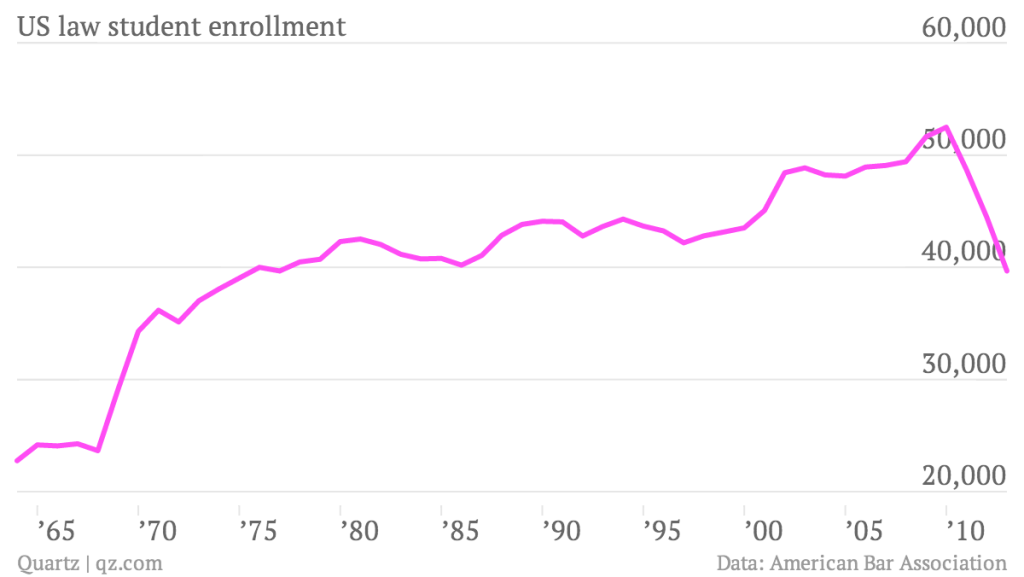
Fresh numbers from the American Bar Association show US law school enrollment tumbling 11% over last year to 39,675. That’s the number of full-time and part-time students who started law school studies in the fall of 2013. Overall, enrollment is down 24% from the 2010 peak. The Wall Street Journal’s Law Blog points out that we’re back to 1977 enrollment levels, an era that predated the surging growth of lawyers during the 1980s.

Campos chimes in:

What’s particularly striking about these numbers is that first year enrollment is down by 24.4% even though admissions standards have been slashed all across legal academia (Yale, Harvard and Stanford are the only elite schools that haven’t dropped admissions standards, and many non-elite schools have cut median LSAT scores for admits by ten percentage points or more). … [I]f law schools had maintained the admissions standards that prevailed a decade ago, next fall’s incoming class would feature about 24,600 matriculants, which is a number about 13% larger than the average annual total of jobs for lawyers that the Bureau of Labor Statistics estimates will become available over the course of this decade.

The Crimes Of The Financial Crisis

Jed S. Rakoff, a US District Court judge for the Southern District of New York, contemplates why no high-level executives have gone to jail. The factor that he thinks is “arguably the most important”:

It is the shift that has occurred, over the past thirty years or more, from focusing on prosecuting high-level individuals to focusing on prosecuting companies and other institutions. It is true that prosecutors have brought criminal charges against companies for well over a hundred years, but until relatively recently, such prosecutions were the exception, and prosecutions of companies without simultaneous prosecutions of their managerial agents were even rarer.

The reasons were obvious. Companies do not commit crimes; only their agents do. And while a company might get the benefit of some such crimes, prosecuting the company would inevitably punish, directly or indirectly, the many employees and shareholders who were totally innocent. Moreover, under the law of most US jurisdictions, a company cannot be criminally liable unless at least one managerial agent has committed the crime in question; so why not prosecute the agent who actually committed the crime?

In recent decades, however, prosecutors have been increasingly attracted to prosecuting companies, often even without indicting a single person. This shift has often been rationalized as part of an attempt to transform “corporate cultures,” so as to prevent future such crimes; and as a result, government policy has taken the form of “deferred prosecution agreements” or even “nonprosecution agreements,” in which the company, under threat of criminal prosecution, agrees to take various prophylactic measures to prevent future wrongdoing. Such agreements have become, in the words of Lanny Breuer, the former head of the Department of Justice’s Criminal Division, “a mainstay of white-collar criminal law enforcement,” with the department entering into 233 such agreements over the last decade. But in practice, I suggest, this approach has led to some lax and dubious behavior on the part of prosecutors, with deleterious results.

A Trip Through The Cold War

In an excerpt from Drugged: The Science And Culture Behind Psychotropic Drugs, Richard J. Miller details one of the CIA’s more outlandish schemes:

The CIA not only performed experiments on individuals but also came up with schemes for contaminating the water supply of potential enemies with LSD so as to incapacitate entire hostile populations. For this they would need large amounts of the drug, at one point ordering the equivalent of 100 million doses from Sandoz. When they found out that obtaining such a large amount as this might be somewhat problematic they turned to Eli Lilly and Company, whose capable chemists broke the secret Sandoz patent and assured the CIA that they could produce LSD in tons or similar amounts.

Thankfully for the future of humanity, this eventuality never came to pass. In the end the CIA concluded that the effects of hallucinogenic drugs like LSD were just too unpredictable for general use in the Cold War, and should just be reserved for very specific circumstances.

Nevertheless, in the atmosphere of general paranoia that pervaded the postwar era, the CIA maintained an important role in manipulating the developing drug culture. CIA operatives acted as drug suppliers if they were interested in observing drug effects under particular circumstances, and infiltrated different drug-using groups with political points of view deemed to be of “interest” so as to relay information back to Washington.

Confounded By Consciousness

Stefany Anne Golberg explores the philosophy of Miguel de Unamuno, a man who lived “in a state of existential crisis, hovering over the abyss”:

“I am,” wrote Unamuno 100 years ago. But who am I? All we have is our individuality, wrote Unamuno — if we are something else we are nothing. “They tell me I am here to dish_Unamuno1925 realize I know not what social end; but I feel that I, like each one of my fellows, am here to realize myself, to live.” All I have is myself, wrote Unamuno, and still he tried to run away. Consciousness, he learned, was not all it was cracked up to be. Consciousness, which has shown us many interesting truths about existence, has brought even more confusion. The more systems of thought we develop — the more equations we prove — the more contradictions we are handed. The more we learn about life on Earth, the more mysterious the universe becomes. When we back away from this confusion, we become hypocrites, wrote Unamuno. Yet, when we confront the chaos, we suffer. Consciousness is our gift and our enemy. “Consciousness,” wrote Unamuno, “is a disease.” This thing called consciousness, we learn, is simply awareness of one’s own limitations. In other words, it is consciousness of death. And this is the tragic sense of life.

(Photo of Unamuno in 1925 via Wikimedia Commons)

Getting Over “Guilty Pleasures”

Tracing the term’s history, Jennifer Szalai finds that it “exudes a false note, a mix of self-consciousness and self-congratulation”:

When “guilty pleasure” first appeared in the New York Times, in 1860, it was used to describe a brothel. The term appeared only a handful of times in the paper of record until the late nineteen-nineties, when it started coming up in its contemporary incarnation again and again, at the tail end of the culture wars. (According to the online Times archives, “guilty pleasure” shows up approximately a twelve hundred and sixty times—twelve hundred and forty-seven of those since 1996.) In some ways, the timing seems strange; the guilty pleasure was becoming a part of the cultural vocabulary right around the time cultural distinctions were ceasing to matter. But maybe it was precisely because those distinctions were becoming moot that people felt emboldened to use it. The guilty pleasure could then function as a signalling mechanism, an indicator that one takes pleasure in something but knows (the knowingness is key) that one really shouldn’t. Once distinctions were blurred, you could announce a love for pop culture that, in an earlier era, you would have been too ashamed to admit.

Her conclusion:

The guilty pleasure is a vestige of America’s disappearing middlebrow culture, of that anxious mediation between high and low, which at its best generated a desire to learn, to value cultural literacy and to accept some of the challenges it requires. General magazines once flourished because of it; even Ladies’ Home Journal, better known now as a chipper dispenser of service journalism and horoscopes, used to publish the likes of Edith Wharton and W. H. Auden. But the guilty pleasure seems to me the distillation of all the worst qualities of the middlebrow—the condescension of the highbrow without the expenditure of effort, along with mass culture’s pleasure-seeking without the unequivocal enjoyment.

If you want to listen to Rihanna while reading the latest from Dean Koontz, just go ahead and do it. Don’t try to suggest you know better. Forget the pretense and get over yourself. You have nothing to lose but your guilt.

In Religious Leaders We Don’t Trust

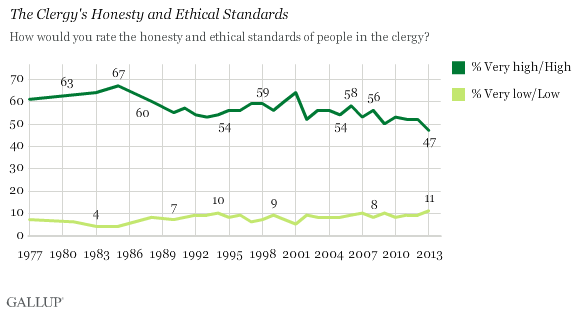
Our opinion of the clergy is declining:

Clergy Honesty

Kate Tracy unpacks the numbers:

Americans are divided along party lines, as well as age. Gallup found more trust in clergy among Republicans (63%) than Democrats (40%). Similarly, clergy members appear more trustworthy to older Americans than millennials: half of Americans older than age 55 trust clergy members, while only 32 percent of millennials (18 to 34 years) report the same.

Erik Voeten parses the poll:

[T]he authority of clergy is intrinsically linked to how much we trust them. This is especially problematic for religions like Catholicism that rely strongly on the authoritativeness of clergy. That is why clergy in these religions invest so heavily in symbols that are difficult to imitate, such as celibacy. Celibacy tends to deter imposters.  It is also why the Catholic Church is rightly worried about the consequences of declining trust.

My own view is that this is the crisis Francis has rightly judged to be a mortal threat to the church’s reach and message. So he has attempted to portray a pastoral dimension in his own actions as bishop of Rome that recasts moral authority not as something imparted by tradition or office or vestments or privilege. His very way of life is the only moral authority he wants to claim.

The Cult Of Cola

Paula Marantz Cohen labels the Coca-Cola franchise “a religion of Americana”:

Not an American religion, but a religion devoted to the idea of America — which is to say, to those Norman Rockwell scenes of homecoming, fly fishing, and presents under the tree.

Disney might be compared with Coke in having something of the same religious aspirations, but Disney has a more complicated apparatus — movies and theme parks (a visit to one of which is liable to bankrupt a family of four), not to mention the dubious figure of its founder, Walt Disney, a misanthropic anti-Semite (OK, Coke’s Colonel Pemberton was a drug-addicted Confederate soldier, but never mind). To worship at the altar of Coke, you just have to like the drink and put out the paltry sum required to buy it — which, even if it may produce rotten teeth, diabetes, and obesity, isn’t creating centuries of civil war and ethnic cleansing. It tastes good and it’s refreshing, especially after you’ve spent the afternoon trying to assemble an IKEA cabinet or five hours in heavy traffic to eat overcooked turkey at your Aunt Leona’s. …

Part of what makes Coke’s triumphal history go down so easily is that no one around today was alive before the beverage existed. Coke is “real,” as the promotional slogans remind us, because, artificial sweeteners, colorings, and preservatives aside, it has endured in more or less the same form for as long as anyone can remember. It is moving to see those old, round-cornered Coca Cola machines and those small, green-tinted glass bottles. The red on white Coca Cola script is a kind of Madeleine experience for childhood. Even if you never experienced anything like the America of Norman Rockwell (who did many of the Saturday Evening Post advertisements for Coca Cola during the 1940s and 50s) there’s something about that Coca Cola script that makes you think you did. I suspect individuals around the world feel this, even if they hate everything else that America stands for.

Keep Your Fictional Character Off My Daughters! Ctd

Ann Friedman disagrees with Douthat as to what worries today’s young women:

Now, I’m doubtful that educated twentysomething women are itching to reform and marry every L-train Peter Pan they swipe right on Tinder. But fertility is a legitimate back-of-the-mind anxiety for many young women, and we tend to imagine (explicitly or otherwise) timelines for ourselves as we try to navigate the limitations of biology. Douthat is wrong in assuming that the challenge lies mostly in getting the Nathaniels of the world to grow up and commit. It’s a much bigger question of how women successfully combine family and career. We’re well aware that we lose fertility at a certain age, but also that we lose professional power after we have kids. This is a generation of women who were raised on movies portraying the plight of the working mother, came of age in one of the worst economies in recent history, have read dozens of trend stories about the expense and trauma of IVF, yet still hope to have “it all.” They know the tough decisions that await them in their thirties. And so, they figure, better put in the professional work now — get as far as you can before it’s time to procreate. I wasn’t surprised to read a report from the Pew Research Center last week that women in their twenties are out-earning their male colleagues. The pressure is intense: Do it all now so you can have it all later.

Douthat pulls out some more sociology in his response to his critics:

If there’s evidence that 1) women’s stated sexual preferences are somewhat more conservative than what men say they want and what our cultural norms encourage, that 2) women’s happiness increases when their sex lives conform to their own preferences rather than to the culture’s more libertine script, and that (at least anecdotally) 3) men tend toward a kind of indecisive, listless, semi-exploitative relationship style when their preferences are too easily fulfilled, then perhaps — just perhaps — what we have here is a case for a somewhat more conservative sexual culture. Not a culture where the Ministry of Virtue locks Nathaniel P. away for crimes against chastity; not a culture where nobody ever has a one-night stand or a friend with benefits; not a culture where women are treated like porcelain or taught to quiver in fear of the ravening lusts of lecherous males. Just a culture where it’s a little easier for women (and men) to act on attitudes and preferences that, in the aggregate (!!!!), seem to correlate more with happiness and flourishing than many social liberals are willing to acknowledge or admit.

Andrew Gelman points to another study that found the exact opposite effect from the one Douthat cited in his column:

[T]he existence of two published results in the exact opposite direction suggest, at the very least, that any effects are likely to be lower than claimed in the published articles. As always, multiple comparisons problems are all over the place here — the Conley and Rauscher paper also had some “the difference between significant and non-significant is not itself statistically significant” moments — and I think reporters should be careful before taking the claims based on this sample and assuming that they apply to the population. The sex of your children is going to have all sorts of effects on your behavior and attitudes. With so many possible outcome measurements and various small effects in different directions, we can’t expect a sample size of 600 or 1,000 to form a coherent story, and I think there is a problem in that the conventions of scientific research papers, and of journalism, are that all the results should cohere.

He has a problem with this whole line of inquiry, however:

Why is it all about “the effect of daughters”? Why not “Does having sons make you support the Democrats?” … Lots of discussion about how you, as a parent, might change your views of the world if you have a girl. But not so much about how you might change your views if you have a boy. Lots of discussion of how having a girl might affect your attitudes on abortion, not so much discussion about how having a boy might affect your attitudes on issues such as gun control or war, which disproportionately affect young men. This is a real problem, when issues of girls and boys, men and women, are treated asymmetrically.

The Year Of Francis

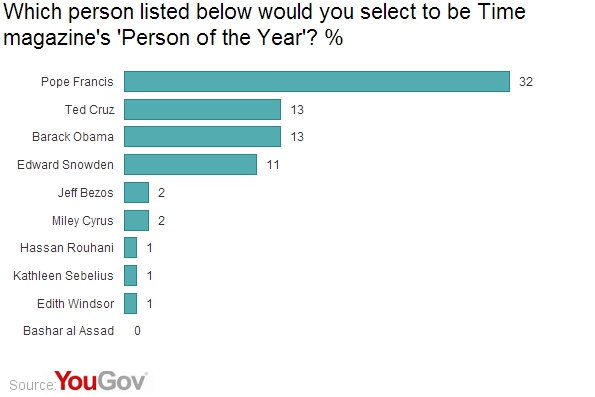
Americans agree with Time:
Person Of Year

Even The Advocate named Francis as their person of the year:

As pope, he has not yet said the Catholic Church supports civil unions. But what Francis does say about LGBT people has already caused reflection and consternation within his church. The moment that grabbed headlines was during a flight from Brazil to Rome. When asked about gay priests, Pope Francis told reporters, according to a translation from Italian, “If someone is gay and seeks the Lord with good will, who am I to judge?”

The brevity of that statement and the outsized attention it got immediately are evidence of the pope’s sway. His posing a simple question with very Christian roots, when uttered in this context by this man, “Who am I to judge?” became a signal to Catholics and the world that the new pope is not like the old pope.

Sean Bugg dissents, while I simply reel at the gay community’s embrace of a Pope. I mean: 2013 was a huge year for marriage equality – but also for gay-Catholic relations? What have I, what have I, what have I done to deserve this? Candida Moss is another Doubting Thomas:

[W]e have yet to see the kinds of doctrinal tinkering the media has attributed to him.

When it comes to the hot-button cultural issues that animate the Rush Limbaughs of the world, nothing has changed. Francis has been clear that the church’s position on abortion is not up for discussion, and he recently excommunicated Father Greg Reynolds of Melbourne, Australia, presumably for officiating at unsanctioned gay marriages. This pope may be extraordinarily compassionate, but he still enforces church order.

Damon Linker makes similar points:

Unlike his predecessors, Francis holds an apparently sincere belief in dialogue, bridge-building, conciliation, and the adjudication of differences. It seems important to him to appear cheery, tolerant, cosmopolitan. He has made respectful, open-minded statements about the members and beliefs of other Christian churches, as well as about Jews, Muslims, and even atheists.

But in every case where Francis has reached out to those who disagree with him, he has done so while indicating that his own beliefs grow out of Catholic bedrock. In the same airborne news conference during which he made headlines for seeming to counsel against damning gay priests, he responded dismissively to a question about women’s ordination, stating bluntly, “That door is closed.”

But Linker ends up softening his argument somewhat:

Even as Francis’s gestures make headlines, the Church does not think in terms of news cycles or election cycles, but rather in terms of centuries. A new Pope appoints the bishops, archbishops, and cardinals who will govern the Church of the future and in turn elect the next Pope, who will then make his own appointments, and so on, down through the decades. It may seem crazy to progressive Catholics that they’ll likely have to wait another 100 years for their Church to declare the use of condoms to be morally licit or to permit a woman to celebrate Mass. But something has to set the wheels of change in motion, and that just might be the modest but vital reform that Pope Francis ends up being remembered for most of all.

I think Damon is wrong about contraception. The highest authorities in the church argued exactly that almost fifty years ago – that condoms and the pill were licit. It was an over-reaching papacy that quashed it unilaterally. And undoing that over-reach is arguably the core goal of Francis’ pontificate.