Fournier Digs In

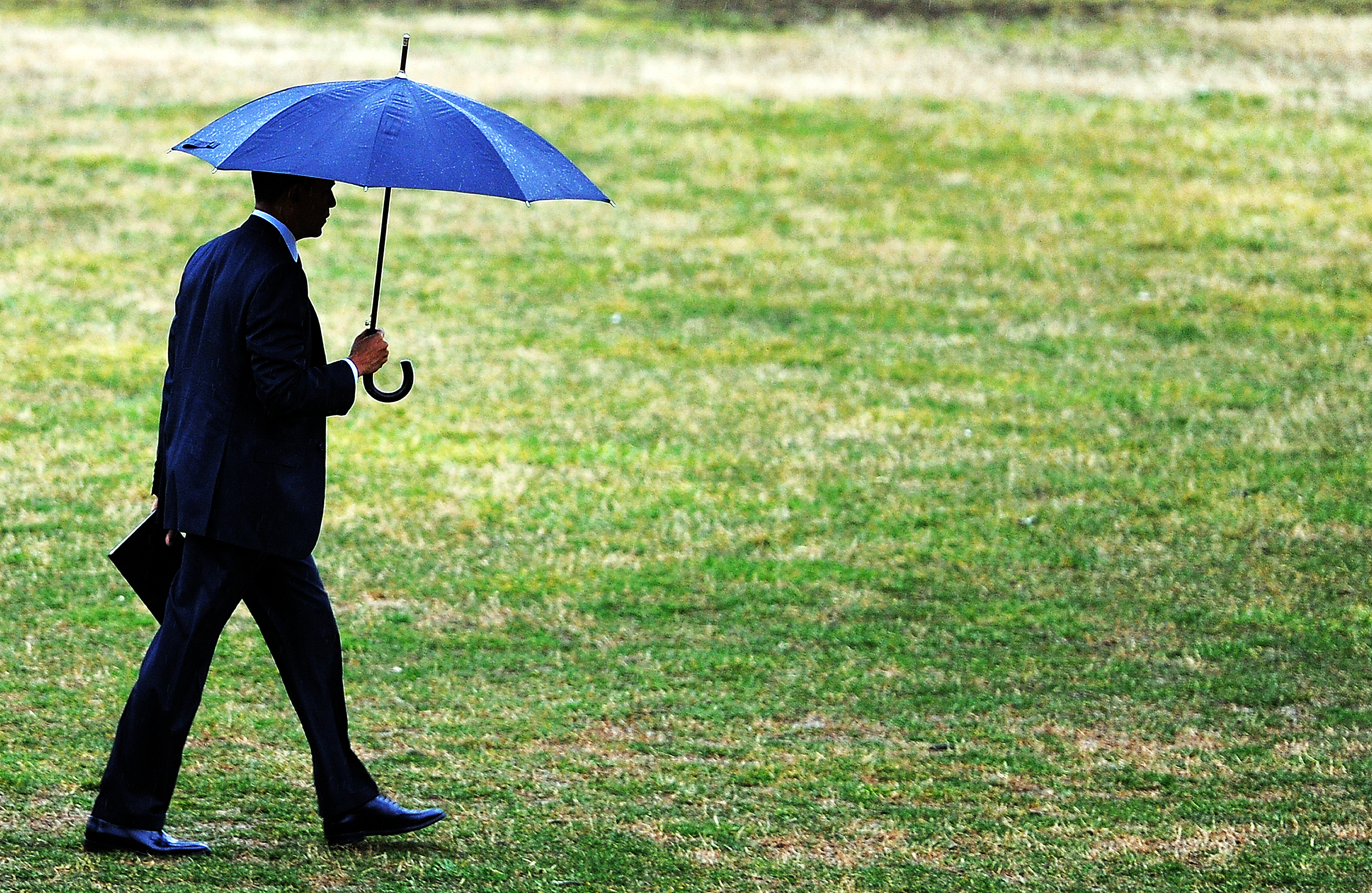
US President Barack Obama uses an umbrel

Like many other veterans of the Village, the former McCain supporter, Ron Fournier, has never liked the Obama era. Its implicit repudiation of so much that came before still rankles many in the capital’s permanent chattering and political class. And so Fournier’s dogged and constant attempts to drag this presidency to the low levels of its predecessor are not exactly surprising. But the latest is a classic, down to its melodramatic title: “This Is The End Of The Presidency.” The thesis is that Bush and Obama are essentially the same failures in the same way and for the same reasons. And when the analogies are laid out as an analogy as far as it can … well, it’s so preposterous and lazy an argument it beggars belief.

Here’s the gist of Fournier’s Obama-Is-Bush absurdity in its various stages. Obama, like Bush, allegedly began his second term by going far out on an ideological limb. If only Obama had listened to Fournier! The president would never have supported immigration reform (even though it was temporarily deemed even by Republicans as the sine qua non if they were ever to win the White House again). He would have presumably abandoned the healthcare reform that had already been passed and had been at the center of a furious campaign. He would have chosen to “spend [his] political capital wisely, taking advantage of events without overreaching,” as Fournier brilliantly suggested a year ago in a far-seeing column of surpassing prescience and non-falsifiable vagueness.

So he would have seized on Sandy Hook by proposing a moderate package of gun control, with overwhelming public support, right? Wrong! He shouldn’t have done that either! What should he have done? Er, hard to tell from Fournier’s column, which simply lumps together random things he doesn’t like about Obama and compares them with random things that everyone now concedes were dreadful under George W. Bush.

But what Obama shouldn’t have done is

rub Republican faces in defeat. Obama forced his rivals to accept higher taxes on the wealthy. It was his prerogative; he won the election. And he set the tone for a harsh and humiliating 2013.

Let’s just unpack that a little, shall we? If Obama had done nothing at the end of 2012, tax rates would have gone up dramatically on most Americans, with revenues increasing by almost 20 percent, as the Bush tax cuts’ self-imposed expiration finally arrived (after their massive failure to create growth and a massive success in creating unprecedented debt). Obama – in an act of overbearing hubris – only let the tax cuts expire for a tiny proportion of Americans earning more than $400,000 a year, halving the total tax increase and concentrating it only among the very rich, whose wealth and incomes had exploded since 2000. On spending, the sequester remained in place, keeping government spending at levels tighter than in almost every previous recovery’s, very much including Reagan’s. Here’s the impact on the deficit of this and other measures that Obama agreed to, from the Wall Street Journal:
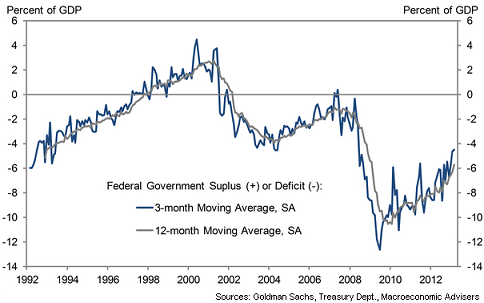
deficits0413Talk about liberal over-reach! This decision to prevent much larger automatic tax rises and to reduce spending and the deficit by these amounts during a still-lingering downturn is what Fournier regards as rubbing “Republican faces in defeat.” Seriously.

But Fournier is not done yet. Both Bush and Obama had first term “successes” that turned to defeat in their second term. Bush’s first term success was – wait for it – the Iraq War, whose core casus belli Bush had lied about. And so obviously the analogy with Obama is to the ACA, a first term success some of whose provisions Obama had also lied about.

How does one note that a war that killed more than a hundred thousand people, and destroyed America’s moral credibility and global power is not really in the same universe as a health reform law, modeled on a Republican governor’s, that, so far, has done nothing but provide access to health insurance for many, forced some to buy more expensive and comprehensive coverage, frustrated millions by being launched on a faulty website, and possibly already arrested soaring healthcare costs? I guess it’s possible to see both things as equivalent – a brutal, lost war and a fledgling overhaul of the country’s healthcare system. But I think most sane people not captive to Beltway narratives would beg to differ.

But then, according to Fournier, both Bush and Obama failed to cop to errors! Yes, Obama had that brutal press conference where he owned up completely to failure on Healthcare.gov, and beat himself up again and again in apologizing. But that, according to Fournier, wasn’t any better than Bush’s flailing around in the obvious catastrophe of Iraq, keeping Rumsfeld until 2006, and dithering until the mid-terms gave him the courage to do something more tangible than wait and watch. Again: I simply beg to differ. The difference between Obama’s response to error and Bush’s is the difference between night and day.

Ditto the difference between partisan Democrats keeping after Bush in 2005 (while never voting to curtail his war and acquiescing in most of its abuses) and the near-pathological attempt to destroy Obama by Republicans in 2013. What was stunning this year was the revelation that the GOP was prepared to wreck the entire global economy and the credit of the US government, if it could get them one small political edge over a re-elected president. This negotiating tactic was a new level of extremism, as Americans rightly understood. And if Obama had won the same Republican support for healthcare reform that Bush had from Democrats on Iraq, the last five years would have been much, much different. Or was that Obama’s fault as well?

All these critical, central facts for the last five years do not fit anywhere in Fournier’s analysis. And the truth is: nothing this president has done compares even faintly with the damage wrought by his predecessor. Bush exploded the deficit in a time of growth; Obama has cut it dramatically in a time of near-depression. Bush gave us two disastrous wars; Obama has largely ended both, and set in process diplomatic initiatives in Syria, Iran and Israel-Palestine that, if successful, can defuse potential new ones. Obama has tackled a huge domestic problem – the accessibility and cost of healthcare – which Bush allowed to fester and on which the current GOP has no policies except a return to the disastrous status quo ante. Bush initiated the first ever American-run program of torture of prisoners. Obama ended it. Bush presided over the worst breach of national security since Pearl Harbor. Obama killed Osama bin Laden and decimated his forces on the ground in Afghanistan and Pakistan. Bush presided over the total collapse of the free market system in the US; Obama has painstakingly rebuilt it.

If you exclude all this context and focus on superficial Washington games and tropes, you can maybe concoct a theory of the past five years that makes Fournier’s analysis seem plausible. It’s just that you have to erase the actual events from your brain and your memory.

It tells you a lot about Washington that doing that will make you the editor of National Journal.

North Korea’s Unusual Candor

BR Myers analyzes the recent purge of Kim Jong Un’s uncle, Jang Song-thaek, noting an unprecedented level of disclosure in the post-purge propaganda:

North Korea had prided itself on complete unity ever since the establishment of a “unitary ideology” in 1967. When the regime warned against subversive behaviors it resorted to cartoons with animal figures rather than admit to actual internal disunity. Power struggles elsewhere were gloated over as evidence that only North Korea had leaders whose greatness stood above dispute. The benevolent charisma of the leaders was said to be so irresistible that even representatives of enemy states, like Jimmy Carter and Kim Dae Jung, succumbed to it. And now the North Koreans find out that Kim Il Sung’s own son-in-law and Kim Jong Il’s right-hand man was engaging in crimes since the 1980s? Yet they are still expected to believe in the infallibility of Kim Jong Il’s choice of successor?

How Myers sees the North Korean regime:

[I]t is a race-oriented, militaristic state with socialization of assets. But the militarization of a peace-time society cannot be sustained without the perception of an ongoing national emergency. North Korea has shown that this perception can be maintained through limited conflicts and crises, without engaging in all-out war. … As I see it, North Korea cannot cease being a military-first state without losing all reason to exist. To ask the regime to disarm is to ask it to commit political suicide. Once you’ve grasped that, you realize that neither sticks nor carrots are going to keep the regime from continuing to arm itself, and continuing to look for the tension that is its lifeblood. And that’s when you start to get really worried.

Abraham M. Denmark speculates on the meaning of the purge:

[I]nstability at home could translate to more belligerence abroad. Many North Korea watchers believe that past acts of aggression, including limited-scale attacks against South Korea, reflected Kim’s attempts to demonstrate strength and resolve in the face of foreign opposition in order to burnish his domestic reputation—especially with the military. This suggests that 2014 may be a difficult year with North Korea, with the potential for military attacks and nuclear tests in the offing.

Museums In The Age Of Selfies

3705898967_b2268c78ab_b

Eric Gibson thinks overzealous smartphone users are ruining the museum experience:

Rather than contemplating the works on view, visitors now pose next to them for their portrait. In pre-digital photography the subject was the work of art. Now it is the visitor; the artwork is secondary. Where previously the message of such images was “I have seen,” now it is “I was here.”

If visitors now regard a museum’s treasures as mere “sights,” they might come to regard the institution itself in a similar vein—not as a place offering a unique, one-of-a-kind experience but just another “stop” on a crowded itinerary, and as such interchangeable with any other. At the very least, it’s hard to see how this new culture of museum photography can fail to undermine the kind of long-term visitor loyalty to museums toward which so many of their public engagement efforts are directed. On the one hand, the visitor who makes an emotional connection with a work of art is likely to return. On the other hand, I can’t imagine there are many tourists who, having once had themselves snapped propping up the Leaning Tower, feel compelled to do so again.

Jillian Steinhauser begs to differ:

[T]he obvious point Gibson has missed is that people are often taking pictures because they’re excited about art. They came because they wanted to see it with their own eyes. And they’re using their cameras and smartphones as a form of interaction – we live, after all, in the age of mechanical reproduction, not the age of aura.

Did we lose something in the exchange? Probably. But that doesn’t mean we should throw up our hands completely. The way we understand and process art has changed – you can take it home with you, blow it up on your computer screen, remix it in Photoshop, Snapchat it to your friends – in part because the way we understand nearly all cultural production has changed.

(Photo of Anish Kapoor’s Untitled by Leo Reynolds)

Blame It On Obamacare, Ctd

The ACA is getting scapegoated. Suderman expects this to continue:

The instinct for the White House and its defenders will be to protest that most of these changes in employer coverage are a longstanding part of the existing market, that they happened before Obamacare, and that the law isn’t the cause of every health insurance woe in the nation. Obamacare, they’ll say, is responsible for the part of the system that’s getting better, not the part that’s staying bad.

But Democrats will have a hard time selling this argument to a skeptical public. Partly because it sounds awfully self-serving, taking all the credit and none of the blame. Partly because the impression has already sunk in that Congress doesn’t understand the real-world effects the health care law is having. But mostly, however, because President Obama has already lied about who the health law will affect, and how. For lots of Americans, it won’t be easy to trust the president or his party on the subject again.

Philip Klein makes related points:

Given that the law was sold as a way to fix a broken health care system, rightly or wrongly, the law is going to be blamed for any persistent problems.

It’s impossible for Americans to sort out whether a given change took place as a result of the law or whether it would have happened anyway. If they don’t like a change to their health care situation that occurred after a giant new law went into effect, they’re going to blame that giant new law.

If I were a vulnerable Democrat incumbent in 2014, I wouldn’t want to pin my re-election hopes on being able to convince angry voters that changes that they hate would have happened with or without the health care law. “Correlation doesn’t equal causation” is not exactly a winning campaign slogan.

Barro thinks this is why the GOP hasn’t come up with a real alternative to the ACA:

Liberals chose to reform health policy despite the political risks, because their political coalition includes the people who are most extensively screwed by the health policy status quo. Conservatives have decided that cynicism is a better political strategy, for the reasons Klein inadvertently lays out. They’re probably right on the politics, but that’s nothing to be proud of.

The View From Your Window Contest: Winner #184

vfyw_12-14

A reader writes:

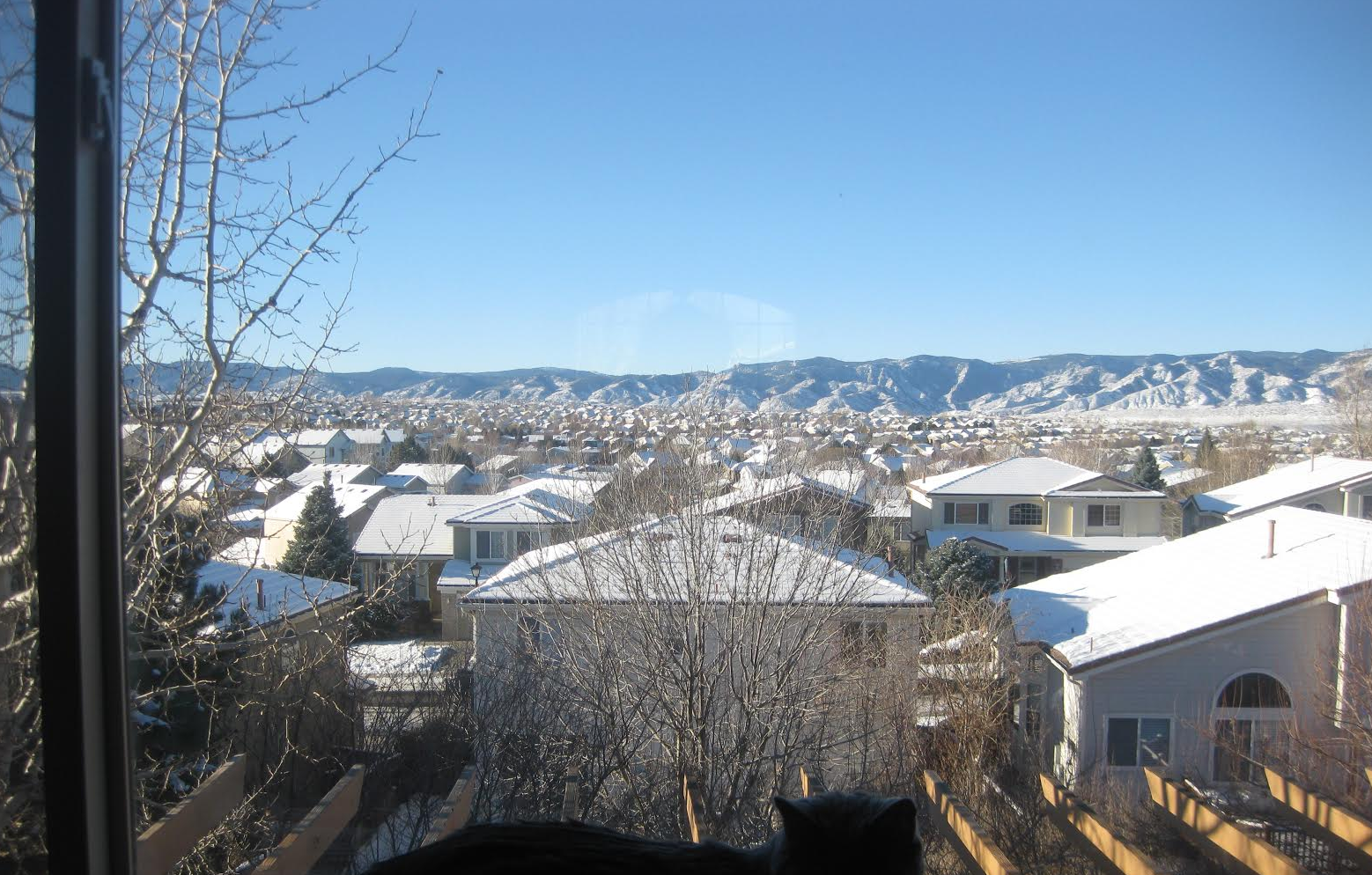
No San Jose-style giveaways this week, I see. We have a sea of McMansions in a relatively flat valley, mountains in the distance, and a cat. This could be any of a number of recent boomtowns in the American West. Or perhaps somewhere in Alberta. But I’m going to go with my first impulse, which was the outskirts of Las Vegas, specifically Henderson, NV, looking to the east. The terrain looks right and I believe they’ve had some record breaking cold lately (hence the dusting of snow). Hopefully the evergreen trees in front of a few houses are merely misdirection.

Another:

It’s been a long time since I’m made a guess, just because so many of the recent contests have been so damn difficult, but I figured I’d give this one a chance. Snow cover, relative lack of trees (particularly out in the distance past the development), large tracts of newly constructed suburban housing … it definitely suggests a city with a booming economy somewhere in the dry Mountain West. All the major cities in Utah and Colorado are immediately disqualified because the mountains in the background would be much, much taller. Billings, Santa Fe, Albuquerque, and Grand Junction don’t have the right kind of hills in the background. Boise is really the only city that fits all of the criteria, so I’m going with that.

Another:

I’m guessing this is Pocatello, Idaho. The mountains in the distance look very much like the area pocatelloand the town sits in a kind of bowl-like valley surrounded by them. How do I know Pocatello? I’m a documentary TV producer and I went through with a Pakistani crew and a host, who is “the Julia Roberts” of Pakistan. We went to meet and interview a pair of Pakistani immigrant doctors who live in Pocatello and have become local legends for their work in the community. That said, Pocatello is not the most exciting place in the world. Its main claim to fame is having its city flag voted the ugliest in the United States.

Seen to the right. Another reader:

With two holiday parties to go to today, unfortunately I don’t have time to look for the address, but that sure looks a lot like Tuscon. This picture nicely illustrates how that city looks like something straight out of The Martian Chronicles.

Another:

I give up. I’m stumped. I spent my entire PTO day yesterday trying to find this place and focused on Colorado and Utah with no luck. I figured the leaves off the trees and the new construction it was Denver or Colorado Springs or Salt Lake City.  Let’s go with Colorado Springs.

And I’m 3% sure the cat’s name is Mr. Phipps.

Update from the photo submitter:

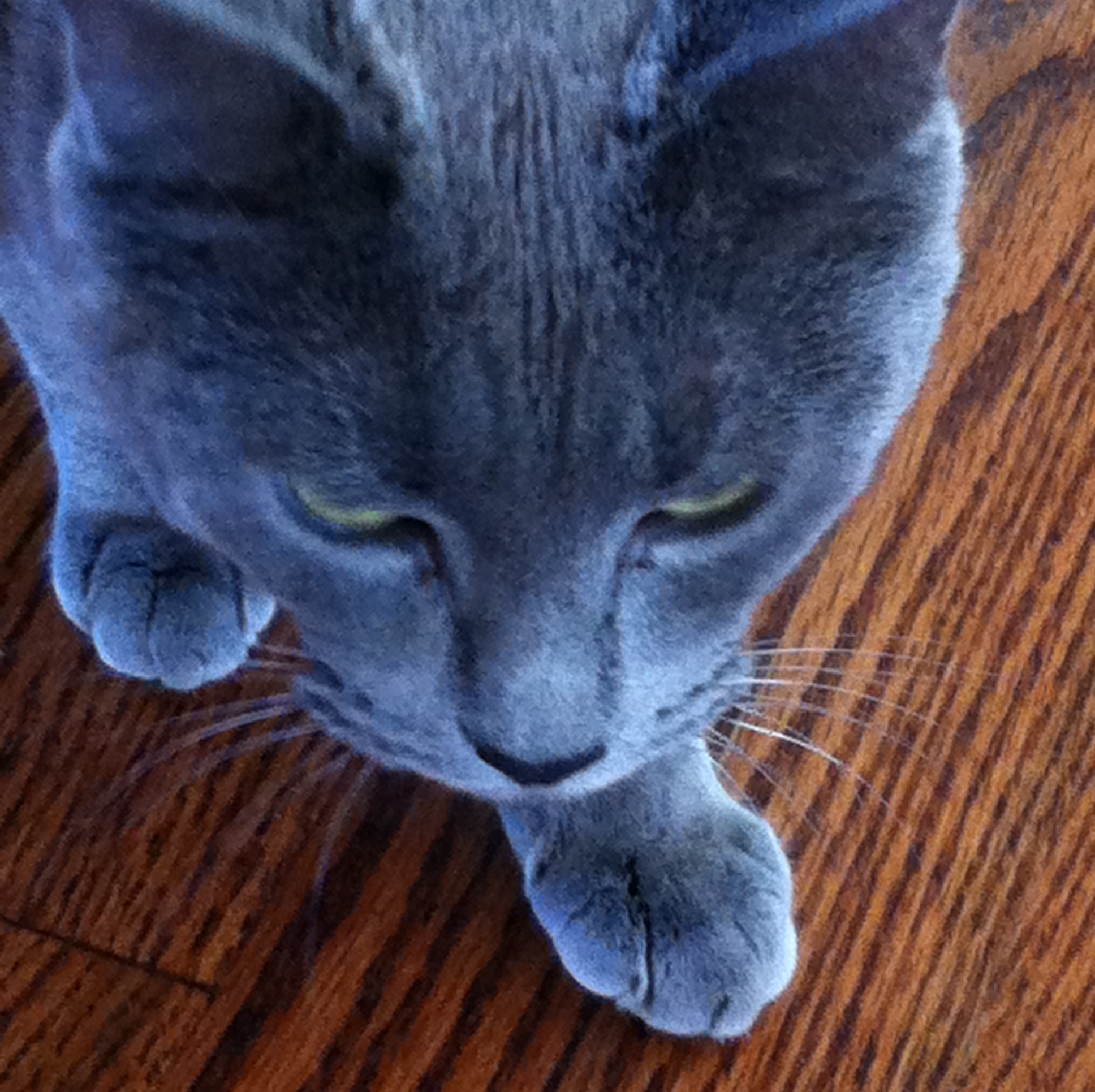
HA! No. The cat’s name is Romeo:

photo 3(1)

The boy earned that named because he loves hard, guards the house against those slanderous squirrels, and is more than a bit impulsive.

Another reader gets punny:

Thanks to the huge spoiler in the photo this week. I want to be the first to state the obvious: this is obviously Kathmandu.

Another:

I have ceased to be amazed by people guessing these locations. That said, this one strikes me as nearly impossible.

It could be virtually any large subdivision in the American West (or even Appalachia, I guess, but I think not). I’ll guess a suburb southwest of Denver, call it the “Valley Enclave” subdivision of the neighborhood in Littleton, CO that is around 39.569771, -105.155785. Facing Southwest from somewhere around 30 Mountain Pine Drive.

Anyway, I also wanted to pass along my thanks for continuing to blog over the weekend. It must be taxing to post what is nearly 24/7. Wanted you to know it’s appreciated. Especially by a law student in the middle of exams who needs a distraction.

The Dish team is indeed indomitable. Another reader:

Nice picture. Lots of two story track homes, Western US style, evergreen trees in the front yards, relatively barren hills in the backgroun. Must be a large Western US suburb close to lower mountain ranges. Guessing Highlands Ranch or Aurora in Colorado, sitting next to the Southern Denver ranges.

It’s the former. Another gets it:

Fresh pow on the foothills … cookie cutter houses packed in like sardines … looks like Highlands Ranch, Colorado!

Another notes, “This is where the shooter in yesterday’s school shooting lived.” One of several schematics from an impressive reader:

fig1

A previous winner writes:

We’re looking at the eastern edge of the Rockies from the West Denver suburb of Highlands Ranch, which shares a zip code with Littleton, CO. In fact, Google Maps kept alternately telling me the address is in Highlands Ranch and Littleton. (And therefore near Arapahoe and Columbine – a news article on Friday’s shooting mentioned that a home in Highlands Ranch was searched.)

My dad immediately recognized Colorado, which is good because I probably would have started in Idaho or something. This image of HR I found helped a lot, as the mountains match the section found to the far right of the contest pic.

I think the picture was taken from [the correct address, redacted at the submitter’s request]. A vast scene of subdivisions is a nightmare! Different subdivisions have different styles so I could rule out several neighborhoods. We were near a corner on the left, and my best reference was the alternating pattern of rectangular roofs and asymmetrical roofs – see below. Note the approximate location of the cat seen in the contest pic:

roofs

Another previous winner also got the correct address and adds:

When I first saw this week’s view, I thought, “no, it couldn’t be, could it?” I grew up in the western suburbs of Denver (shout out to Lakewood!), and the sight of the foothills blanketed in fresh snow brings back many fond memories. Now a Minnesotan, I wish we had a little more vertical terrain to go along with the snow, ice and cold that keeps us company for a good part of the year.

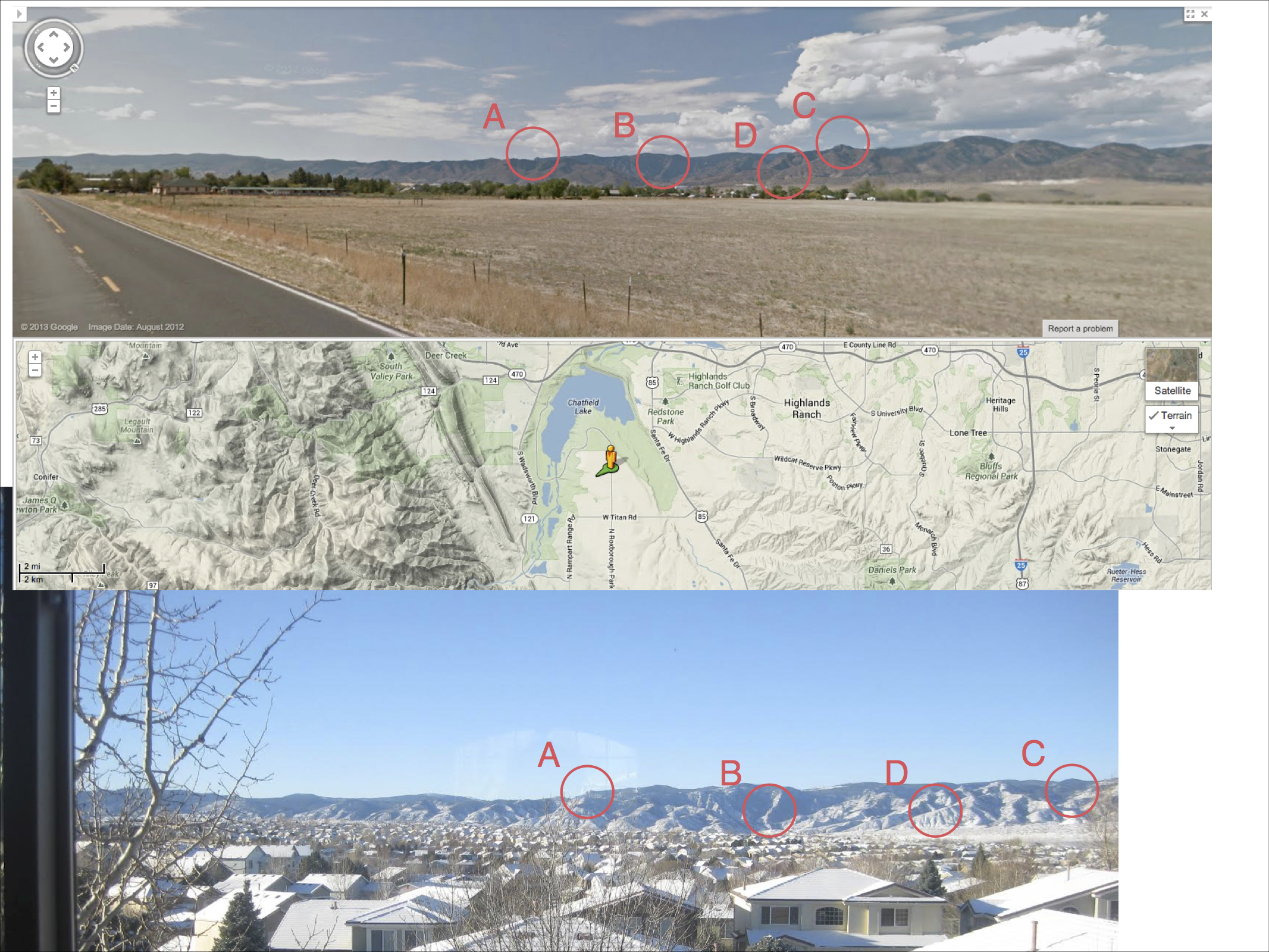
Off I went to see if I could confirm this was in fact the sight of the same hills. It is amazing what you can do with two thumbs and an iPad! Scanning the 3D satellite images, I looked for the signature of the two well-defined ridge lines and the starkly contrasted southeast slope face that show up in the right third of the view.

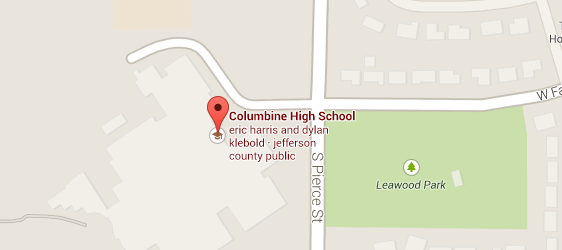
After a few minutes working from Boulder south, I found what looked to be a match. Given the proximity and angles, I first thought that Columbine may be the town – fitting as a bookend to go along with the one-year anniversary of Newtown:

image

(Side note: it doesn’t seem right to me that the attackers – no mention of the victims – get their names listed alongside the place mark for Columbine High School on Google Maps – how can we change this?)

But the sight lines for the hills didn’t work for Columbine; instead it was clearly neighboring Highlands Ranch and its relatively new subdivisions that aligned.

Of the three non-winners who correctly guessed the exact address this week, one of them has participated in five times as many contests as the other two, so he wins the prize this week:

Between the look of the hills, the snow, and the sprawl, I immediately recognized this week’s photo as the Front Range foothills as seen from the southern Denver-area suburbs, looking southwest. I grew up in those hills just a little bit west of what you can see in the photo.

A couple minutes of scanning the foothills with Google Earth found the exact hills in the photo, then I moved NE until I saw some neighborhoods with houses facing the right direction and enough sprawl between them and the hills to be a potential location of the shot. The first neighborhood I checked wasn’t quite right, but the second was a match. I would consider this house to be a part of Highlands Ranch, but according to Google Maps, the address of the house is [redacted address].

And it wouldn’t be a window contest with a creepily accurate entry from Doug Chini:

VFYW Highlands Ranch Actual Window Marked - Copy

This one comes with a bit of deja vu. It was only last April that I was flying through the Alps near Rohrmoos looking for the distinctive mountains in VFYW #148, and now nine months later we get a similar search. Thankfully, this new set of peaks was much easier to find. This week’s view comes from Douglas County, Colorado. It was taken at [redacted address] in the Denver suburb of Highlands Ranch and looks southwest along a heading of 220.48 towards the Front Range of the Rockies. A best estimate for time and date would be December 9th at 8:33 AM (or perhaps December 5th). Attached is a marked bird’s eye view looking toward the mountains, an external shot of the window, and an interior view of the actual home office/alcove where the pic was snapped:

VFYW Highlands Ranch Interior Window Clean - Copy

The submitter of the contest photo wrote:

This is the view from my home office in Highlands Ranch, Colorado. We are in unincorporated Douglas County just south of Littleton. We were the focus of school reform this past election. We lost again to the conservative reformers.  But this is our home too and we’ll keep fighting for our kids and their teachers.

The Dish covered the school board election here. The submitter follows up:

Thank you for using my picture. To help narrow the win, if needed, the address is [redacted address]. Of course, this is a home address so please don’t publish. The view is looking west and a little south out over the western part of Highlands Ranch. Chatfield and Roxborough are between the window and the foothills.

A little more to add. I know the more urban of your readers will suck their teeth at this vast sea of suburbia. That is ok. I was that person too at one point. We’ve been here now for nearly ten years and I’ve never been happier anywhere else. When family from San Francisco or Seattle visit they wonder where the “there” is located. I laugh it off and kick rocks, but the truth of the matter is that this vast ‘burb is where my friends live. It is where my kids are growing up and it is where I fall in love my wife over and over and over again in between grocery shopping, car loops, and the rec center swimming pool. Besides, downtown Denver is like 20 minutes away for when we want to get all cultured up.

On a sad note, the most recent school shooting happened only eight miles to the north from where this picture was snapped. In fact, due to our intense feelings about the Douglas County School Board (oppose) and the reputation of Arapahoe High (top-notch), we tried mighty hard to get a house that fed to AHS. We failed in that endeavor. It is our sincere hope that the kids and their families at AHS will find healing and love in the days and years ahead. I wish there was more that we, that I, could do to ensure that nothing like this could happen anywhere again to any child.

(Archive)

Are Our Surveillance Laws Obsolete?

On Monday, US District Court Judge Richard Leon ruled that the NSA’s sweeping phone-metadata program is likely to be unconstitutional. Lyle Denniston gives details:

From a legal standpoint, the most significant part of Judge Leon’s ruling was that it would undercut the most significant foundation the government has claimed for the legality of the telephone data sweeps.

He ruled that he was not bound by a 1979 Supreme Court ruling that both the Obama Administration and the secret FIS court that has approved the data sweeps have interpreted as authorizing the program.  Judge Leon said that the Supreme Court in the case of Smith v. Maryland did not deal with the communications world as it exists today, so its ruling does not directly apply to what NSA is now doing on a worldwide basis in search of terrorism information.  He found that, today, telephone and other communications companies are essentially engaged in a joint intelligence-gathering program with the federal government.

Orin Kerr felt that the ruling was weakly argued:

Today’s cell phones are not just phones, Judge Leon emphasizes. They are computers with functionality wholly apart from telephony. Today’s cell phones are maps, cameras, text messaging machines, and even lighters that can be held up at rock concerts. As a result, Judge Leon argues, Americans have an “entirely different” relationship to phones than they did in 1979. And Judge Leon therefore cannot possibly follow a decision from the pre-cell phone era.

I find this argument deeply unpersuasive. Most obviously, why does it matter that today’s phones are combined in a single device with other functions? The NSA’s program is not collecting information about the use of those other functions. It is only collecting the same information that was collected in Smith v. Maryland: Information about numbers dialed using the device’s telephone functionality and when the call was made.

Emily Bazelon explains what has changed since 1979:

At issue is the part of the Patriot Act, building on the Foreign Intelligence Surveillance Act, that allows the government to collect an enormous trove of phone call metadata, and then query it based on an “identifier” phone number called a “seed.” A seed is a number associated with terrorist activity, based on a reasonable and articulable suspicion. Sounds OK so far. But wait: Once you’re an NSA agent with a seed, you can analyze all the numbers within three hops from that seed—meaning the numbers the seed called and received calls from, and the numbers connected to those numbers. Judge Leon points out that if one seed calls just 100 numbers in five years, and each of the numbers in the next two hops also connects with 100 numbers, the NSA can trawl through the metadata for 1 million phone numbers. And that’s got to be a low-ball estimate, since it doesn’t take into account the possibility that someone used one of those phone numbers to order from, say, Domino’s Pizza, allowing the NSA to vacuum up zillions of other callers. There were fewer than 300 seeds in 2012, according to the NSA. Still, the data collection ratchets up exponentially so fast that we have to be talking about a database with everyone’s metadata.

Ambers weighs in:

Does the government have a compelling enough interest to justify these privacy violations? Leon concludes that they haven’t made that case. There is no important government interest that would be placed in jeopardy if the program were adjusted to require some sort of individualized suspicion to be articulated, he writes, and the government never produced evidence that the program had stopped an imminent terrorist attack that a program with more safeguards would not have.

Amy Davidson reads through the opinion:

There are several exclamation points in this decision. Judge Leon plainly feels that he has been lied to, and that we all have been. And he seems to be done with it. We hear a lot, he writes, about the expectation of privacy, and how it has disappeared in this day and age—don’t we all know we leave digital trails that can be followed? If we have given up on the privacy of our metadata, Judge Leon writes (quoting Smith in part), “I would likely find that is the result of ‘ “conditioning” by influences alien to well-recognized Fourth Amendment freedoms.’ ” In other words, cynicism does not give the government a pass when it comes to its constitutional obligations. And neither should the courts. We are allowed to expect more.

Allahpundit considers Snowden’s impact:

[I]f not for Snowden’s leaks, this case literally might not have happened. Per the Supreme Court’s ruling in the Clapper case earlier this year, you can’t get standing before a federal judge by merely speculating that the NSA is targeting you. You need to show a real likelihood of concrete injury. Right, says Leon — and now, thanks to Snowden’s exposure of PRISM, we’ve got that. The leaker has changed the legal facts on the ground, enough so to make a Fourth Amendment lawsuit possible.

Drum bets that the ruling will be reversed:

I’m delighted that Snowden helped this get more attention, and delighted that a judge wants it to stop.  But district court judges make lots of rulings that never go anywhere, and this is most likely one of them.

Andrew Cohen praises the judge:

Leon has given the nation a gift: In a single document, vetted by an independent mind, he chronicles both the factual history of the metadata program as well as the statutory underpinnings of it. He places the facts and the law into constitutional context. And he places the constitutional dynamics of the case into historical context. It’s a worthy endeavor. Even if Leon is overturned on appeal, it won’t mean he was wrong.

A Troublesome Truth About Europe’s Muslims

Muslim-survey

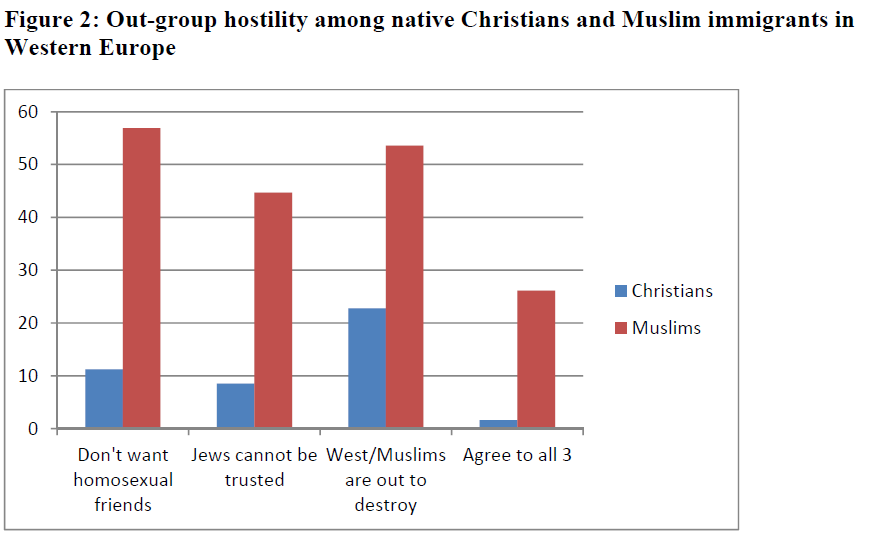
Erik Voeten points to a survey revealing that ample majorities of Muslims living in several Western European countries hold fundamentalist religious views, such as that there is only one acceptable interpretation of the Quran and that it supersedes the laws of the country in which they live:

This study is bound to attract ample media attention (it already has) and will be seen as a verification for political parties with extreme views, such as Geert Wilders’s PVV in the Netherlands. This is not an issue per se, facts are facts, however uncomfortable they may be, and from what I can tell, this is a professional survey (technical report here) done by a reputable academic scholar. Indeed, the survey was conducted in 2008, and the researchers appear to have waited until now to publicize these findings. Nevertheless, I wished that the publication of a sensitive survey like this would be partnered with a bit more information. For example, I could not even track down country-specific marginals for the main survey questions and key analyses in the article come without tables or graphs.

Still, the finding that 54 percent of Muslims in these six Western European countries believe that the West is out to destroy Muslim culture can hardly be ignored.

A Dutch newspaper, Trouw, cites Arabist Jan Jaap de Ruiter who argues that Muslims have a tendency to give “socially desirable” answers to survey questions. Even if this is true, I’d still be very concerned that the apparent socially desirable answer is that Jews should not be trusted and that the West is out to get Muslims. An added concern is the absence of generational differences in the survey responses; suggesting that this is not an issue that is likely to go away any time soon.

Cas Mudde downplays the survey:

In the end, the main question is: What does this all mean? Most media only report [Ruud] Koopmans’s warning against the intolerance of Muslim fundamentalism. However, in a very nuanced conclusion, he also stresses that religious fundamentalism should not be equated with support for, or even engagement in, religiously motivated violence, and emphasizes that Muslims constitute only a small minority of West European societies. Hence, “the large majority of homophobes and anti-semites are still natives.”

Rachel Gillum responds to the survey with one finding that Muslims in America are no worse than Christians:

Just over 57 percent of the general American population believes that “right and wrong in U.S. law should be based on God’s laws,” compared to 49.3 percent of U.S.-born Muslims and 45.6 of foreign-born Muslims.  About a third of each group believes that society should not be the one to determine right and wrong in U.S. law.  Such numbers reveal that the general American population is more fundamentalist than the average European, and that Muslim Americans are less fundamentalist than European Muslims, according to the Koopmans study.

She tries to explain the difference:

The bulk of Muslim immigrants in the U.S. today arrived during or after the 1990s, the large majority pursuing economic opportunities and advanced degrees. Muslim immigrants in the U.S. are thus just as wealthy as, and tend to be better educated than, the average American. This high-skilled migration flow to the U.S. stands in contrast to the low-skilled labor immigration that Western Europe attracted following World War II to help rebuilding efforts. More immigrants were later admitted into European countries to meet rapid economic growth, allow family reunification and provide asylum.  Muslims in Western Europe have had significant issues with poverty and integration, making up around 20 percent of the low-income population, compared to 2 percent among U.S. Muslims.

The Campaign To Sell Obamacare

The insurance industry is preparing a massive Obamacare ad campaign. Benen remarks upon it:

If the industry expected the Affordable Care Act to collapse – or at a minimum, struggle badly for the foreseeable future – insurers would wait on the sidelines. If the industry expected “Obamacare” to succeed, they’d quickly get in the game, competing for consumers’ business before their rivals could snatch up prospective customers. Now that insurers are poised to spend a half-billion dollars in advertising, it appears the industry is confident the system will prevail. To hear Republicans tell it, “Obamacare” is in some kind of death spiral, from which there is no recovery. In reality, the ACA reached its nadir a month ago, and is bouncing back quite nicely.

Krugman is on the same page:

Now, some people will see this as bad news. Obamacare is just going to add to insurer profits! And it will indeed make money for the likes of Aetna and Wellpoint. In an ideal world, this wouldn’t be happening: single payer would clearly have been a better system. But it wasn’t going to happen. This was the health reform we could get — and when it works, as the big money now believes it will, it’s going to make a huge, positive difference to millions of lives.

Ezra comments:

The fact that the insurers are launching their campaigns is … independent confirmation that HealthCare.Gov is rapidly improving. Major insurers are virtually the only group aside from the federal government that has real visibility into the functioning of Obamacare’s digital architecture. They know what the pace of enrollment looks like, and how many 834s are being correctly generated, and whether angry customers are calling their help lines. They know there are still problems even if the Obama administration is downplaying them. But if they think the system is sound enough to begin driving people to it that’s good evidence that the improvements are real.

Sargent chimes in:

What’s striking is that this comes even as the absolute certainty among Republicans that the law cannot do anything other than fail spectacularly — indeed, that this has already happened — has only hardened. The New York Times reports that a whole batch of Republicans who were unseated in 2012 are running again for Congress explicitly because they believe Obamacare’s failure has given them an opening — and that they have replaced their previous focus on other issues with a single minded focus on the law.

PTSD Isn’t Limited To Our Troops

PTSD Contractors

Mark Thompson summarizes a RAND study (pdf) on how PTSD and depression have afflicted military contractors:

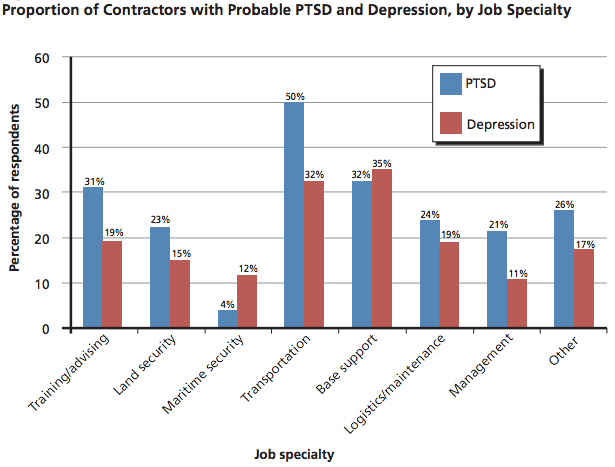
“The proportion of contractors who met criteria for PTSD or screened positive for depression was notably higher than that among military populations,” the Rand study concludes. One in four contractors surveyed probably had PTSD, the report says, but that rate doubled — to a sky-high 50% — for those operating convoys, “most likely due to greater combat exposure,” including ambushes and roadside bombs. Eighteen percent screened positive for depression and half reported abusing alcohol. Rand researchers conducted an anonymous online survey of 660 workers, nearly two-thirds of them American, who deployed at least once between 2011 and 2013. It marks the first survey of such contractors. …

Contract personnel can be a bargain: unlike troops, they generally are not entitled to government-funded help for any mental ailments that may have been triggered, or aggravated, by their civilian service. “There is a significant unmet need for health care, with only 28% of those with probable PTSD and 34% of those with probable depression receiving mental health treatment in the 12 months prior to the survey,” the report says.

Happiness Insurance

Charles Kenny points to research showing that, while having health insurance doesn’t always lead to better health outcomes, it does seem to make people happier:

The study suggested, unsurprisingly, that in places where out-of-pocket expenditures constitute a large portion of total health cost—compared to insurance and government financing—more households are burdened by high medical bills. In Brazil and Vietnam, out-of-pocket expenditures account for the considerable majority of total health spending, compared to about one-fifth of spending in the U.S. and less than 10 percent in the U.K. or Germany.

So perhaps it isn’t a surprise that expanding access to health insurance leads to fewer “catastrophic” expenditures—and greater happiness. In Thailand in the year 2000, 31 percent of households in which a member had required inpatient care faced health bills of more than 10 percent of the household’s total yearly consumption. The passage of a universal health insurance policy in 2001 reduced that proportion by half, to 15 percent.  And Patrick Asuming at Columbia University, who studied (PDF) a health insurance scheme in Ghana that covered hospital and clinic visits alongside approved medications, found that offering a random group of recipients subsidies for insurance led to more people getting insurance, better self-reported health (including fewer days feeling ill), and greater levels of contentment. Having such insurance increased the chance that recipients reported themselves happy or very happy by 22 percent.