“The Anti-Didion”

That’s what Heather Havrilesky dubs Nora Ephron after reading her anthology The MOST of Nora Ephron:

When everything fell to pieces for Didion—her husband of thirty-nine years died of a heart attack in 2003, and her daughter died of acute pancreatitis in 2005—her signature foreboding tone needed few adjustments. In The Year of Magical Thinking and Blue Nights, Didion describes these losses in the same melodramatic yet detached style that she once used to describe Los Angeles’ pristine blue skies as “the weather of catastrophe, of apocalypse,” or to capture the uneasy course of a family holiday in Hawaii, taken “in lieu of filing for divorce.” Didion’s unmatched dexterity as a writer hasn’t changed, but something feels wrong for the first time. Closing her last two books, it’s hard not to implore of the book-jacket photo, “But, Joan, how do you actually feel about all of this?”

Ephron, on the other hand, tells us exactly how she feels every step of the way—whether she’s clashing with her former boss, New York Post owner Dorothy Schiff, or reflecting on cheesecake and pot roast and the futility of making egg rolls that aren’t even as good as cheap Chinese takeout. Ephron does all this in the plainest language, with the least fanfare and the greatest amount of humor she can manage. Here is how she describes, to a reporter from the New Yorker, her mother’s death by cirrhosis, which was aided by an overdose of sleeping pills administered by her father:

“When that happened, I don’t know how to say this except . . . it was a moment of almost comic relief. It seemed entirely possible, in character, understandable, and I think we all filed it under Will I Ever Be Able to Use This in Anything.” Likewise, when Ephron discovered that her husband, Carl Bernstein, was cheating on her while she was pregnant with her second child, she translated that nightmare into the surprisingly giddy best-selling novel Heartburn, which subsequently became a film starring Meryl Streep and Jack Nicholson.

When life gave Ephron lemons, in other words, she made a giant vat of really good vodka-spiked lemonade and invited all of her friends and her friends’ friends over to share it, and gossip, and play charades. Whereas when life gave Joan Didion lemons, she stared at them for several months, and then crafted a haunting bit of prose about the lemon and orange groves that were razed and paved over to make Hollywood, in all of its sooty wretchedness—which is precisely what this mixed-up world does to everything that’s fresh and young and full of promise.

A reader responds to a recent post:

To me, the big difference between the experience of Joan Didion and that of the reader in your update, is the way their husbands died. One died of a sudden heart attack and the other from a terminal illness. It’s the sudden death that can totally upend you because it comes out of the blue, without any warning. With a terminal diagnosis, at least there’s some mental preparation for the worst even as you hold out hope – and pray – for your loved one’s recovery.
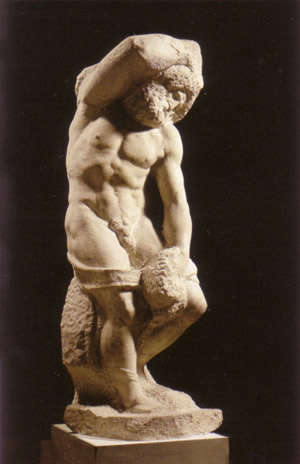
A Struggle Set In Stone

Morgan Meis turns his attention from Michelangelo’s David to his unfinished Slave sculptures, originally intended for the tomb of Pope Julius II:

Without knowledge of Michelangelo’s career, it would be impossible to know that David and The Slaves were created by the same man. The Slaves writhe and twist. It is often dish_michelangelo said that The Slaves are trying to escape from the stone in which they are trapped. Partly this is true. Michelangelo never finished the work that would have freed them. But even in finished form they would squirm and struggle against their fetters. What are these fetters? Probably they are the fetters of matter itself. Or worse. They are trying to escape from what they are. They are trying to escape from what is inside. Or not even trying to escape. Just struggling. Locked in a struggle that cannot be won. It is simply endured.

The Slaves twist and torque. The bodies do not stand up, as David does. They turn over on themselves. David glared out at the world, defiant in his self-regard. The Slaves collapse under the strain of regarding the self. The Slaves do not meet anyone’s gaze. There is no need to do so. There is no one to look at. The enemies are not out there. The Slaves twist around on their own axes.

This is the beginning of the infamous figura serpentinata, the “snake pose” of later Mannerist art. Artists after Michelangelo will contort the body, in sculpture and painting, into all manner of grotesque poses. It became a fad of sorts, the figura serpentinata. Looking at Michelangelo’s Slaves, however, we can only assume that he achieved the serpentinata by honest means. That’s to say, Michelangelo had his own serpent, turning and twisting, collapsing within. Not a fad, but a genuine spiritual struggle, the results of which are left to us in stone.

(Photo of The Bearded Slave by Michelangelo, 1525-1530, via Flickr user FLORENCEandTUSCANYtours)

Corpulent Commutes

In an excerpt from his book Happy City: Transforming Our Lives Through Urban Design, Charles Montgomery examines how road design affects our waistlines:

Consider Atlanta. The average working adult in Atlanta’s suburbs now drives 44 miles a day. (That’s 72 minutes a day behind the wheel, just getting to work and back.) Ninety-four percent of Atlantans commute by car. They spend more on gas than anyone else in the country. In a study of more than 8,000 households, investigators from the Georgia Institute of Technology led by Lawrence Frank discovered that people’s environments were shaping their travel behavior and their bodies. They could actually predict how fat people were by where they lived in the city. Frank found that a white male living in Midtown, a lively district near Atlanta’s downtown, was likely to weigh 10 pounds less than his identical twin living out in a place like, say, Mableton, in the cul-de-sac archipelago that surrounds Atlanta, simply because the Midtowner would be twice as likely to get enough exercise every day.

Here’s how their neighborhoods engineer their travel behavior:

Midtown was laid out long before the dispersalists got their hands on the city. It exhibits the convenient geometry of the streetcar neighborhood even though its streetcars disappeared in 1949. Housing, offices, and retail space are all sprinkled relatively close together on a latticelike street grid. A quart of milk or a bar or a downtown-bound bus are never more than a few blocks away. It is easy for people to walk to shops, services, or MARTA, the city’s limited rapid transit system, so that’s what they do.

But in suburbs like Mableton, residential lots are huge, roads are wide and meandering, and stores are typically concentrated in faraway shopping plazas surrounded by parking lots. Six out of every 10 Atlantans told Frank’s team that they couldn’t walk to nearby shops and services or to a public bus stop. Road geometry was partly to blame. Frank and others have found that that iconic suburban innovation—the cul-de-sac—has become part of a backfiring behavioral system.

Update from a reader:

I think it’s a bit of a jump of logic for Charles Montgomery to suggest that longer commutes and suburban-style road design affect our waistlines.  Sure, the white male living in Midtown Atlanta is likely to be 10 pounds lighter than his counterpart in Mableton, but is that because of walking habits, or self-selection?  That white male living in Midtown (Atlanta’s gay neighborhood, mind you) is also more likely to go to the gym, eat kale salads from Whole Foods, bike around town, and take extra pains to care about his appearance.  The white male living in Midtown is, probably, single and urban-minded, while the white male living in suburbia is almost certainly married with kids.  I don’t know Montgomery’s methodology, but there are a whole host of factors here other than road design.  The kinds of white males who choose to live in a vibrant, diverse and hip urban neighborhood are the kinds of white males who – to paint with very broad strokes – take care of their bodies, for reasons of vanity or health.

In any event, I defy you to find a gay neighborhood in the USA that isn’t remarkably fit compared to its suburban counterparts – to the consternation, I expect, of any number of gays who don’t really want to go to the gym every day, but have to keep up with the Joneses.

Carlin’s Catechetics

Hemant Mehta spots this passage from the just-released Conversations with Carlin, in which the late comedian looks back at the childhood religious experiences that helped lead him to atheism:

When you’re seven years old and preparing for your first communion, they tell you a lot of things about how the host is gonna be in your mouth, and it’s the body of Jesus, the body of God, and this will sanctify you, and you’ll feel different. You’ll feel the presence of God. Well, I did my first communion, and I went back to my pew, and I didn’t notice any of that. I noticed this wafer and I’m trying to be reverent, but it wasn’t transformative. So I noticed that. I think in retrospect, it began to make me a little less willing to just jump on everything they said and take the ride. I think I thought that there was an awful lot of exaggeration going on — an awful lot of fanciful talk and magic that they were trying to evoke. And they were always talking about pain and punishment and penance and suffering, and to me, that just didn’t fit. Somehow – and I said this on an early album — they were pushing for pain, and I was pulling for pleasure.

There were times when I still did what some people do who don’t believe well. You find some comfort in it. I would pray for something I wanted, and I would pray if I was scared, because it was a reflex. It was something I had learned, and it made me feel better. I think what that is when we do that is, we’re praying to ourselves — to our better selves. Some call it a higher self. I think the universe is all of us, and when we externalize this thing and call it God, it’s really a way of projecting ourselves onto another identity — onto our better, higher selves that pretty much know everything they need to know, and everything that’s good. So I think praying is all about finding that part of yourself. They call it God. It’s easier to organize people politically, and get them to believe a lot of other things, if you have them believing in an invisible man.

A Poem For Sunday

beginningoftrust

As mentioned yesterday, this weekend we’re featuring poems from debut collections of poetry. Below is “Beginning of Trust” from Waiting for Saint Brendan and Other Poems by David McLoghlin, published by the Irish press Salmon Poetry:

I’ve forgotten for how long now
I have fallen asleep
knowing you’ll be there tomorrow.
It influences even the way I breathe
and rest into dreams.

And I’m here,
listening to you breathe beside me
in the night light:
I’m here, looking at you,
amazed at your trust
in sleep, in love, in me.

I want to wake you
and tell you what has happened.

(From Waiting for Saint Brendan and Other Poems © 2012 by David McLoghlin. Reprinted with kind permission of Salmon Poetry. Photo by Peter Smida)

Quote For The Day

“There is no need to traverse earth and sky to find a wondrous object full of contrasts of infinite greatness and littleness, of deep gloom and amazing brightness, capable at the same time of arousing piety, wonder, scorn, and terror. I have only to contemplate myself; man comes from nothing, passes through time, and disappears forever in the bosom of God. He is seen but for a moment wandering on the verge of two abysses, and then is lost.

If man were wholly ignorant of himself he would have no poetry in him, for one cannot describe what one does not conceive. If he saw himself clearly, his imagination would remain idle and would have nothing to add to the picture. But the nature of man is sufficiently revealed for him to know something of himself and sufficiently veiled to leave much in impenetrable darkness, a darkness in which he ever gropes, forever in vain, trying to understand himself,” – Alexis de Tocqueville, Democracy in America.

A Bike’s Life

This embed is invalid


In the short film seen above, Chris McCoy and Adam Neustadter offer a whimsical look at mortality from the perspective of a bicycle. Scott Myers interviewed the duo:

Scott: What was the genesis of this project?

Chris: The original germ of the idea came from the fact that my bike kept getting stolen, and then I began hallucinating that I was seeing it around Los Angeles. I’d see a bike whiz by, I’d momentarily go that’s my bike!, and then I’d realize that it was not my bike and I was suffering from bicycle PTSD or something. I started thinking about what might have happened to my bike after it was taken, which was an idea I ended up discussing with Adam. We’d both wanted to work on something together for a long time, and telling the story of an inanimate object – and humanizing that object, making you feel sympathy for it – felt like an interesting challenge. So we began working on the script. …

Scott: Why give the Protagonist (the bicycle) an English accent?

Chris: There is actually quite a logical reason for the Bicycle having an English accent – the bicycle we used is a Raleigh, which are famously made in Nottingham, England. So of course it would have an English accent. It would be preposterous for it not to.

Adam: We also liked the implied backstory it gave the bike. How did this old British bicycle end up in Venice Beach? You know he must have had some hard miles to get to where we meet him.

How The Nativity Scene Was Born

BeagleCreche

We have St. Francis to thank for the humble crèche:

The only historical account we have of Francis’ nativity scene comes from The Life of St. Francis of Assisi by St. Bonaventure, a Franciscan monk who was born five years before Francis’ death. According to Bonaventure’s biography, St. Francis got permission from Pope Honorious III to set up a manger with hay and two live animals – an ox and an ass – in a cave in the Italian village of Grecio. He then invited the villagers to come gaze upon the scene while he preached about “the babe of Bethlehem.”

Francis’ display came in the middle of a period when mystery or miracle plays were a popular form of entertainment and education for European laypeople. These plays, originally performed in churches and later performed in town squares, re-enacted Bible stories in vernacular languages. Since church services at the time were performed only in Latin, which virtually no one understood, miracle plays were the only way for laypeople to learn scripture. Francis’ nativity scene used the same method of visual display to help locals understand and emotionally engage with Christianity. Within a couple of centuries of Francis’ inaugural display [in 1223], nativity scenes had spread throughout Europe.

A reader sent the above photo:

Don’t know if this would qualify for a Face of the Day or not, but I figured you’d appreciate this one. This elderly beagle has the run of the neighborhood. I came upon him in this cozy spot in a neighbor’s yard.

Mental Health Break

One of those fancy nature timelapses, best viewed in full screen:

This embed is invalid

Into The Atmosphere from Michael Shainblum on Vimeo.

Living in California all my life, I had as much time as I needed to really capture the essence and beauty it provides. This video was an ongoing project for about a year with an estimated 75,000 images taken, and about 12,400 made it into the 3.5 minute piece. My Grandmother Alice Harpin passed away during the last two weeks of shooting this video. The film is dedicated to her memory.

Calling Life Into Question

Ferris Jabr explains how he’s come to the conclusion that “life does not actually exist”:

Why is defining life so frustratingly difficult? Why have scientists and philosophers failed for centuries to find a specific physical property or set of properties that clearly separates the living from the inanimate? Because such a property does not exist. Life is a concept that we invented. On the most fundamental level, all matter that exists is an arrangement of atoms and their constituent particles. These arrangements fall onto an immense spectrum of complexity, from a single hydrogen atom to something as intricate as a brain. In trying to define life, we have drawn a line at an arbitrary level of complexity and declared that everything above that border is alive and everything below it is not. In truth, this division does not exist outside the mind. There is no threshold at which a collection of atoms suddenly becomes alive, no categorical distinction between the living and inanimate, no Frankensteinian spark. We have failed to define life because there was never anything to define in the first place.

Jabr isn’t alone in this line of thinking:

I nervously explained these ideas to [Scripps Research Institute researcher Gerald] Joyce on the phone, anticipating that he would laugh and tell me they were absurd. After all, this is someone who helped NASA define life. But Joyce said the argument that life is a concept is “perfect.” He agrees that the mission to define life is, in some ways, futile. The working definition was really just a linguistic convenience. “We were trying to help NASA find extraterrestrial life,” he says. “We couldn’t use the word ‘life’ in every paragraph and not define it.”

Carol Cleland, a philosopher at the University of Colorado Boulder who has spent years researching attempts to deliniate life, also thinks that the instinct to precisely define life is misguided—but she is not yet ready to deny life’s physical reality. “It’s just as premature to reach the conclusion that there is no intrinsic nature to life as it is to define life,” she says. “I think the best attitude is to treat what are normally taken as the definitive criteria of life as tentative criteria.”