Faces Of The Day

dish_familyportrait

For his series Generations, photographer Julian Germain captures 4 or 5 generations in one family portrait.  Writing in 2005, Tom Shakespeare praised Germain’s work:

Photography captures a single moment in time. But the work of Julian Germain succeeds in raising questions about time passing which bring together past, future and present within the single image. He has succeeded in using portraiture to explore the particular and the specific in a way that eloquently poses questions about the life of every viewer, sending us away moved and challenged. His work explores not just the individual lifespan from birth to death, but also the context of family and society, which gives meaning to personal stories.

(Photo by Julian Germain)

Should Atheists Be Transhumanists?

Controversial novelist Zoltan Istvan argues in the affirmative, asserting that “atheist voices and their writings have paved the way” for the age of transhumanism. He defines “the core of transhumanist thought”:

It begins with discontent about the humdrum status quo of human life and our frail, terminal human bodies. It is followed by an awe-inspiring vision of what can be done to improve both — of how dramatically the world and our species can be transformed via science and technology. Transhumanists want more guarantees than just death, consumerism, and offspring. Much more. They want to be better, smarter, stronger — perhaps even perfect and immortal if science can make them that way. Most transhumanists believe it can. … If you don’t care about or believe in God, and you want the best of the human spirit to raise the world to new heights using science, technology, and reason, then you are a transhumanist.

Peter Lawler nods, writing that “what Ishtan says makes some sense”:

It seems to me, however, that a philosopher today would still be on firm ground in thinking that transhumanist hope of particular persons around today is no more reasonable that the Christian hope for personal salvation.  From that view, transhumanism isn’t really so atheistic.  The hope is that we can transform ourselves into the functional equivalent of gods.

Brendan Foht isn’t convinced that atheism and transhumanism are naturally linked:

Istvan is certainly right that transhumanists are motivated by a sense of disappointment with human nature and the limitations it imposes on our aspirations. He’s also right that transhumanists are very optimistic about what science and technology can do to transform human nature. But what do these propositions have to do with atheism? Many atheists like to proclaim themselves to be “secular humanists” whose beliefs are guided by the rejection of the idea that human beings need anything beyond humanity (usually they mean revelation from the divine) to live decent, happy, and ethical lives. As for the idea that we cannot be happy without some belief in eternal life (either technological immortality on earth or in the afterlife), it seems that today’s atheists might well follow the teachings of Epicurus, often considered an early atheist, who argued that reason and natural science support the the idea that “death is nothing to us.”

Previous Dish on transhumanism here, here, and here.

Bertrand Russell’s Brand Of Unbelief

http://youtu.be/WqyVrJtM7Ik

Despite the philosopher’s reputation as a staunch unbeliever, Clare Carlisle argues that he walked the line between atheism and agnosticism:

[T]he same intellectual integrity that made Russell unable to accept religious beliefs also prevented him from embracing atheism. Rather like the 18th-century Scottish philosopher David Hume, Russell maintained a sceptical attitude to metaphysical questions. He explains this position very clearly in a 1953 essay on his agnosticism, where he states that, “it is impossible, or at least impossible at the present time, to know the truth in matters such as God and the future life with which Christianity and other religions are concerned.” …

Although Russell often seems in his writings to be drawn towards a quasi-atheist position, his own agnosticism is reinforced by his recognition that the word “religion” does not have a very definite meaning. “If it means a system of dogma regarded as unquestionably true,” he writes, “it is incompatible with the scientific spirit, which refuses to accept matters of fact without evidence, and also holds that complete certainty is hardly ever attainable.” The agnosticism article was published at a time when critics of religion were often assumed to be communists; Russell counters this suggestion by pointing out that the kind of communism advocated by the Soviet government fits his definition of dogmatic religion, and that therefore “every genuine agnostic must be opposed to it”. It is clear that a passionate aversion to dogmatism runs through both his critique of religious oppression and moralism, and his more positive doctrine of philosophical agnosticism. Russell sometimes seems to be moving towards the view that how ones believes, and not just what one believes, is ethically significant – a view that will be embraced by any reflective religious person.

Previous Dish on Russell here, here, and here.

Ruling On Religion

This week, a Supreme Court ruling in the UK found that a Church of Scientology chapel qualified as a “place of meeting for religious worship,” and could therefore be legally registered as a place of marriage. Nelson Jones provides background and analysis:

The clear message in [the new] judgement is that these definitions of religion and worship, based as they are largely on the Christian model, are no longer appropriate in a religiously plural society. Ideas about God, noted Lord Toulson, were more properly the stuff of “theological debate” than questions for the law to unravel. Instead of worrying about whether or not the object of veneration of a group calling itself a religion fits into conventional ideas of what a god is, Toulson adopted a fairly ad hoc test. For him, religion was to be described, rather than defined, as “a spiritual or non-secular belief system, held by a group of adherents, which claims to explain mankind’s place in the universe and relationship with the infinite, and to teach its adherents how they are to live their lives in conformity with the spiritual understanding associated with the belief system”.

Scientology, whatever you think of it, ticks all these boxes.

Slightly more controversial, to some, was Toulson’s comparison of Scientology to Buddhism, in that both systems aim at achieving enlightment. Buddhism has an Eightfold Path, while L Ron Hubbard’s system is “aimed ultimately at complete affinity with the [eighth] dynamic or infinity”. It’s worth noting here that the judgement takes its information about Scientology entirely from materials submitted by a minister at the chapel that requested registration, Laura Wilks, rather than, say, the more critical account recently published by the BBC’s John Sweeney. It was an analysis of marriage law rather than the pros and cons of [Church of Scientology leader] David Miscavige’s international organisation.

Andrew Brown remains doubtful that Scientology qualifies as a religion:

The main thing, I think, is the separation of worship from any condition of moral benefit. Satanists clearly qualify as a religion under Toulson’s rules. But this, in turn, means that a religion is not automatically a charity. As I understand it, that’s also the legal position. Whether you qualify as a religion for marital purposes is independent of whether you qualify as one for charitable purposes and thus gain various tax advantages. … [T]his legal and conceptual distinction is very important. We may not want the state to judge the truth of myths. We certainly still need it to have an opinion on their effects.

Would Math Exist Without Us? Ctd

A reader writes:

I found your post quite interesting. This was a concept that I was first introduced to by my philosophy professor in college. As a matter of fact, I was once again reminded of this concept when I recently read one of your posts titled “The Inevitability in Beauty,” and have been thinking about it ever since. It seems like much of what we may erroneously believe was a work of creation was in fact a work of discovery. Pythagoras discovered the Pythagorean theorem, and Beethoven discovered his Fifth Symphony, as much as Newton merely discovered gravity, as opposed to creating it. I would even go so far as to say that individuals like Nelson Mandela, Harvey Milk, and Susan B. Anthony merely discovered new dimensions of justice. What they fought for would have been just whether or not they actually fought for them, or whether or not they were even born. Finally, as someone who is interested in Islamic Mysticism, and enjoys your Sunday posts because of your interest in Christian and Catholic Mysticism, I will go so far as to say that Jesus discovered grace. God’s grace already existed before the birth of Jesus, and Christ’s genius was in recognizing the immense love that God already had for his children.

Another has a very different take:

You do know that this is an old argument against religion – one used by Hitchens, among others? On the wild chance you were unaware of it, the argument goes like this:

If you wipe out all trace of humanity and a new race of intelligent animals learn to use tools and agriculture and build cities, they will recreate science and math identically to ours.  Maybe not in the same order, but they will discover the same truths that we did.  They will have Newtonian physics and they will have evolution and they will link bacteria and viruses to particular illnesses.  They will come up with geometry and calculus that match ours exactly.

However, there will not be a Christianity; there will not be an Islam; there will not be a Buddha. There may be some similarities between their history of religion and ours – an evolution from nature spirits to pantheon gods to monotheistic religions.  But the specific details would be different.  Things like the trinity seem particularly unlikely to be replicated in this new world even while something as complex as calculus will be.  It is the nature of the differences between the two systems, one that requires evidence and replication and the other that requires none.

But this is not an argument against religion. It is an argument for ecumenism.

Jewish Without Judaism?

Rachel Silberstein explores the philosophy of David Silverman, president of American Atheists, who argues that one can’t be a Jew and an atheist at the same time:

The late Christopher Hitchens once observed that a great number of the most influential atheists throughout history, from Marx to Einstein, were Jews: “I think it’s a Jewish duty, since the curse of monotheism was first inflicted on us by the Jewish people,” he told Jeffrey Goldberg in one of his final interviews. “It’s very good that it should be repudiated by them to a great extent.” Silverman disagrees, but only slightly. “He used the word wrong,” he said. “They are not Jews, they are children of Jews. Just as I am not a Jew, I am a child of Jews.”

This is the conclusion Silverman came to over the past two years while writing his new book, I, Atheist: America’s Loudest Heathen Fires Back. … Previously outspoken about the compatibility of cultural Judaism and atheism, Silverman found that, in trying to write his chapter on Jewish atheism, he … ultimately concluded that Judaism is, at its heart, a religion—one that is incompatible with atheism. He notes that much of what is defined as Jewish culture, such as music or food, is simply Judaism-the-religion “taking credit” for a geographically specific regional culture—Ashkenazic culture primarily being simply Eastern European, for instance. The only thing world Jewry has in common is the Torah, he says, and as a religious doctrine, the Torah cannot be reconciled with atheistic values. “I see Judaism more malevolently than I used to,” he said. “Judaism is no better than any other religion.” And so, the man who was once America’s most prominent Jewish atheist now says he is no longer a Jew.

Back To An Islamic Future?

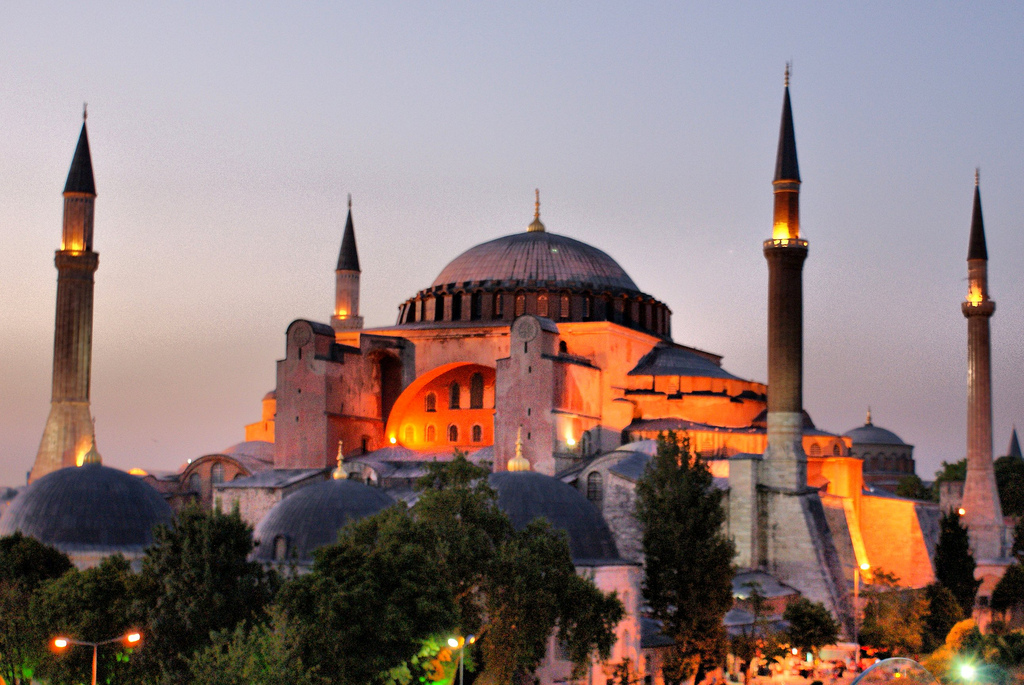
hagiasophia

The Hagia Sophia in Turkey served as a Christian church from 537 AD until 1453, when Constantinople was conquered by the Ottoman Turks, who turned it into a mosque. Since 1935, it has been a museum, a decision made by secular Turkish leaders. Jacob Resneck reports on the efforts afoot in Turkey to turn the Hagia Sophia back into a place of Muslim worship:

Some critics say the spate of conversions of Byzantine-era Christian houses of worship from museums to mosques reflects the government’s payback against Turkey’s former secular military elite, which has historically jailed leaders of religious parties and staged coups against elected governments.

“It is mostly a challenge to the secular rulers of Turkish republic,” said Engin Akyurek, a professor of Byzantine art at Istanbul University. The government “re-converts church-mosques which were used as museums during the republican era so it is related to the domestic politics,” he said.

Terry Mattingly offers further background:

The problem, of course, is that many Muslims — some would say “most,” rather than “many” — believe that it is impossible under Sharia law for a worship space that has been used as a mosque to ever be used for another purpose. Obviously, the secular leaders of Turkey would have never considered allowing Haggia Sophia to be used, once again, as one of the world’s greatest cathedrals.

[Resneck’s] report notes that the primary tensions that are driving this story appear to be WITHIN ISLAM, as opposed to another round of tensions between Muslims and Turkey’s tiny oppressed Christian population.

Dreher condemns the efforts to re-purpose the site:

There is no need to do this.

None. It is an act of cultural imperialism, nothing more. The Islamists simply want to rub the noses of secularists and Christians in their powerlessness under the new Islamist order. It is true that in ages past, triumphant religions made their own temples out of the temples of the defeated. The Church did this to many pagan temples, and, notably, seized the grand Cordoba mosque in the Reconquista, and turned it into a church. Neither Christians nor Muslims have clean hands in these matters.

That said, nearly a century ago, the secular rulers of Turkey made the generous decision to make the Hagia Sophia, which stood as one of the world’s great Christian churches for 1,000 years, into neutral ground between the religions. That part of Istanbul is home to glorious mosques, most notably the famed Blue Mosque.  There are plenty of beautiful and historic places for Muslims to pray in that part of Istanbul. The Hagia Sophia stands today as a monument, not a house of worship. I have been there. Were it still a mosque, that would be one thing. But again, for most of the last century it has been a museum. What is wrong with that? We live in a different era now, an era in which among advanced countries, this kind of thing is not supposed to happen.

(Photo of the Hagia Sophia by David Spender)

Giving Jesus The Wikipedia Treatment

In an interview, Steven Skiena and Charles Ward, authors of Who’s Bigger? Where Historical Figures Really Rank, explain how they developed a ranking system that attempts to quantify human significance.  Their analysis finds that Jesus was the most historically significant person who’s ever lived:

We do not answer these questions as historians might, through a principled assessment of their individual achievements. Instead, we evaluate each person by aggregating the traces of millions of opinions in a rigorous and principled manner. We rank historical figures just as Google ranks Web pages, by integrating a diverse set of measurements about their reputation into a single consensus value.

Significance is related to fame but measures something different. Forgotten U.S. President Chester A. Arthur (who we rank at 499) is more historically significant than young pop singer Justin Bieber (currently ranked 8,633), even though he may have a less devoted following and lower contemporary name recognition.

We would call Jesus “the most significant person ever.” We measure meme strength, how successfully is the idea of this person being propagated through time. With over two billion followers a full 2,000 years after his death, Jesus is an incredibly successful historical meme.

You can explore the Bigger webpage here, which includes the data that informs the book and arranges rankings by category and country. Cathy Lynn Grossman unpacks the methodology – and notes what it misses:

Wikipedia and Google ngrams (a searchable collection of words in scanned English language books) are the basis of the “Bigger” research — and also the source of its bias toward the Anglo-American, English-language version of history in books and online.

Relying on Wikipedia, where only 15 percent of editors are women and user-generated data can be riddled with errors, is also a risky choice, critics have noted.

This methodology … crimped the authors’ ability, for example, to rank the Dalai Lama. The current leader of Tibetan Buddhism was often listed by his official title, the 14th Dalai Lama, which is a status, not an individual, in the data. That meant his ranking couldn’t be calculated.

Cass Sunstein is unimpressed. He concludes that “Skiena and Ward have produced a pretty wacky book, one that offers an important warning about the misuses of quantification”:

Wikipedia is an immensely valuable and in some ways astonishing resource; and if the goal is to measure what interests people, it is hardly senseless to consult it. But Wikipedia itself reports that in October 2010 it had about 116,000 editors (who made at least one edit), and there is no reason to think that the interests and concerns of those 116,000 people—as measured in October 2010—are an accurate reflection of the interests and concerns of the planet’s seven billion people. As I have noted, Skiena and Ward used the English-language version of Wikipedia, but there are more than 280 other versions, and other Wikipedias would likely produce different rankings. If the goal is to learn about worldwide fame or significance, it is more than a bit strange to rely exclusively on the English-language version of Wikipedia. At most, the resulting rankings reflect only the preoccupations of the English-speaking world, and mainly the United States. Surely Jesus would not have done so well in China, to say nothing of all those American presidents. What Skiena and Ward have really done is take a particular version of Wikipedia, as of a certain day in 2010, and use a statistical model from Ngram to project changes, over time, from specific measures of Wikipedia “fame” on that day. It is a nice trick, but it doesn’t help us to rank historical figures in terms of significance.

The War On Yoga?

India’s Supreme Court is considering whether or not yoga, a Hindu practice, should be part of the secular country’s public school curriculum. Mark Movsesian explains that in traditional yoga, religious and secular elements of the practice are inseparable:

In traditional understanding, yoga is itself a religious act. The postures themselves lead the practitioner to God, whether the practitioner intends this or not. In traditional understanding, in other words, one can’t separate the religious and secular aspects of yoga and one really shouldn’t try. Indeed, some American Hindus object to the way our popular culture treats yoga as a designer gym routine. Much as many American Christians seek to “Keep Christ in Christmas,” the Hindu American Foundation has mounted a campaign to “Take Back Yoga” for the faith.

Dreher says he’s “with the Hindus on this”:

I don’t see how it is possible to separate yoga from religious practice — and as a practicing Christian, I would not participate in it, nor would I allow my children to participate in it. To do so would be a violation of conscience. I have friends who are either Christian or secular who practice yoga, and don’t believe there is any spiritual content to it. I respect that. But I disagree.

In Orthodox Christianity, there are some prayer rules that involve the Jesus Prayer, and many prostrations. That is, they involve the meditative use of the phrase “Lord Jesus Christ, have mercy on me,” or some version thereof, along with making the sign of the cross, and bending and moving in ways that look like calisthenics. You could claim, I suppose, that following such a prayer rule is not really religious, if you just use the Jesus Prayer as a kind of contentless mantra. The idea would be not that the words are an actual petition to Jesus, who may or may not exist (the argument would go), but that these words were simply used as a way to calm and focus the mind.

A commenter on Rod’s blog adds:

Most Hindus I know have no resentment towards westerners using Yoga exercises for health or ordinary forms of contentment. They don’t consider that the same as genuine Yogic practice, but neither is there something sacred about the poses and exercises themselves, which are only a small and relatively superficial aspect of Yoga. In fact, part of the history of modern Hatha yoga as practiced in the west is that it’s very much a hybrid created in large part by the British in India over recent centuries, incorporating aspects of British calisthenics and other exercise regimens with traditional Yoga.

My recommendation would be to take an open-minded approach, and use whatever aspects of yoga are helpful to one’s health, and to one’s spiritual practice, whatever one’s religion might be. … It would be a mistake to impose upon these basic physical practices some sort of sacred character or unbending theological significance that they just don’t have, even in the traditional sense.