The Literary Mandela

Imraan Coovadia reads into the late leader’s appreciation for Tolstoy:

Mandela was not an intellectual reader, reading for the sake of reading, but he found books useful. He found novels useful. As President he would stop his driver so that he could buy some novel at the bookshop. “One book that I returned to many times was Tolstoy’s great work, War and Peace,” he wrote. “I was particularly taken with the portrait of General Kutuzov, whom everyone at the Russian court underestimated.” For Mandela, Kutuzov “made his decisions on a visceral understanding of his men and his people.” He was prepared to sacrifice the city of Moscow when it became necessary. Mandela even compared Kutuzov with King Shaka, who was also uninterested in making a stand to defend mere buildings. The real-life Mikhail Illarionivich Golenischchev-Kutuzov (1745–1813), field marshal of the Russian empire, was of no importance to Mandela, but Tolstoy’s character was. …

Key for Mandela was the strategy of retirement and passivity that Tolstoy’s Kutuzov applied so thoroughly as to surrender to the overwhelming force of collective and unplanned life. He saw that “circumstances are sometimes stronger than we are,” resembling Lincoln, who accepted that “events have controlled me.” His principal weapons were not military. “‘Patience and time, these are my mighty warriors!’ thought Kutuzov,” who “used all his powers to keep the Russian army from useless battles.” He accomplishes the destruction of the French invasion force, or rather allows it to be accomplished by objective historical forces, because he understands and incarnates the truth: “The source of this extraordinary power of penetration into the meaning of events taking place lay in that national feeling, which he bore within himself in all its purity and force.” When Napoleon’s Grande Armée was defeated, his fate is summary. “For this Russian man, as a Russian, there was nothing more to do. For the representative of the national war there was nothing left but death. And so he died.” Nobody could be so summary about Nelson Rolihlahla Mandela, 1918 to 2013, who bore within himself “national feeling . . . in all its purity and force.”
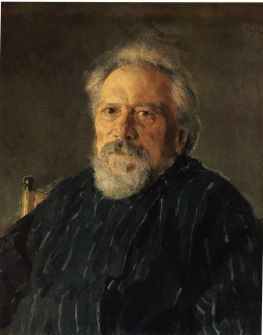
An Unknown Russian Master

Eileen Battersby introduces the work of Nikolai Leskov, a contemporary of Tolstoy who is “often referred to as Anton Chekhov’s favourite writer”:

“Storyteller” is the most apt word for Leskov. He does not invent so much as relate. His yarns are dish_leskovinspired by things he saw and heard while spending an intense two years travelling throughout old Russia as a young man. He was a natural sponge, eyes out onstalks, missing nothing and grasping the essential ambivalence of life and art. Structure and form did not interest him; his impulse was to hold an audience. … Leskov was religious yet detested ecclesiastical bureaucracy just as he resented political oppression. When his travelling came to a[n] abrupt end – he had been working for his uncle, who could no longer afford to employ him – Leskov moved to St Peterburg and became a prolific journalist.

Never the reactionary he was considered to be, he was very outspoken – as are his characters, none more so than the eponymous narrator of The Enchanted Wanderer, a sinner doomed to be dying without the relief of death. That title piece dominates this astutely chosen selection because of its novella length and its unforgettable narrative voice of a giant man who, having killed an elderly monk by mistake when he was a boy, has endured a picaresque nightmare of a life. Best read at a single sitting, it offers a fabulous entry not only into Leskov’s work but also into the Russia that produced him. All the energy, hunger and chaos created by the vast underbelly of a peasant population still existing within the hardship of serfdom festers though the narrative.

(Portrait of Leskov by Valentin Serov, 1894, via Wikimedia Commons)

A Short Story For Saturday

The opening lines of Ernest Hemingway’s “The Snows of Kilimanjaro,” written in 1938:

“The marvelous thing is that it’s painless,” he said. “That’s how you know when it starts.”

“Is it really?”

“Absolutely. I’m awfully sorry about the odor though. That must bother you.”

“Don’t! Please don’t.”

“Look at them,” he said. “Now is it sight or is it scent that brings them like that?”

The cot the man lay on was in the wide shade of a mimosa tree and as he looked out past the shade onto the glare of the plain there were three of the big birds squatted obscenely, while in the sky a dozen more sailed, making quick-moving shadows as they passed.

“They’ve been there since the day the truck broke down,” he said. “Today’s the first time any have lit on the ground. I watched the way they sailed very carefully at first in case I ever wanted to use them in a story. That’s funny now.” “I wish you wouldn’t,” she said.

The story also can be found in The Complete Short Stories of Ernest Hemingway. The Dish recently featured other short stories here, here, here, here, and here.

Megyn Kelly Spins, Fails

HitlerMaryWithJesus

I have to say there have been moments when I’ve thought Megyn Kelly was a real blast of fresh air in the fetid, morning-breath swamps of cable news: whip-smart, mildly sassy, occasionally rebellious, she is a real star on the propaganda network of the GOP/Tea Party. So I wondered how she would respond to her rather unfortunate assertions this week that both Santa Claus and Jesus Christ were “white”. Here’s the original segment. Here is her response.

I’d say two things. The original segment was clearly not as light-hearted and humorous as Kelly now insists it was. She did not originally refer to the Slate piece as “tongue-in-cheek” and responded to its provocation by being offended, not amused. Since both tapes are out there, make your own mind up. But rather than cop to an obvious error – made off the cuff – she made the decision to hunker down and accuse others of persecuting Fox News because it isn’t liberal. So the classic and silly notion that white Republicans are somehow an oppressed class – and minorities should just stop whining – became her “correction.” But that’s not a correction. It’s a distraction.

More to the point, the much more disturbing assertion that “Jesus was white” – something Kelly injected into the conversation all by herself – is left hanging. She claims in one aside in her response that the question “is not settled.” But it is. Jesus was a first century Jew. He’s not a northern European. He was Semitic, not Caucasian. Now maybe Kelly will unpack why she may believe that Jews are somehow “white” in her racial categorization of humanity, while, say, Hispanics are not. But it seems likely she won’t. That would open a very large box of premises Roger Ailes prefers to keep vacuum-wrapped.

So she screwed up – which we all do. But on the core measure of whether she could fairly cop to her screw-up, correct and apologize for it, she failed. I tend to think that how journalists respond to error is more instructive than how they report and analyze in factually impeccable fashion. On that count, Kelly emerged this week as a flak and a hack. I guess I was foolish for hoping for more.

(Painting: Mother Mary with the Holy Child Jesus Christ, Oil/canvas, 1913. By Adolf Hitler.)

The View From Your Window Contest

vfyw_12-14

You have until noon on Tuesday to guess it. City and/or state first, then country. Please put the location in the subject heading, along with any description within the email. If no one guesses the exact location, proximity counts.  Be sure to email entries to contest@andrewsullivan.com. Winner gets a free The View From Your Window book or two free gift subscriptions to the Dish. Have at it.

Keeping The Black Market Clean

Despite the ominous hijacking of a truck filled with radioactive material earlier this month, The Economist reports that the chances of someone detonating a “dirty bomb” are slim and getting slimmer:

By many accounts, the most plausible dangers appear to be declining. For a start, an “overwhelming” number of buyers turn out to be undercover cops, says Mark Hibbs of the Carnegie Endowment for International Peace, a think-tank. A sizeable network of informers helps Georgia’s interior ministry to keep a close eye on the four or five cells in the country currently trying to obtain or sell radiological material, says Mr Pavlenishvili. When one of them is lining up a potential deal, it is almost always because his or a foreign unit is preparing a sting operation, he adds. Mr Pavlenishvili’s unit has not got wind of a single profitable sale – Georgia’s underworld makes its money on other crimes such as drug-running.

Considering the growing risk and persistent lack of money to be made, it is amazing that smugglers continue to give it a shot, says Lyudmila Zaitseva, an academic working on a University of Salzburg database on nuclear and radiological trafficking.

Many traffickers no doubt reckon that terror groups will pay dearly for dirty-bomb ingredients. After all, counterterrorism officials citing seized al-Qaeda documents have said as much. Yet although a terrorist-made dirty bomb of mass destruction cannot be excluded, it remains unlikely. For one thing, rooting around to obtain dangerously radioactive material is a great way to attract the attention of the authorities. A bust could doom a painstakingly assembled terror cell.

In any case, most of the stuff being peddled is fraudulent rather than dangerous, says Adrian Baciu, head of the Romanian police’s nuclear and radiological unit until 2004 (he later worked for four years in Interpol’s counter-terrorism directorate). To hype their products, sellers typically describe it as material used in a nuclear bomb, a reactor, the Space Shuttle or the like. “Excuse my language … just bullshit,” says Mr Baciu. In one sting, he arrested four men trying to sell, for several hundred thousand dollars, material from a calibration kit for radiation-detection equipment. It could be safely handled with cotton gloves. Another cell tried to pass off as dangerously radioactive a piece of ordinary iron. Trafficking in Romania, he says, has tapered to almost nothing.

A Poem For Saturday

Diamonds last forever but a blossom is beautiful too

This weekend we’ll be featuring poems from exciting debut collections. The first is “To a Camellia Blossom” from She Has a Name by Kamilah Aisha Moon, just published by Four Way Books:

I saw your pretty head lying
beneath the bush. Without
thinking, I kneeled
and cradled you, petals sighing
into grateful palms.  Beauty face down
is an abomination. Why
must you suffer the weight
of early perfection?  Your vividness
lifts me, lifts all. I wanted
to hold you. Just like that.
Until. I know this kind
of blooming well, to be
so lush, insides so swollen with life
that what was meant to hold you up
can’t. I wasn’t meant
to hold you, yet here we are
on this stray, brisk day in April
trembling and fulfilled, unlikely
and true. Before I knew what
to call you, I reached and imagined
season after season.  Unmoored.

(From She Has a Name © 2013 by Kamilah Aisha Moon. Reprinted with kind permission of Four Way Books. Photo of a Camellia Theaceae blossom by Thomas Mueller)

The Internet Is For Robots

Bot Traffic

A new report from web security company Incapsula shows that as much as 61% of web traffic is from bots, not real people. Frederic Lardinois unpacks it:

At first glance, this sounds like this means the number of nefarious attacks is up, but Incapsula actually notes that the bulk of growth in this number is due to what it calls “good bots.” Visits from certified agents from search engines and similar tools increased from 20 percent to 31 percent, for example. According to Incapsula, many search engines have lately increased their sampling rates. In addition, the SEO tools that try to help websites rank higher once they are crawled, also now often visit sites more often than ever before.

He adds an important caveat, that “Incapsula gathered this data by looking at stats from its own 20,000 customers” and that “companies that sign up for the kinds of security services the company offers may not be exactly representative of the Internet as a whole.” Still, Alexis Madrigal worries about the bots impact on the digital economy:

The point is: It’s so easy to build bots that do various things that they are overrunning the human traffic on the web. Now, to understand the human web, we have to reckon with the logic of the non-human web. It is, in part, shady traffic that allows ad networks and exchanges to flourish. And these automated ad buying platforms — while they do a lot of good, no doubt about it — also put pressure on other publishers to sell ads more cheaply. When they do that, there’s less money for content, and the content quality suffers. The ease of building bots, in other words, hurts what you read each and every day on the Internet.

Presidents Under The Stethoscope

Rose Eveleth flags a treasure trove for American history buffs, a curious website by “Doctor Zebra” that allows visitors to “peruse the weird medical history of every single U.S. President”:

President are people, and they struggled with the same illnesses and bad habits as the rest of us. And this one website chronicles them all—the weird bodily ailments of every United States President. The site might not be the prettiest, but it’s got all the information there. From John Adams’s baldness to Herbert Hoover’s problem with performing his handshaking duties. Seriously:

The annual White House reception, in which Hoover had to shake hands with thousands of visitors, was a problem. His hand was at times so swollen that he could not write for days. Once he received a bad cut from a diamond ring that was turned inward; the reception was abruptly halted.

The list also has serious ailments like throat cancer, scarlet fever and sudden death. You can also sort by organ system, and see just which presidents had trouble with eyes, ears, hair and heart. Surprisingly, while 16 presidents are listed as having problems with alcohol (John Quincy Adams, Martin van BurenWilliam HarrisonMillard FillmoreFranklin PierceJames BuchananAndrew JohnsonUlysses GrantRutherford HayesChester ArthurGrover ClevelandWilliam TaftFranklin RooseveltGerald FordRonald ReaganGeorge W. Bush), only two are listed as having liver problems (Zachary Taylor and John Kennedy).

Explore more of the site here.

Singing The Praises Of Llewyn Davis

Jack Hamilton gives a rave review of the new Coen brothers movie:

Inside Llewyn Davis is easily the best film ever made about the folk revival, and it’s also one of the very best films ever made about music, period. For a movie about authenticity obsessions that recreates its place and period with exacting detail, its soundtrack isn’t much for slavish verisimilitude: [lead actor] Oscar Isaac’s singing voice is far more indebted to Jeff Buckley (still a twinkle in his folksinging father’s eye in 1961) than [folk legend Dave] Van Ronk or even Bob Dylan. These anachronisms strangely work, making the music feel newly vital while honoring the spirit and conviction of the period. And the film’s performance sequences are luxurious and fully real: they’re not cut short by impatient edits, hitched to montages, or bludgeoned into bold-faced Turning Points.

Tomas Hachard appreciates that the film shows that “some people faced private tragedy and inner turmoil even in the open-minded, happy-go-lucky 1960s, and many came out just as lost as when they entered”:

Inside Llewyn Davis’s main character is not destined to lead an artistic movement, even if he has the views for it: Though he’s secure in his convictions, Llewyn is insecure in life. He wanders from couch to couch in New York like a man in permanent limbo. The characters around him can seem archetypal and cartoonish at first, until you realize that we’re seeing them through Llewyn’s eyes, filtered by his preoccupations and rigid determinations of how the world should work. For example, when Jean (Carey Mulligan), his friend, fellow musician, and sometime lover, shares that she might one day like to settle down in the suburbs with kids and that playing music may just be a way to get there, Llewyn tells her, “It’s a little careerist, it’s a little square, and it’s a little sad.”

Eileen Jones finds that the movie’s “themes of hardship, joblessness, pinched resources, scarce opportunities, and swiftly lowering expectations” still resonate today:

Though the film is set in 1961, it’s not a 1961 we’ve ever seen posited in any other period film that readily comes to mind. Here is no vision of the “Camelot” presidency of JFK, of martini-drinking advertising executives in sleek suits, or even of the comparatively flourishing folk music scene in its Bob Dylan heyday. Here is an alternate vision of America in its great era of prosperity. The Coens have made a movie about failure in an era when, the standard pop-histories tell us, nobody really failed. They continue to look at the struggle of those on the margins, at failure among bungling strivers with grandiose dreams. The directors somehow maintain their faith that we’ll actually be interested enough in our own lived experience to appreciate their black comic vision of it.

In spite of its main character’s hardships, J. Hoberman calls the movie “certainly [the Coen brothers’] warmest film in the 16 years since The Big Lebowski“:

Crashing on couches, mooching meals, and obtusely refusing to “sell out,” poor Llewyn is one more hapless Coen protagonist. The folk singer is alternately sullen and pugnacious; having just put out an album titled Inside Llewyn Davis that no one seems interested in buying, he doggedly pursues an apparently hopeless career in a dead-end scene, amply stocked with colorful grotesques. … The Coens have characterized Inside Llewyn Davis as an exercise in futility, “an odyssey in which the main character doesn’t go anywhere.” The movie is in fact a prolonged flashback to the protagonist’s moment of triumph and the ignominious defeat that inevitably follows.