Face Of The Day

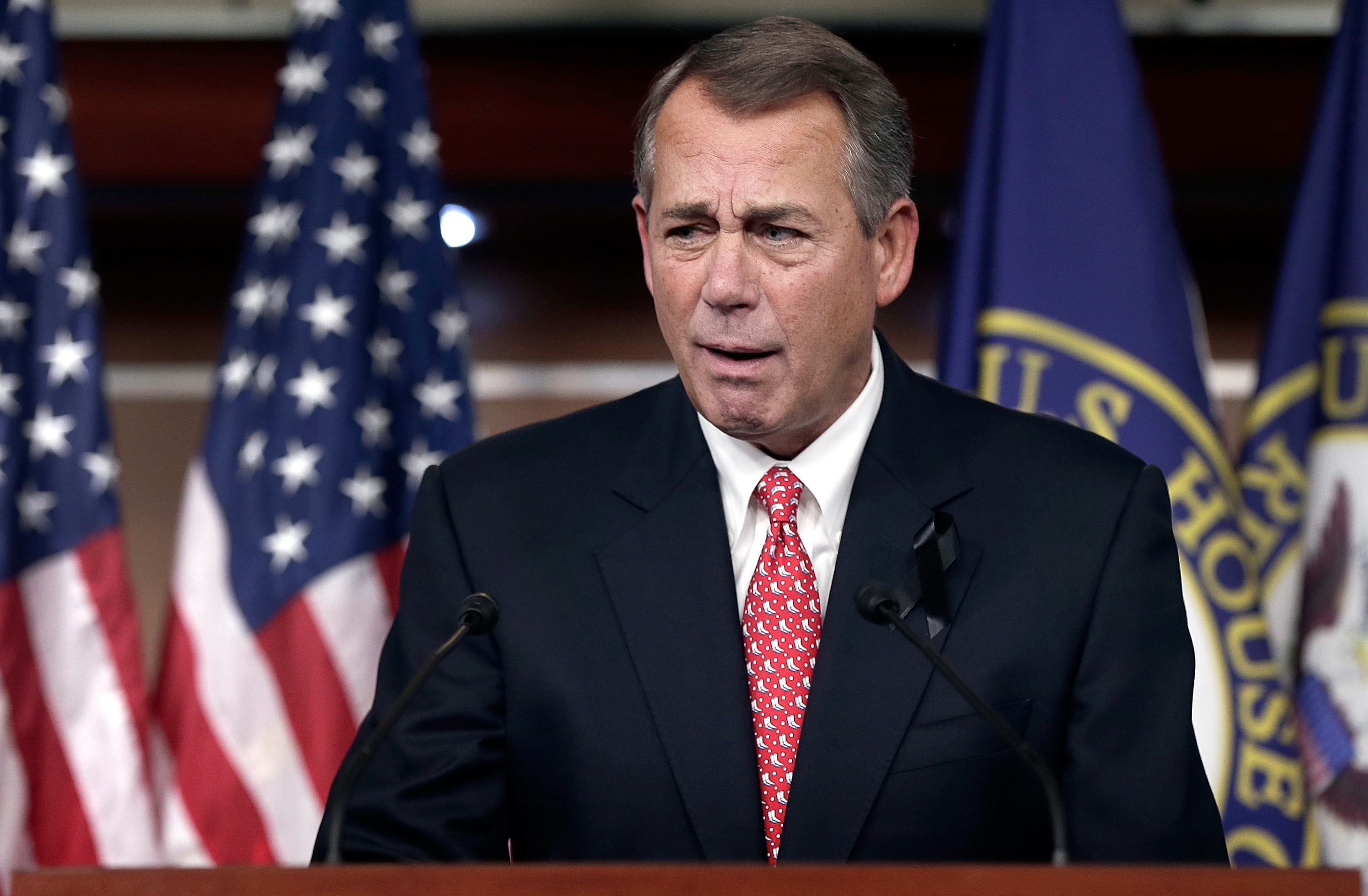
John Boehner Holds Media Briefing At The Capitol

U.S. Speaker of the House John Boehner (R-OH) answers questions during a press conference in Washington, DC on December 12, 2013. When asked if he would press ultra-conservative groups to tone down their criticism of a pending budget deal, Boehner said, “I don’t care what they do.” By Win McNamee/Getty Images.

The Reality Of Serious Weight Loss, Ctd

Reviving the thread, a reader sighs, “I should have set a timer for how long it would take a physician to tell me my weight will kill me”:

My original letter prompted this predictable response:

As a physician I am dismayed by one of your readers’ quotes: “I am healthy despite my weight.” That’s the equivalent of saying I’m healthy despite my heart disease or I’m healthy despite my colon cancer.

It is that global belief, which is quickly being undermined by research, that puts doctors outside the reality of the lives of their patients. Recent studies have shown that in the absence of heart disease, diabetes, high blood pressure or other chronic illnesses that can correlate with obesity, but do not always, obesity itself may not be the risk it is assumed to be. The blunt instrument of weight, or the specious BMI, as an absolute indicator of health does not square with the actual experience of many people. The prescription to lose weight – a “losing” proposition in the long run for most people – does not recognize the reality that doing as prescribed – eating healthily and exercising regularly – doesn’t always result in weight loss, but it may result in health.

Another is more blunt:

By insisting on continually recommending weight loss to their fat patients instead of emphasizing healthy habits for all, doctors like your reader do real harm.

In fact, studies have shown that many health professionals have a bias against fat people, finding them disgusting, lazy, noncompliant, etc. Largely because of this bias and its effects, fat people are less likely to go to the doctor. And when they do go, they get substandard care, with symptoms of serious health problems often ignored and attributed to fat rather than the underlying condition.

I’m not saying doctors shouldn’t talk about good nutrition and exercise and other health habits with their fat patients. They should talk about all these things with all their patients, all the time. But as anyone who has ever been to a doctor like your reader knows, most of the time conversations about health habits are ignored in favor of pointless and harmful scolding about weight loss.

Recent Dish on doctors’ bias against fat patients here. Another reader brings mental health into the equation:

The physician who e-mailed you is surely saying what is decreasingly popular to say out loud: obesity is a health risk. But the implication in that e-mail that the numbers on the scale are of paramount importance overlooks the mental health aspect of living and dying by the scale.

I have lost about 70 pounds, from a high of almost 250 to a low in the 170s. I am lucky that I never hit the point of stretch marks or damaged skin, so I saw the changes in the mirror and gained the promised confidence, but for a long time, I frequently weighed myself. When I lost weight, of course it felt good, but at some point, the urge to step on the scale at every opportunity became overwhelming. If my weight was up, I would enter a cycle of self-hatred, sometimes culminating in the use of laxatives (which I have never told anyone – I may have an undiagnosed eating disorder). All this over five pounds or less. For perspective, a person’s weight can fluctuate by 10 pounds over the course of a day.

This happened over and over and over again until I put my scale away so deep in my closet that I have forgotten where it is. I may have lost it in a move by now. I am so much happier, even if I’m not hovering around my all-time lowest weight.

Hersh vs Obama, Ctd

Earlier this week, Sy Hersh questioned whether Assad actually launched the Syrian chemical weapons attack. Eliot Higgins pushes back:

Hersh … discusses the possibility that the sarin was produced by Jabhat al-Nusra, the al Qaeda-affiliated group that’s fighting Assad. I asked chemical weapons specialist Dan Kaszeta for his opinion on that. He compared the possibility of Jabhat al-Nusra using chemical weapons to another terrorist attack involving sarin: the 1996 gassing of the Tokyo subway by the Aum Shinrikyo cult.

“The 1994 to 1996 Japanese experience tells us that even a very large and sophisticated effort comprising many millions of dollars, a dedicated large facility, and a lot of skilled labor results only in liters of sarin, not tons,” Kaszeta said. “Even if the Aug. 21 attack is limited to the eight Volcano rockets that we seem to be talking about, we’re looking at an industrial effort two orders of magnitude larger than the Aum Shinrikyo effort. This is a nontrivial and very costly undertaking, and I highly doubt whether any of the possible nonstate actors involved here have the factory to have produced it. Where is this factory? Where is the waste stream? Where are the dozens of skilled people — not just one al Qaeda member — needed to produce this amount of material?”

Joanna Paraszczuk and Scott Lucas pile on:

Hersh also does not examine how insurgents could fire multiple chemical warheads on opposition-controlled towns like the West Ghouta Moadamiyyat ash-Sham. That town, one of the first places that started to demonstrate against the Assad regime over two years ago, has been under a tight regime siege for over a year and is literally surrounded by key regime military strongholds. It is right next to the Mezzeh Military Airport, the site of fierce fighting between regime and insurgent fighters, and just south of the 4th Armored Division base, Sumarieh residences, and key police housing. So while it is easy to see how regime forces could fire on Moadamiyyat ash-Sham from outside the town — indeed, the regime is firing conventional weapons at the town on a daily basis — it would be practically and logistically impossible for insurgents to fire at short-to-medium range from outside the town.

Nor does Hersh bother to examine motive. Why would insurgents fire multiple chemical weapons at Moadamiyyat ash-Sham, a strategically-important opposition-controlled town that had resisted a siege for almost a year at the time of the August 21 attacks? Who would want to weaken the town by causing mass casualties and mass panic?

The Recession Hasn’t Ended For Everyone

unemployment

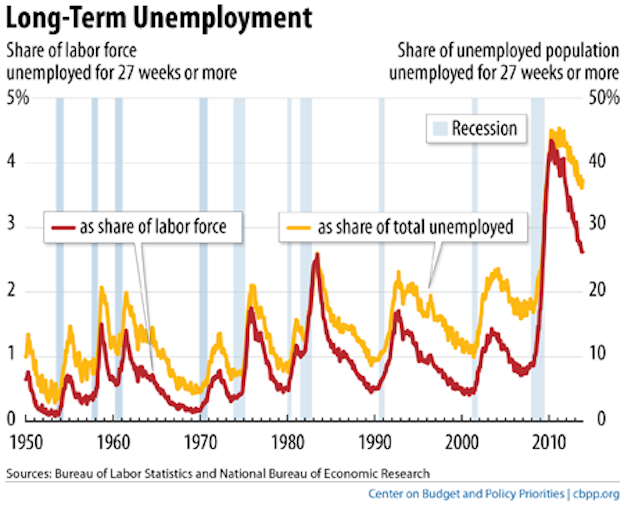
Matthew O’Brien wishes Congress would deal with long-term unemployment:

It’s been over four years since the recovery officially began, but it still feels like a recession to most people. Maybe that’s because with three unemployed people for every job opening, things are still as bad as they ever got last recession. Not that Washington has paid much attention the past few years. It’s been too preoccupied with short-term deficits to care about long-term unemployment. That was obvious when a Congressional hearing in April about people out of work for six months or more drew all of … one senator at the start. And it is even more obvious now with the latest budget deal.

Michael Strain explains why we should care:

People derive so much of their identity and of their moral core from being able to work. It’s how people provide for their families, express creativity, gives you a sense of purpose. There are all these moral and spiritual and psychological benefits to working. So if you want to ask how society is doing broadly, certainly the economics are important, but more important is whether this society is functioning in a way that people can live the fullest life possible and can maximize their potential. And right now, for these 4 million folks, we’re failing.

Yglesias suggests ways to help the unemployed:

One is direct government hiring of the long-term unemployed to do some kind of public service work. Making this happen would require you to go outside the standard civil service and federal contracting frameworks, which obviously neither civil servants nor federal contractors are going to like. But it has the job-creating punch of a major war without all the death and destruction. The other is relocation assistance. The metropolitan areas of Bismarck, Fargo, Grand Forks, Sioux Falls, Ames, Iowa City, Lincoln (Neb.), Midland, Burlington, Mankato (Minn.), Logan, Rochester (Minn.), Billings, Dubuque, Morgantown, Odessa, Rapid City, Omaha, Waterloo (Iowa), Columbia (Mo.), and St. Cloud all have unemployment rates below 4 percent … Grant programs to connect the long-term unemployed with job opportunities on the Plains and offer financial assistance for relocation could do a lot of good.

Suzt Khimm reports on the situation:

Advocates for the unemployed say they’re not surprised by the difficulties they’re facing on Capitol Hill. “We’ve known from the beginning this was going to be an uphill battle,” says Judy Conti, federal advocacy coordinator for the National Employment Law Project. And there is one fallback solution for Democrats if Congress doesn’t act before the end of the year: Unemployment benefits can be restored retroactively, as they were in 2010.

Chart from the CBPP.

Does Science Serve Science?

Fresh off a Nobel win, biologist Randy Schekman launches a high-profile boycott of the most prestigious academic journals, including Science, Nature, and Cell:

While they publish many outstanding papers, they do not publish only outstanding papers. Neither are they the only publishers of outstanding research. These journals aggressively curate their brands, in ways more conducive to selling subscriptions than to stimulating the most important research. Like fashion designers who create limited-edition handbags or suits, they know scarcity stokes demand, so they artificially restrict the number of papers they accept.

A paper can become highly cited because it is good science – or because it is eye-catching, provocative or wrong. Luxury-journal editors know this, so they accept papers that will make waves because they explore sexy subjects or make challenging claims. This influences the science that scientists do. It builds bubbles in fashionable fields where researchers can make the bold claims these journals want, while discouraging other important work, such as replication studies. In extreme cases, the lure of the luxury journal can encourage the cutting of corners, and contribute to the escalating number of papers that are retracted as flawed or fraudulent.

Tim Cross offers a measured endorsement:

Any scientist will tell you that Nature and Science publish a lot of excellent work. And Dr. Schekman is perhaps not the most disinterested observer: as he mentions in the article, he is the editor of eLife, an “open-access” journal (that is, one that does not charge readers) with ambitions to rival the top dogs. But working researchers will also tell you, perhaps after a few drinks, that Dr. Schekman is far from alone in thinking that the relentless focus on publishing in “high-impact” journals causes big distortions in how science is done. Many are reluctant to speak up, fearful of the damage they might cause to their careers by rocking the boat.

Going a big step further, Michael Eisen, co-founder of the open-access publisher PLOS, would do away with journals entirely:

[W]e need to listen to Schekman. Indeed we need to go one step ahead. While I admire what the new journal eLife is doing, where Schekman is the editor, it still rejects a lot of good papers that don’t meet the reviewers’ and editors’ standards of significance. This significance is determined by a scientist’s peers (in case of eLife) along with editors of journals (in case of Nature, Science, Cell and most other journals). But peer review isn’t devoid of problems. I believe that we need to dispense entirely with journals and with the idea that a few reviewers – no matter how wise –can decide how significant a work is at the time.

But Chris Lee doesn’t buy the argument:

Yes, the high-impact journals publish a lot of stuff that seems to lack substance. But the more specialist journals seem to publish a lot of rubbish, too. Maybe not so many overwrought claims of stunning importance, but there are plenty of statements of the bleeding obvious. Yes, if you find the right journal, you too can publish the finding that water is wet as original science. 

The problem here runs deeper than the publishing industry and its unholy coupling to the business of doing science. It comes down to our definitions of science and scientific output. For instance, if I take the laws of physics and calculate the behavior of a light wave in some new material, that counts as science. But it’s really just a calculation. If I measure the behavior of light in the material and find that it agrees with the calculation, that counts as science. But it’s actually just finding that the laws of nature are still true. The reason for doing these two things usually turn out to be good, and the experiments and calculations are useful. But the findings aren’t exactly startling stuff. This is the mundane nature of much of science. It has to be done, it has a good and useful purpose—but it’s not the science that we envision when we’re at school. Yet due to the way in which scientific output is measured, each and every one of those calculations and measurements has to be published.

This means that we need to have a large number of publishing venues, and since counting publications isn’t enough, they have to be ranked. Therein lies the problem. Boycotting a journal or a system is not going to help. As long as we try and reduce the sum total of scientific performance to a few numbers, the system will be gamed, and everyone will try to optimize it. It’s unavoidable.
Ask Rick Doblin Anything: Talking Personally About Psychedelics

In today’s video from Doblin, he explains how his own experiences with psychedelic drugs have influenced him and his work:

[vimeo 81738328 w=580]

In a followup, he explains what his family makes of his work as a psychedelic researcher, including a moving story about doing MDMA while visiting his grandmother and a funny story about his daughter’s experience with the DARE program:

[vimeo 81737285 w=580]

His previous videos are here. Some background:

Rick Doblin, Ph.D., is the founder and executive director of the Multidisciplinary Association for Psychedelic Studies (MAPS). He received his doctorate in Public Policy from Harvard’s Kennedy School of Government, where he wrote his dissertation on the regulation of the medical uses of psychedelics and marijuana and his Master’s thesis on a survey of oncologists about smoked marijuana vs. the oral THC pill in nausea control for cancer patients. His undergraduate thesis at New College of Florida was a 25-year follow-up to the classic Good Friday Experiment, which evaluated the potential of psychedelic drugs to catalyze religious experiences.

His professional goal is to help develop legal contexts for the beneficial uses of psychedelics and marijuana, primarily as prescription medicines but also for personal growth for otherwise healthy people, and eventually to become a legally licensed psychedelic therapist. He founded MAPS in 1986, and currently resides in Boston with his wife and three children.

Our extensive coverage of the spiritual and therapeutic benefits of psychedelics is here (or, in chronological order, here).

Who Is Getting The Better Deal?

McArdle believes that the budget deal is good for the GOP:

[T]actically, I think this is a clear win for the Republican Party. The last thing they need right now is to take the focus off the Patient Protection and Affordable Care Act and revive Obama’s flagging poll numbers with an ill-timed budget battle. Their best shot at a budget they really like is, after all, to retake the Senate in 2014.

Noam Scheiber disagrees:

Republicans are way over-estimating the extent to which Obamacare will be a liability for Democrats.They assume the problems of the first two months will extend indefinitely into the future—that they’re structural (flawed conceit) rather than mechanical (flawed website)—when the evidence suggests implementation is improving by the day. By contrast, the state of the economy is typically the biggest driver of the public mood. If the economy is humming along next fall, the Democrats’ prospects (and those of incumbents generally) could look pretty damn good.

Amateur Hour Is Over

Alexis looks at this year’s top ten YouTube videos and notices a trend toward professional production:

If YouTube began as America’s Funniest Home Videos, it has now become Saturday Night Live — including the commercials. The platform’s biggest hits are all produced by professionals.

His analysis:

The change in the way that the most popular YouTube videos are produced parallels the professionalization of blogging that has occurred in the last decade.  At one point, many of the most popular blogs were run by single individuals, just because. But media companies responded by creating blogs of their own, or simply hiring bloggers or purchasing blogs. So, after a brief flowering of user-generated online media rivaling the scale and reach of professional online media, we’ve seen a retrenchment of traditional media structures.

(Video: How Animals Eat Their Food by MisterEpicMann, YouTube’s #3 video for the year with over 89 million views.)

Democrats Should Run On Obamacare?

Maybe:

[T]op Democratic pollster Stan Greenberg – having just done extensive polling in 86 competitive House districts — is advising Dems they should go on offense over the Affordable Care Act. The key finding: Even though voters in the battlegrounds have extreme doubts about the law, they still prefer implementing it to the GOP stance of repeal. And after a month of crushingly awful press for Obamacare, opinions on this matter in the battlegrounds have barely budged since October.

Going on the offensive would be long overdue and desperately needed. Tomasky predicts that “HealthCare.gov is going to be a net plus for Obama and the Democrats”:

[M]y bet is based on a lot more than enrollment numbers. It’s based on the numbers of people who are benefiting and will benefit from aspects of the law. These aren’t in the thousands. They’re in the millions. About 70 million citizens will enjoy free—free—preventive care for a range of services that typically weren’t covered at all before or at best were covered and required a co-pay. About half of them are Medicare recipients (= old people = voters). Preventive care, as you may know, is something our system hasn’t been doing very well. Now it will.

More than 100 million Americans live with what the insurance companies would define as pre-existing conditions. Over these next few months, as their symptoms flare up or especially if they worsen, requiring lengthy hospital stays and intense treatment, they’re going to be seeing that they don’t have to fret about money or whether they’re going to continue to be covered anymore. Mental-health coverage is going to be improved dramatically for up to 60 million Americans. Nearly 7 million senior citizens are going to find in the coming months that they’re no longer screwed by the doughnut-hole prescription-drug problem that was created by the Bush Medicare Part D law of 2003 and corrected by Obamacare. It is saving these 7 million seniors an average of $1,000 a year, which for many of these folks is probably a reasonable chunk of their income