An End In Sight For Gitmo?

Serwer sees the new defense bill as a sign that Obama may actually be able to shut down Gitmo after all:

The defense bill would clear the way for the majority of the remaining detainees, 82 out of 162, to be transferred abroad. An earlier Senate version of the bill had also allowed Gitmo detainees to be brought to the US for trial, while the House version had preserved prior restrictions on transfers of detainees. The resulting compromise between the Republican-controlled House and the Democratic-controlled Senate nevertheless leaves intact a ban on bringing Gitmo detainees to the US for trial, leaving a number of detainees to an uncertain fate–even as it paves the way for most of the men currently detained at the facility to leave. More could be cleared for transfer as the administration conducts its reviews of the detainees left at the facility. As a presidential candidate in 2008, Barack Obama vowed to close the facility. The defense bill would make it easier to keep that promise, which has remained unfulfilled a year into his second term.

Benjamin Wittes supports the bill:

The administration will cast this as a step forward for closing Guantanamo. I don’t care a fig about whether Guantanamo stays or goes. I do care a lot, however, about holding people we don’t need or want to be holding, and this bill would go a long way to restoring the administration’s flexibility to transfer detainees it wishes to get rid of. That’s a very good thing—whatever one thinks of Guantanamo.

No Republican Is Safe

This week, Congressman Steve Stockman announced that he is going to try to primary Senator John Cornyn (R-TX). A letter Stockman wrote to his supporters calls Cornyn a traitor:

You are in a foxhole fighting to save our constitutional Republic… …and the last thing you need is a Republican bayonet in your back. But that’s what liberal John Cornyn has been doing to you every day.

Cornyn spokesman Drew Brandewie responds with the above tweet. Daniel Strauss adds:

Stockman’s attack is what a number of tea party challengers have been making against the Republican incumbents they’re challenging. The problem for Stockman is that Cornyn is rated as one of the most conservative lawmakers in his chamber, according to a National Review analysis of Senate voting records.

Molly Ball wonders why Cornyn is being challenged:

[I]f even staunch conservatives like Cornyn can’t satisfy the right, the Tea Party has truly entered its dada period.

Before, right-wingers were content to purge actual moderates, like former Indiana Senator Richard Lugar and Delaware Representative Mike Castle, or patrician establishmentarians like Dewhurst. Now all it takes to provoke their wrath is the belief that government ought to be allowed to function. Next, perhaps they’ll they turn on Cruz, who serves on several Senate committees and is vice chair of the senatorial committee. I asked a GOP consultant who follows Senate races what Cornyn’s supposed sin against conservatism had been—what transgression earned him the wrath of the right. “Well,” the consultant answered, “the honest answer is that he’s not crazy.”

Weigel sees Stockman as little threat to Cornyn:

Steve Stockman? He was a one-term congressman in 1995-1997, narrowly won a primary to return in a new seat in 2012, has $38,000 on hand, and was being derided by fellow Republicans for having failed to disclose a substantial amount of charity money. This should not be seen as some bellwether of Tea Party power. This will be a highly quotable but un-serious primary.

John Sides looks beyond the immediate rate:

The issue for the GOP isn’t so much the 2014 Texas Senate race.  The issue is that, in general, the party would be better off — that is, it would control more seats and be better-positioned to steer policy — if it could discourage primary challengers in races where negative consequences are more likely.  And Stockman’s example — particularly if successful — may only reinforce the desire of other conservatives in the party to mount similar challenges.   When those challenges happen in states or districts that aren’t quite as red as Texas, the party may suffer, just as it has in Nevada, Delaware, Indiana, and Missouri.

A Victory For Men’s Health

Only four years after Dan Savage proposed vaccinating boys as well as girls against HPV, the Canadian province of Alberta announced plans to do just that. (The much smaller province of Prince Edward Island pioneered the practice earlier this year.) Omar Mouallem applauds the move:

Males in any HPV-immunized community already benefit from shots administered to females. Two years after Australia introduced a national vaccination program for girls in 2007, cases of genital warts in young women and men dropped 59 and 39 percent, respectively. There, in the only country to federally fund coverage of both genders since February 2013, the conversation no longer focuses solely on cervical cancer. It’s about all of the symptoms, including warts, regardless of who is more likely to be affected.

New evidence suggests that a universal program could save more lives than anticipated. Oral HPV infections are now almost three-to-one male. Some researchers believe this is because men on average have more sexual partners, but Nigel Brockton, a Calgary oncologist who studies the relationship between HPV type 16 and oral pharyngeal cancers, links this ratio to the desquamation (shedding) of infectious cells, which occurs more readily on female genitalia. With fewer Canadians smoking than a generation ago, tonsil tumors should technically be declining, but they aren’t, perhaps because cunnilingus has become standard sexual practice. Since the lag time between infection and symptoms can be decades, HPV could become as much a men’s health issue as a women’s concern before all of the evidence is in.

A Minimal Minimum-Wage Hike, Ctd

A reader offers a cri de couer against increasing the minimum wage:

You quote a number of academics who seem to have no real-world experience. The minimum wage kills jobs. End of story. I am a perfect example. I run a very successful financial advisory practice, and I would gladly hire two or three teens to work for me personally. But I will not do it at the minimum wage. They simply don’t bring enough economic benefit to warrant me paying them that much. So, what’s the end result? Two or three teens go without a job and instead do nothing. No job. No experience. No learning. Nothing.

I personally know at least a dozen seniors in high school and freshmen in college who would jump at the opportunity to work with me for nothing, let alone $3 per hour or $5 per hour. All of the ancillary skills and benefits would far outweigh any wage they may earn. Yet, the minimum wage laws prevent this from happening. And instead they are just unemployed – economic casualties. I still have a successful business with or without them. They suffer, not me.

The reader sounds like many liberal magazines with unpaid intern programs. Update from a reader:

If he really needs to hire a helper for his business, he would do so, regardless of the minimum wage. But his business, he says, is “very successful,” so he’s obviously prospering without a young mentee. He would, however, as some sort of public service, be happy to pay “two or three teens” less than the minimum wage to work for him. Okay then, let’s take him at his word – if he could pay two teens $5/hour or three teens $3/hour, why can’t he afford to pay one teen $7.50/hour – or even the $15/hour implied by three teens at $5/hour? Since he won’t suffer with 3, 2, 1 or no hires, as he says, the minimum wage should make no difference. So why the discrepancy? Well, that would probably be because he’s completely full of crap.

Another:

The reader who cares not for how many studies have shown the minimum wage is not a job killer is a great example for your epistemic closure files. What could professional economists with centuries of combined training who have spent decades studying this question, bringing together data from a variety of economies across the world know, compared to one man who wishes he could pay low wages? I hope his contempt for data doesn’t extend to his business, as financial advising should be a data-driven endeavor.

Meanwhile, other readers are criticizing Gary Becker for arguing that France’s generous minimum wage is to blame for its jobless problem:

A good deal of the difference between French and American youth unemployment has to do not with the minimum wage but with labor flexibility. By this I mean the ability to easily hire and fire employees, as well as the hiring of temporary employees. This is very difficult to do in France (as well as Spain, Italy, Japan, among others) and has led to a two-tier labor market of nearly un-fireable older employees and a mass of young workers unable to find or maintain employment.

Another adds:

Far more serious is the social obligation that French employers accept when choosing to hire someone. So when it costs a lot in wages, then add to that all the pension, healthcare and other fees and taxes (which in France and most of Europe are significantly higher than in America), businesses don’t look to hire until they’re desperately overworked and have very good prospects for it to continue for the duration of the hiring contract. Even then, why hire inexperienced, possibly unmotivated people into entry-level jobs? The Continental idea of a job for life lives on in more ways than one, and that’s what kills youth employment.

One enterprising reader looked up unemployment rates and minimum wage levels for various Western countries:

Australia: Minimum wage: $16.37/hour (US$14.90/hour); overall unemployment rate of 5.7% and youth unemployment (15-19) of 17.1 %.

France: 9.43 Euro/hour (US $13.01/hour); overall unemployment rate of ~10.9% and youth unemployment (>25) at 25.8%.

United States: $7.25/hour (less for certain professions); overall unemployment rate of ~7% and youth unemployment (15-19) at 16.3% back in July of 2013

Japan: $8.17-$10.65/hour (depends on industry); overall unemployment rate of 4% and youth unemployment rate at 7%.

Great Britain: 3.72L (under 18 years old=$6.10/hour), 5.03L (18-20=$8.25/hour), 6.31 (21+ =$10.35/hour); overall unemployment rate of 7.5% with a youth unemployment of 21%.

His conclusion:

There is no clear relationship between minimum wage levels and unemployment rates, especially when you are comparing two very different labor markets.

Looking at just those five countries, which are all modern industrial nations, we find that the United States has the lowest minimum wage for adults and yet comes in third place out of five for overall unemployment. Japan – with a higher minimum wage than the US – has much lower unemployment for adults and significant lower unemployment for its youth. Australia, with a much higher minimum wage, still has a much lower unemployment for adults and just a tad higher unemployment for its youth.

There is no clear linear rule to take from this – and acting as if there can really be deceptive if one doesn’t try to understand the complexities here.

Another supports an extreme form of wage subsidies:

I know its politically unpalatable, but really, minimum wage of $9 or $10 should be paid directly from the government, with a business-paid minimum wage of 1$ an hour to prevent gaming the system. Think about it: People who are unemployed are going to cost the government one way or another, whether through disability payments or unemployment insurance. And if the cost to business of hiring a new employee is $1 an hour, why in the world wouldn’t they hire more people? You get conservative solutions – more hiring in the private sector, fewer social programs, and leaving individuals with the choice to run their own lives – combined with liberal policy goals, e.g., a living wage.

Recent Dish on wage subsidies and the minimum wage here.

Obamacare’s Monthly Check-Up

Enrollments have increased significantly:

enrollment

Kliff provides details:

Just about 1.2 million people have gained health coverage through Obamacare, according to new federal data released Wednesday morning. Approximately 365,000 of those people have purchased private insurance and 803,000 have been determined to be eligible for the public Medicaid program. These numbers count data from both October and November, and show an especially quick growth in HealthCare.gov enrollment.

Philip Klein downplays the enrollment spike. He focuses on individuals buying private plans:

Just 364,682 Americans picked a health insurance plan through President Obama’s health care program between the Oct. 1 launch of the insurance exchanges and Nov. 30, the Department of Health and Human Services announced today. Though the pace of signups accelerated during November, as only 106,185 Americans had picked plans as of Nov. 2, the combined signups were still less than half the administration’s target of 800,000 enrollments by the end of November. Adding a caveat, HHS noted that it is trying to correct a problem that may have resulted in some of the signups being counted twice, thus potentially overstating the number.

Josh Barro puts the numbers in a much more favorable light: 

My best guess is that signups for private insurance through the federally-run Affordable Care Act exchanges are rising very sharply: About 69,000 during the week ending Dec. 2, up from only about 2,000 in the program’s first week, ending Oct. 7. That means the signup pace is nearly doubling, week-to-week. Unfortunately, I can’t be sure, because the Department of Health and Human Services, which runs the federal exchange, is awfully cagey about its data.

Drum chimes in:

There was a big jump at the end of November, and continued growth in the Thanksgiving/Black Friday week after that. That said, these numbers still need to grow substantially. At this point in the game, the enrollment rate needs to start pushing 200,000 per week or so on the federal exchange in order to meet the overall enrollment goals set for March of next year. There’s still lots of work ahead.

C.H. at The Economist wants data on who has enrolled:

Perhaps most important is what the new report does not include. It does not reveal what share of shoppers are young. Obamacare relies on enrolment from young, healthy people to subsidise the cost of insuring the sick. The report also merely explains how many people have chosen a plan; it does not describe how many enrolment forms have been successfully sent to insurers. Without this next step, some of the 364,682 people who have chosen a plan may not have insurance in January after all.

Douthat takes a step back:
For myself, as a skeptic of the law, part of what’s been striking about watching Obamacare unfold to date is how it’s managed to go badly relative to its supporters’ projections in ways that I didn’t necessarily anticipate. (I worried more about employer dumping into the exchanges leading to budget-busting subsidy payouts, for instance, which currently seem like a fairly-remote possibility.) Presumably we should continue to expect the unexpected, and be prepared for developments that don’t just fall somewhere in between “ringing success” and “death spiral,” but surprise us with where exactly they fall, and how their consequences play out.

Making History In Montevideo

URUGUAY-MARIJUANA-LEGALIZATION

Uruguay becomes the first country to legalize the cannabis trade:

The law, effective from next year, will allow registered users to buy up to 40 grams of marijuana a month from a chemist’s; registered growers to keep up to six plants; and cannabis clubs to have up to 45 members and cultivate as many as 99 plants. A government-run cannabis institute will set the price – initially likely to be close to the current black market rate of $1 a gram – and monitor the impact of the program, which aims to bring the industry under state control and push illegal traffickers out of business.

The country’s president has positioned the law as a test:

Before the passage of the bill, president José Mujica called on the international community to assist in what he admitted was an experiment aimed at finding an alternative to the deadly and unsuccessful war on drugs. “We are asking the world to help us with this experience, which will allow the adoption of a social and political experiment to face a serious problem–drug trafficking,” he said earlier this month. “The effects of drug trafficking are worse than those of the drugs themselves.” If the results of the law prove negative, Mujica has said it could be rescinded.

Roberto Ferdman notes that the law could mean a windfall for the Uruguayan government:

The only entity allowed to deal the drug will be the government. Under the new law, Uruguayans registered with the government will be allowed to buy up to 40 grams (1.4 ounces) of marijuana from government-licensed pharmacies. Private companies roped in to help produce enough weed to meet local demand will have to sell their crop to the government for distribution. The government will rake in some extra cash in the process. The black market for marijuana is worth some $40 million. The government won’t earn as much; it plans to sell the drug for about $1 a gram, roughly 30 percent less than the black market price. But it can count on a lot of customers: Uruguay has a relatively high percentage of pot smokers for the region – third only to Argentina and Chile.

Hannah Hetzer, policy manager for the Drug Policy Alliance, sees a larger trend in the region:

In 2011, Kofi Annan, Paul Volcker and Richard Branson joined former Presidents Fernando Henrique Cardoso of Brazil, Cesar Gaviria of Colombia and Ernesto Zedillo of Mexico and other distinguished members of the Global Commission on Drug Policy in saying the time had come to “break the taboo” on exploring alternatives to the failed war on drugs and to “encourage experimentation by governments with models of legal regulation of drugs,” especially marijuana. More recently, Presidents Juan Manuel Santos in Colombia and Otto Perez Molina in Guatemala have joined these calls for reform. In May, the Organization of American States produced a report, commissioned by heads of state of the region, that included marijuana legalization as a likely policy alternative for the coming years.

By approving this measure, Uruguay has taken the broad regional discussion on alternatives to drug prohibition one step further, representing a concrete advance in line with growing anti-drug war rhetoric in Latin America and throughout the world.

But as much as American advocates support the law – and some have gone so far as to buy ad time for it -David Down says the law remains remains “deeply unpopular” among Uruguayans:

Consuming weed has been legal here since the 1970s, and several vocal cannabis campaigners have raised concerns about the law, criticizing the government’s plans to monitor cannabis use and limit the number of strains of weed available for sale. The opposing political party here is also threatening to push for a referendum on the law, which was opposed by 61 percent of Uruguayans polled in September. The experiment, in other words, could be short-lived.

(Photo: People take part in a demo for the legalization of marijuana in front of the Legislative Palace in Montevideo, on December 10, 2013, as the Senate discusses a law on the legalization of marijuana’s cultivation and consumption. By Pablo Porciuncula/AFP/Getty Images)

Covering Olympic Oppression

Alyssa praises NBC’s choice of David Remnick to provide political commentary on the Sochi Olympics:

Remnick’s done reporting work (as well as editing the New Yorker) that touches on many aspects of civil society. He’s covered Aleksandr Solzhenitsyn’s return to Russia from exile and written about the life of Russian poet Joseph Brodsky. Remnick’s reported on the rise of Russian oligarchy and the war in Chechnya. In 2007, he wrote a long profile of Gary Kasparov. Last year, he checked in with Petr Verzilov, who is married to Pussy Riot member Nadezhda Tolokonnikova. This year, he filed a thoughtful dispatch on the experience of exile and how it shaped the Tsarnaev brothers, authors of the Boston Marathon bombing.

Remnick, in other words, is a commentator qualified to explain Russian society in some depth to American audiences. The “gay propaganda” law sounds bizarre out of context. But as an attempt to defend “Russian values,” including the Russian Orthodox Church, and to defend and define Russia after the national trauma that was the dissolution of the Soviet Union and ongoing territorial disputes like the one in Chechnya, it makes somewhat more sense. If the “gay propaganda” law is to be the signal issue of the 2014 Winter Olympics, and part of the point of moving the Olympics around the world is to familiarize international audiences with countries they may pay varying amounts of attention to, Remnick is positioned to both contextualize the law and provide a full portrait of Russia to international audiences.

She contrasts Remnick with the new chief of the new Russia Today, Dmitry Kiselyov, suggesting that the latter’s appointment in the lead-up to the Olympics was no coincidence:

[Kiselyov has] suggested that he believes the Cold War isn’t over, but rather, has heated up. His appointment by Putin to head Russia Today suggests that one of the flashpoints in that war is gay rights. And that move is a perfect illustration of the dilemma for NBC, and all the athletes and heads of state who are trying to figure out their approach to the Olympics. Condemning Russia’s treatment of gay people, as well as its other authoritarian policies, is both personally satisfying and morally necessary. But internally, it may only serve to harden the sense among some Russians that their country is culturally different from the people, entities, and nations who criticize it, and that standing firm on Russia’s treatment of LGBT people is an important way for the country to emphasize its cultural and political independence from the decadence around it.

To get a sense of Kiselyov’s anti-gay rhetoric, here is a quote from a couple months back:

“I think that just imposing fines on gays for homosexual propaganda among teenagers is not enough. They should be banned from donating blood, sperm. And their hearts, in case of the automobile accident, should be buried in the ground or burned as unsuitable for the continuation of life.”

Amar Toorf provides the basics on the Kiselyov appointment:

In a decree issued Monday, Putin abruptly liquidated the prominent news agency RIA Novosti, merging it with radio service Voice of Russia to create a new media conglomerate called Rossia Segodnya, or Russia Today. Like its predecessors, the new company will be state-owned, and will be separate from the Russia Today television station, now known as RT. Yet aside from the company’s executive director — a TV presenter and Putin loyalist known for his anti-gay rhetoric and conspiracy theories — details on its scope, structure, or the timeline for its liquidation remain unclear.

Leonid Bershidsky laments the loss of RIA Novosti Editor-in-Chief Svetlana Mironyuk, who tried to make the agency as independent as a state-run outlet can be:

Mironyuk was known as something of a liberal, aligned with former President Dmitry Medvedev, who now serves as Putin’s prime minister. “She has done a lot to make sure that, despite the toughest censorship, RIA Novosti supplied relatively objective information and analysis,” political commentator Grigory Melamedov wrote on his blog at Echo.msk.ru. No one will say this of Kiselyov…

Mironyuk thrived under Medvedev’s presidency, channeling government funds into innovative media products ranging from a large infographics service to commentary delivered by a rapper. Even Russia’s few remaining independent media outlets relied heavily on RIA Novosti for breaking news coverage: With more than 1,700 staff, the agency delivered more news from more locations than the others could ever afford. Mironyuk’s ambitions were expensive. The news agency pays its staff salaries well above market rates for private media outlets. Both Putin’s decree and Ivanov spoke of the need to cut costs. Under Kiselyov, Russia Today will concentrate on carrying a pro-Putin message to foreign audiences, and RIA Novosti projects aimed at the domestic market will be scrapped or downsized.

Marc Champion has more on Kiselyov:

Here’s a quick taste of how he might go about his job. When protests recently broke out in Ukraine, Putin called them “pogroms.” Kiselyov, on his TV show, called the protests a plot by Sweden, Lithuania and Poland to avenge their 1709 defeat by Russian forces at the battle of Poltava. No evidence for this interesting conspiracy was offered.

What Daisy Sindelar is hearing:

Igor Yakovenko, the former head of the Russian Union of Journalists, said the sudden move spoke of “if not panic, then a certain alarm” among the Kremlin elite. “It’s an extremely ineffective decision. I would even say a stupid one,” Yakovenko said. “Because in fact the style of propaganda that’s characteristic for Dmitry Kiselyov is simply open lies. Everything that he says about ‘Maidan,’ everything that he used to say about the Russian opposition, is a complete lie and sometimes sleight of hand. And that’s possible only when you have censorship — conditions in which there’s a monopoly on information.”

The Truthiness Of Virality

Facebook Upworthy

Neetzan Zimmerman, the master of viral content, makes an astute observation:

I’d argue that most viral content demands from its audience a certain suspension of disbelief. The fact is that viral content warehouses like BuzzFeed trade in unverifiable schmaltz exactly because that is the kind of content that goes viral. People don’t look to these stories for hard facts and shoe-leather reporting. They look to them for fleeting instances of joy or comfort. That is the part they play in the Internet news hole. Overthinking Internet ephemera is a great way to kill its viral potential.

In response, Felix Salmon observes that there’s “now so much fake content out there, much of it expertly engineered to go viral, that the probability of any given piece of viral content being fake has now become pretty high”:

If your company was built from day one to produce stuff which people want to share, then that will always end up including certain things which aren’t true. That’s not a problem if you’re ViralNova, whose About page says “We aren’t a news source, we aren’t professional journalists, and we don’t care.” But it becomes a problem if you put yourself forward as practitioners of responsible journalism, as BuzzFeed does.

It has become abundantly clear over the course of 2013 that if you want to keep up in the traffic wars, you need to have viral content. News organizations want to keep up in the traffic wars, and so it behooves them to create viral content — Know More is a really good example. But the easiest and most infectious way to get enormous amounts of traffic is to simply share the stuff which is going to get shared anyway by other sites. Some of that content will bear close relation to real facts in the world; other posts won’t. And there are going to be strong financial pressures not to let that fact bother you very much.

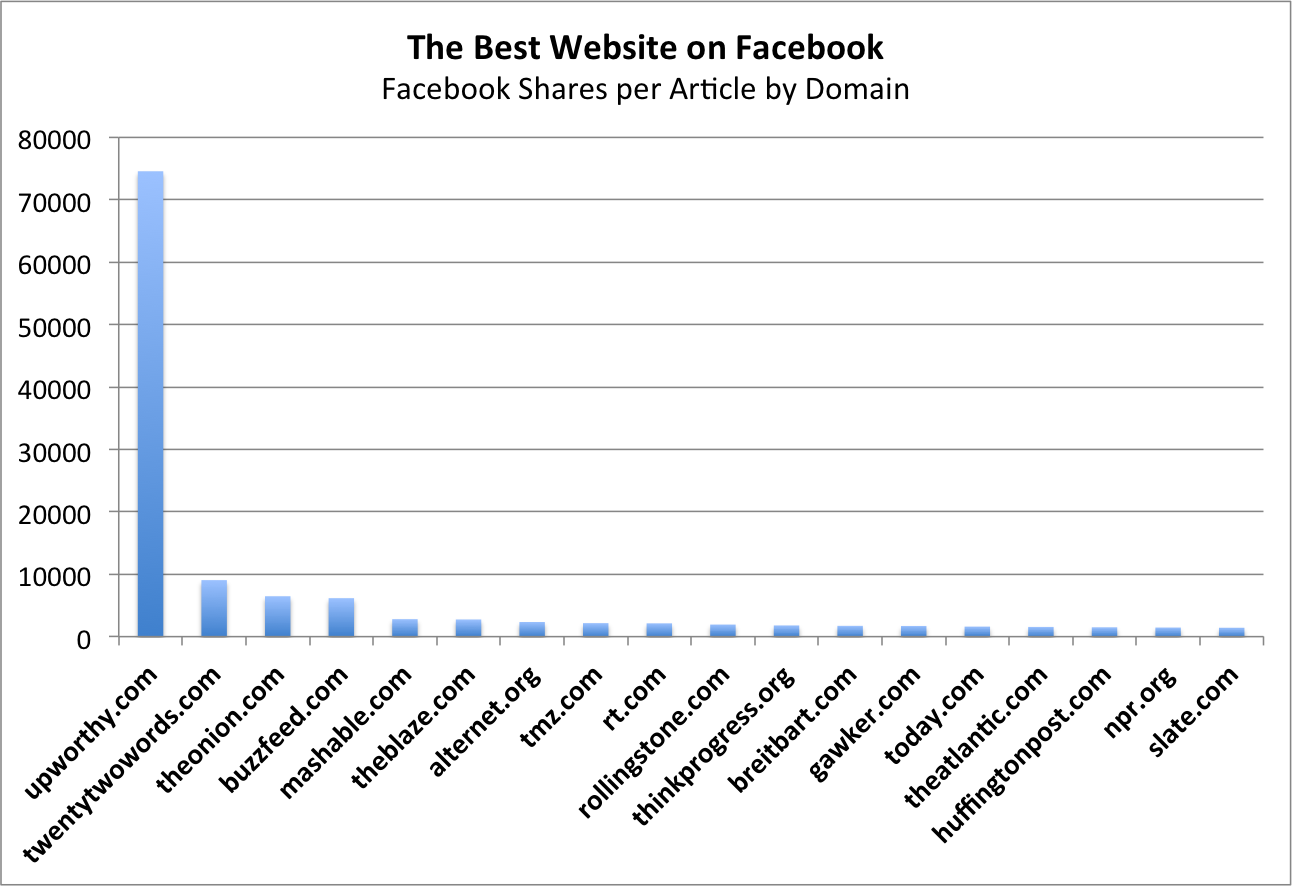
Derek Thompson passes along the above chart on viral traffic:

The most impressive thing about Upworthy is that it publishes just 225 articles a month, according to this data. That’s one for every 508 articles on Yahoo! The site is so much more dominant than other news sites on Facebook that when you graph its Facebook-shares-per-article, it looks like a skyscraper dropped into a desert. Upworthy averages about 75,000 Facebook likes per article, 12x more than BuzzFeed.

Ezra Klein ponders this fact:

The question Upworthy’s success raises is whether there are negative returns to posting so much content. Perhaps the time spent producing thousands of articles, most of which have very slight readership, would be better spent producing hundreds of articles more thoughtfully because more will go wildly viral. Lower content expectations give writers more time to find amazing stories, to get amazing quotes, to come up with amazing headlines.

Or so goes the theory. Certainly a lot of writers would like to believe that. But what Upworthy is doing isn’t giving writers a lot of time to create content that may or may not cohere into something that could go viral. They’re giving writers a lot of time to find content that they’re pretty sure will go viral. If you want to find something that will go nuts on Facebook, time spent sorting through what already exists is likely a lot more efficient than time spent creating something from scratch. It’s entirely possible that if a place like The Post attempted to ratchet back on content expectations they would end up both with less content and less virality.

Drum notes that Upworthy’s much remarked upon headlines are often misleading:

Upworthy’s headline-writing black magic has become endlessly talked about as the apotheosis of our modern, millennial, warp-speed, social-media driven culture. But you know what it reminds me of? Supermarket tabloids.

The supermarket tabs aren’t what they used to be, but back in their heyday this was their meat and drink. Every issue featured half a dozen titillating headlines on the cover that sucked you into a story on page 24 that was….usually kind of meh. They did their best to hide this, of course, but most of the time their headlines turned out to be come-ons that ultimately ended in disappointment. Still, you never knew if the next one might be the real deal. Hope springs eternal, so you kept coming back for more.

Other things in the same category: The New York Post. Modern movie trailers. Ron Popeil infomercials. British tabloids. Porn spam. TED talks.

Yglesias zooms out:

From a business viewpoint, I think an important point to make about this is that “viral” basically just means “is popular on Facebook” since Facebook is really the only host for viral content that matters. And that in turn means that all the viral traffic a website gets is really Facebook‘s traffic. It’s been clear for a long time now—like going back to well before there was an Internet—that journalism just isn’t that popular. Most households in the New York City metro area never subscribed to the New York Times, for example. Facebook, by contrast, is something that people really like. So since Facebook is so much more popular than journalism, it turns out that the most popular kind of journalism is Facebook content.

But this is still really Facebook’s traffic. Not just in the sense that Facebook can always tweak the algorithms that determine what plays well on Facebook, but in the sense that whatever economic value is created by “viral” content will ultimately be captured by Facebook. If you want to advertise to an audience of people eager to consume Facebook-friendly content, after all, the logical place to do that is on Facebook.

What Obamacare Doesn’t Cover

Steinglass unsurprised that many Obamacare plans have high out-of-pocket costs:

Obamacare’s design all but guaranteed limited choice and high out-of-pocket expenses. The insurance sold on the exchanges must comply with many rules: plans must cover a long list of “essential health benefits”, must not charge more to sick patients and must have a set “actuarial value”. (An actuarial value of 60% means that, for an average person, the health plan will cover 60% of health costs. The patient will have to cover the rest from his own pocket.) Obamacare plans are classified as bronze (60% actuarial value), silver (70%) or platinum (90%). These standards make it easier to compare one plan with another. But they also give insurers relatively little room to differentiate their products. To compete on sticker price, they have to cut costs. They typically do this by restricting choice and bumping up deductibles and co-payments.

Cohn worries about these costs:

The trend towards higher out-of-pocket expenses is nothing new. As the Kaiser Family Foundation’s Larry Levitt pointed on Monday, via his Twitter account, it’s been happening even in employer plans, although the amounts are typically lower. And people always have the option of getting policies with lower out-of-pocket expenses. Those policies, which typically fall into the “gold” and “platinum” categories, will cost more in premiums. That’s the fundamental trade-off here: You can pay more upfront, in premiums, or risk paying more later, in out-of-pocket expenses. Of course, that’s difficult for many people at low incomes, even with subsidies, which is why lawmakers should bolster the law’s subsidies and tighten those out-of-pocket limits even more.

What are the chances of that happening anytime soon? Pretty slim. Partly that’s because bolstering the law’s protections would require money, which would require either raising taxes or pushing harder on the health care industry—both defensible, but both difficult politically. The other is that most conservatives don’t actually have a problem with insurance that leaves people exposed to such high medical bills. In fact, this has been one of the most aggravating parts of the Obamacare debate: Conservatives frequently criticize Obamacare because, they say, it forces people to buy more insurance than they want. The minimum requirements, they say, should be lower. But, as the new Avalere analysis should remind everybody, the standards are already weak. How much more threadbare could the minimalist plans be?