What Is Catholic Literature?

In the midst of a searching rumination on the current state of Catholic writing, Dana Gioia offers a description:

Catholic literature is rarely pious. In ways that sometimes trouble or puzzle both Protestant and secular readers, Catholic writing tends to be comic, rowdy, rude, and even violent. Catholics generally prefer to write about sinners rather than saints. (It is not only that sinners generally make more interesting protagonists. Their failings also more vividly demonstrate humanity’s fallen state.) John Kennedy Toole’s A Confederacy of Dunces, for example, presents a huge cast of characters, lost souls or reprobates all, who, pursuing their assorted vices and delusions, hilariously stumble toward grace and provisional redemption. The same dark comic vision pervades the novels of Evelyn Waugh, Anthony Burgess, and Muriel Spark. Ron Hansen’s Atticus begins with the investigation of a murder. Flannery O’Connor’s fiction is full of resentment, violence, and anger. “Good and evil appear to be joined in every culture at the spine,” she observed, and violence is “strangely capable” of returning her characters “to reality and preparing them to accept their moments of grace.” When Mary Karr titled her poetry collection Sinners Welcome, she could have been describing the Catholic literary tradition.

Much of Gioia’s essay grapples with the decline of Catholic art and literature from its heyday in the mid-20th century. One reason he cites for the current impoverishment? A growing obsession with politics:

What absorbs the Catholic intellectual media is politics, conducted mostly in secular terms—a dreary battle of right versus left for the soul of the American Church. If the soul of Roman Catholicism is to be found in partisan politics, then it’s probably time to shutter up the chapel. If the universal Church isn’t capacious enough to contain a breadth of political opinion, then the faith has shriveled into something unrecognizably paltry. If Catholic Christianity does not offer a vision of existence that transcends the election cycle, if our redemption is social and our resurrection economic, then it’s time to render everything up to Caesar.

Wallace Stevens remarked that “God and the imagination are one.” It is folly to turn over either to a political party, even your own. If American Catholicism has become mundane enough to be consumed by party politics, perhaps it’s because the Church has lost its imagination and creativity.

Recent Dish on denominational prose here.

Why Pray For Rain?

dish_rain2

Helen Plotkin unpacks the Jewish prayer “Grant dew and rain for a blessing upon the face of the earth”:

[S]ometimes rain is not just rain. All over the Jewish sources, from the Bible to the Talmud to the prayer book, rain stands in for a more general earthward flow of divine nurture. Talking about rainfall is a way of talking about the relationship between God and humanity. When one is in good shape, so is the other. In fact, water is a major plot-driver of the Bible. Sometimes the narrative suspense comes from a scarcity of water, and sometimes it comes from being overwhelmed by too much water.

How she connects the prayer to contemporary America:

In our own era, Americans have farmed like the Pharaoh. We have used the power of technology to irrigate land without rain, making tomatoes and cantaloupes available year round. We have even relied on the labor of sojourners, people who live apart from those they serve in conditions that the served would never tolerate for themselves, people who are needed but whose growing power gives rise to fear.

And we have been forced to remember that life on earth actually does teeter between deluge and drought. Our focus on power over balance has not protected us from the danger of either kind of water crisis. In these circumstances, the prayer for rain is a powerful offering. The tradition teaches us to read it metaphorically, as an expression of longing for spiritual nourishment, challenging us to live in a way that allows God’s gaze to fall upon us for a blessing. And we can read it more literally as well: May we learn to live in a way that nurtures balance. May our interactions with the natural world leave us neither parched nor drowned. May the rains in their season bring bounty and blessing.

(Image of rain via Yuliya Libkina)

Savior And Savant

How Jay Parini, author of, Jesus: The Human Face of Godunderstands the man Christians worship:

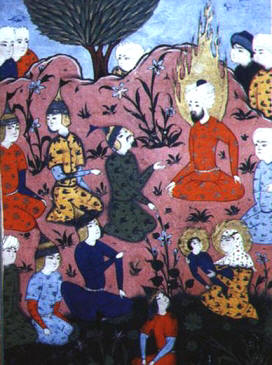
In my view, he was a kind of religious genius born in a fertile place and time: on the Silk dish_sermon Road, when Hellenistic ideas about body and soul had begun to take root in the Middle East, and when the winds of eastern mysticism—with the idea of karma, for instance—blew in from Persia and farther afield. Jesus grasped these concepts, and weaved them into his teaching, overturning traditional Jewish assumptions though building on some of them as well. The Sermon on the Mount offers a unique blend of western and eastern thought, summarizing his ideas. Here he puts forward his radical notions about nonviolent resistance to evil. In the gospels, he spoke in challenging aphorisms and parables. As he walked and taught in Galilee, he modeled behavior that shocked those in who met him.

By his death and crucifixion, he modeled suffering and death as well as life. He understood that his life was symbolic, even mythical. And by his resurrection—which was not the Great Resuscitation but a kind of magical transformation into a new form of life, eternal life, he offered humanity hope.

In an excerpt from his book, Parini elaborates on the significance of the resurrection, noting that when Jesus first appeared to Mary Magdalene, she didn’t recognize him:

Nobody recognized Jesus at first — a point of huge significance, as it underscores the difficult and mysterious nature of the Resurrection, which defies all norms and defeats rationalization.

The embodied spirit of the Messiah returning from the dead was not exactly the same person who died but some altered version of Jesus, transmogrified more than restored to his former state. In reality, the manifestation of Jesus after his death beggars the imagination: he acquired a spiritual body, as we read in I Corinthians 15:44: “It is sown a natural body; it is raised a spiritual body.” There is a subtle teaching here: We should not expect to recognize Jesus at first, even as he wakens within us.

In August, Parini spoke to Ron Charles about how his account differs from Reza Aslan’s controversy-stirring Zealot:

While expressing admiration for Aslan as a writer, Parini takes issue with Aslan’s thesis in “Zealot” that Jesus was a “politically conscious Jewish revolutionary” who advocated overthrowing the Roman Empire. “The core of the Jesus message is what has made him relevant for 20 centuries,” Parini said. “That message — embodied in the Sermon on the Mount — is one of passive resistance to violence. Turn the other cheek. It’s the essence of Christianity. One has to cherry-pick a few odd remarks by Jesus, then read them out of context while ignoring the vast bulk of the Gospels to think Jesus was a zealot, and then — if he were — would anyone care about yet another violent rebel from Galilee, most of whom are now forgotten?”

(Image of Persian Jesus (Isa) miniature of the Sermon on the Mount, date unknown, via Wikimedia Commons)

Quote For The Day

“I have never separated the writing of poetry from prayer. I have grown up believing it is a vocation, a religious vocation. What I described in Another Life—about being on the hill and feeling the sort of dissolution that happened—is a frequent experience in a younger writer. I felt this sweetness of melancholy, of a sense of mortality, or rather of immortality, a sense of gratitude both for what you feel is a gift and for the beauty of the earth, the beauty of life around us. When that’s forceful in a young writer, it can make you cry. It’s just clear tears; it’s not grimacing or being contorted, it’s just a flow that happens. The body feels it is melting into what it has seen. This continues in the poet. It may be repressed in some way, but I think we continue in all our lives to have that sense of melting, of the ‘I’ not being important. That is the ecstasy. It doesn’t happen as much when you get older. There’s that wonderful passage in [Thomas] Traherne where he talks about seeing the children as moving jewels until they learn the dirty devices of the world. It’s not that mystic. Ultimately, it’s what Yeats says: ‘Such a sweetness flows into the breast that we laugh at everything and everything we look upon is blessed.’ That’s always there. It’s a benediction, a transference. It’s gratitude, really. The more of that a poet keeps, the more genuine his nature. I’ve always felt that sense of gratitude. I’ve never felt equal to it in terms of my writing, but I’ve never felt that I was ever less than that,” – Derek Walcott.

Original Sin’s Family Tree

Noting that “genetic diversity in the human population is not consistent with what we would expect if all humans had descended from a single pair of individuals,” Loren Haarsma grapples with what that means for the Christian understanding of original sin:

A variety of scenarios are being proposed by Christian scholars today for how we might understand the Adam and Eve of Genesis 2, and their disobedience in Genesis 3, in light of modern science. Some scenarios propose Adam and Eve as two individuals living in Mesopotamia just a few thousand years ago, acting not as ancestors but as recent representatives of all humanity. As our representatives, their disobedience caused all of humanity to fall into sin. Other scenarios propose Adam and Eve as two individuals, or as literary representations of a small group of ancient representative-ancestors, selected out of a larger population, living in Africa over 100,000 years ago at the dawn of humanity; they were ancestors—but not the sole ancestors—of all humans today; they fell into disobedience against God over a relatively short period of time with a fairly distinct “before” and “after.” Other scenarios propose that Adam and Eve’s disobedience in Genesis 3 is a symbolic retelling of the story of every human who, over our long history, became aware of God’s claims on how they ought to live, and then disobeyed.

Jerry Coyne snarks:

Adam and Eve couldn’t have been the literal ancestors of all humanity. Normally, such a scientific trashing of scripture could be absorbed, at least by liberal theologians. They’d just reinterpret Adam and Eve as metaphors. But that causes big trouble on two counts.

First, if there really were 2,000 or more ancestors, then all of them must have transgressed to bring original sin into the world. That is hard to fathom: did everyone do something bad at the same time? Second, if Adam and Eve were metaphors, and the source of original sin is mysterious, then we have no idea why Jesus died. After all, his death and Resurrection occurred precisely to save us sinful humans from the transgressions of Adam and Eve. If you have to turn that story into a metaphor, then Jesus died for that metaphor. That’s not too palatable to Christians.

An easy and sensible way to solve this conundrum is to assume that the whole scenario is concocted: humans don’t have original sin; there was no Adam and Eve; and the Resurrection and divinity of Jesus were fictions. But Christians won’t have that, for the meaning of Jesus’s life, death, and resurrection is the final, non-negotiable “truth” of Christianity. You can see everything else as metaphorical, but not that. For if you metaphorize Jesus, you’re basically abandoning Christianity.

Recent Dish on original sin here.

Making God In Our Own Image

Paula Marantz Cohen attempts to understand George Eliot’s desire for Christian morality without a Christian deity:

Eliot … was an enormously pious young girl. In Eliot’s The Mill on the Floss, the young heroine, Maggie Tulliver (an autobiographical portrait of its author at that age) is obsessed with God. Maggie reads Thomas a Kempis’ Imitation of Christ, a book that greatly influenced the young Eliot. But in 1853, her knowledge of German led her to another book, Ludwig Feuerbach’s The Essence of Christianity, which she went on to translate. Feuerbach argued that God is not external to us but a projection of our best qualities as human beings. The Devil is the projection of our worst. This way of thinking came to inform Eliot’s view of God, and influenced her understanding of art and the task of the artist.

Last year, in an essay exploring Eliot’s attitude toward religion, Rohan Maitzen drew a parallel between Eliot and Marilynne Robinson:

“It seems to me,” the novelist Marilynne Robinson has said, “that anything that is written compassionately and perceptively probably satisfies every definition of religious whether a writer intends it to be religious or not.”

Like Eliot, Robinson asserts continuities between belief and unbelief, but she does so by identifying as religious what Eliot saw as intrinsically human feelings. Call them “religious” if you like, Eliot might have said. “I have no longer any antagonism,” she wrote in her letters,

towards any faith in which human sorrow and human longing for purity have expressed themselves; on the contrary, I have a sympathy with it that predominates over all argumentative tendencies.

Against those “argumentative tendencies” that seem to define the cultures of atheism and religion alike today, Eliot offers us novels like Silas Marner, novels that express her own faith that with sufficient understanding and attention to what is apart from themselves, people can be their own salvation.

Suicide And Secularism

Jennifer Michael Hecht, author of Stay: A History of Suicide and the Philosophies Against It, argues that in “the decades leading up to the Englightenment … open-minded questioning of religion became increasingly associated with an acceptance of suicide”:

Christianity did not initially reject suicide…. In fact, Jesus’ death was understood by many as voluntary. In the Book of John, Jesus says: “No man taketh [my life] from me, but I lay it down of myself.” Then came the martyrs. Some did not want to die, but many did. “I am yearning for death with all the passion of a lover,” wrote Ignatius of Antioch. … The rage for martyrdom went on for centuries. …

The defense of suicide was taken up most forcefully by David Hume in Britain and Baron d’Holbach in France. In their writings, neither man dwelled on the horror that a suicide can bring to family and friends, nor did they consider that suicides, if saved, might get over their misery, averting a tragic error. Hume poked fun at the church, arguing that if death were entirely the purview of God it would be a sin to avoid a stone that falls toward our head. D’Holbach pitied those forced by their belief in God to endure sadness rather than end their lives at will. Both Hume and d’Holbach considered suicide a valid escape from misery.

Hecht continues, “That view, now a defining stance of secular culture, is a mistake and needs rethinking”:

No matter how much of a burden a person thinks he is, it is nothing compared to the burden of his suicide. People do wrenching damage to their communities when they kill themselves. Studies have shown that when parents of children under 18 kill themselves, their children are three times more likely to kill themselves than children who make it to 18 with both parents alive. When one person in a community kills him or herself, the suicide rate in that community spikes. Sometimes it is called “suicidal clusters,” sometimes “suicidal contagion,” sometimes “social scripting,” but the sociology, epidemiology, and psychology literature clearly shows that if you kill yourself it is likely that others will follow you into the grave.

Suicide contagion has been most exhaustively studied in high schools and colleges. It seems that the first suicide normalizes suicide for those who follow; victims give each other the idea that suicide is an acceptable way to deal with problems.

Previous Dish on suicide here, here, and here.  The Dish thread “Suicide Leaves Behind Nothing” is here.

Bambi’s Jewish Heritage

Paul Reitter explores how a Jewish perspective might have informed Bambi: A Life in the Woods, the 1923 novel by Austrian writer Felix Salten that was adapted into a Disney movie in 1942:

Writing about a Bambi spin-off in 1930, [Karl] Kraus claimed to detect the sound of Jewish dialect—or “jüdeln”—in the speech of Salten’s hares. Salten was a hunter (a humane one, he always insisted), and, as it happened, he had just published a piece about his love of hunting. Kraus joked that Salten’s hares had adopted a Yiddishy tone of voice in order to blend in with a special type of enemy—the Jewish hunter. The hares were “perhaps using mimicry as a defense against persecution.” When Salten died in 1945, an American critic found a more straightforward connection between the plight of some animal characters and that of the Jews. In his obituary for Salten, the critic, having noted Salten’s “Zionist sentiments,” maintained that the fox in Bambi not only comes across as the rapacious “Hitler of the forest,” but also has a mentality of hatred and rage that bears similarities with Goebbels’ anti-Semitism.

It was not until a decade ago, however, that an actual reading of the “Zionist overtones” in Bambi was proposed.

In an essay published in 2003, Iris Bruce argues broadly that the novel evokes the “experience of exclusion and discrimination.” But she also pays close attention to its language. Salten’s suggestive phrase for butterflies is “wandering flowers,” and Bambi describes them elsewhere as “beautiful losers” who have to keep moving, “because the best spots have already been taken.” Bruce stresses, as well, that the culture of the deer develops around the fact of their victimization: They tell their children tales that “are always full of horror and misery.”

Likening Bambi to Kafka’s talking-ape story “A Report to an Academy,” Bruce claims that Salten’s work, too, is a critique of assimilation. One of the deer uses the loaded verb verfolgen to ask whether humans and deer might get along: “Will they ever stop persecuting us?” When another deer answers that “reconciliation” with humans will eventually come about, Old Nettla, a third deer with vastly more experience of the world, will have none of it. Indeed, her response foreshadows a line from Salten’s Zionist book Neue Menschen auf alter Erde (loosely translated, new people on ancient ground), which expresses impatience with the enduring “dream of full integration.” Old Nettla seethes that humans, “have given us no peace and have murdered us for as long as we’ve existed.”

This lecture offers more on the subject.

(Video: Scene from Disney’s Bambi in Hebrew)