Maria Konnikova considers why, “in the current media environment, a list is perfectly designed for our brain”:
Lists … appeal to our general tendency to categorize things—in fact, it’s hard for us not to categorize something the moment we see it—since they chunk information into short, distinct components. This type of organization facilitates both immediate understanding and later recall, as the neuroscientist Walter Kintsch pointed out back in 1968. Because we can process information more easily when it’s in a list than when it’s clustered and undifferentiated, like in standard paragraphs, a list feels more intuitive. In other words, lists simply feel better.
But the list’s deepest appeal, and the source of its staying power, goes beyond the fact that it feels good.
In 2011, the psychologists Claude Messner and Michaela Wänke investigated what, if anything, could alleviate the so-called “paradox of choice”—the phenomenon that the more information and options we have, the worse we feel. They concluded that we feel better when the amount of conscious work we have to do in order to process something is reduced; the faster we decide on something, whether it’s what we’re going to eat or what we’re going to read, the happier we become. Within the context of a Web page or Facebook stream, with their many choices, a list is the easy pick, in part because it promises a definite ending: we think we know what we’re in for, and the certainty is both alluring and reassuring. The more we know about something—including precisely how much time it will consume—the greater the chance we will commit to it.
The process is self-reinforcing: we recall with pleasure that we were able to complete the task (of reading the article) instead of leaving it undone and that satisfaction, in turn, makes us more likely to click on lists again—even ones we hate-read. The social psychologist Robert Zajonc, who made his name studying the connection between emotion and cognition, argued that the positive feeling of completion in and of itself is enough to inform future decisions. Preferences, goes his famous coinage, need no inferences.
Previous Dish on the allure of the list here, here, and here.
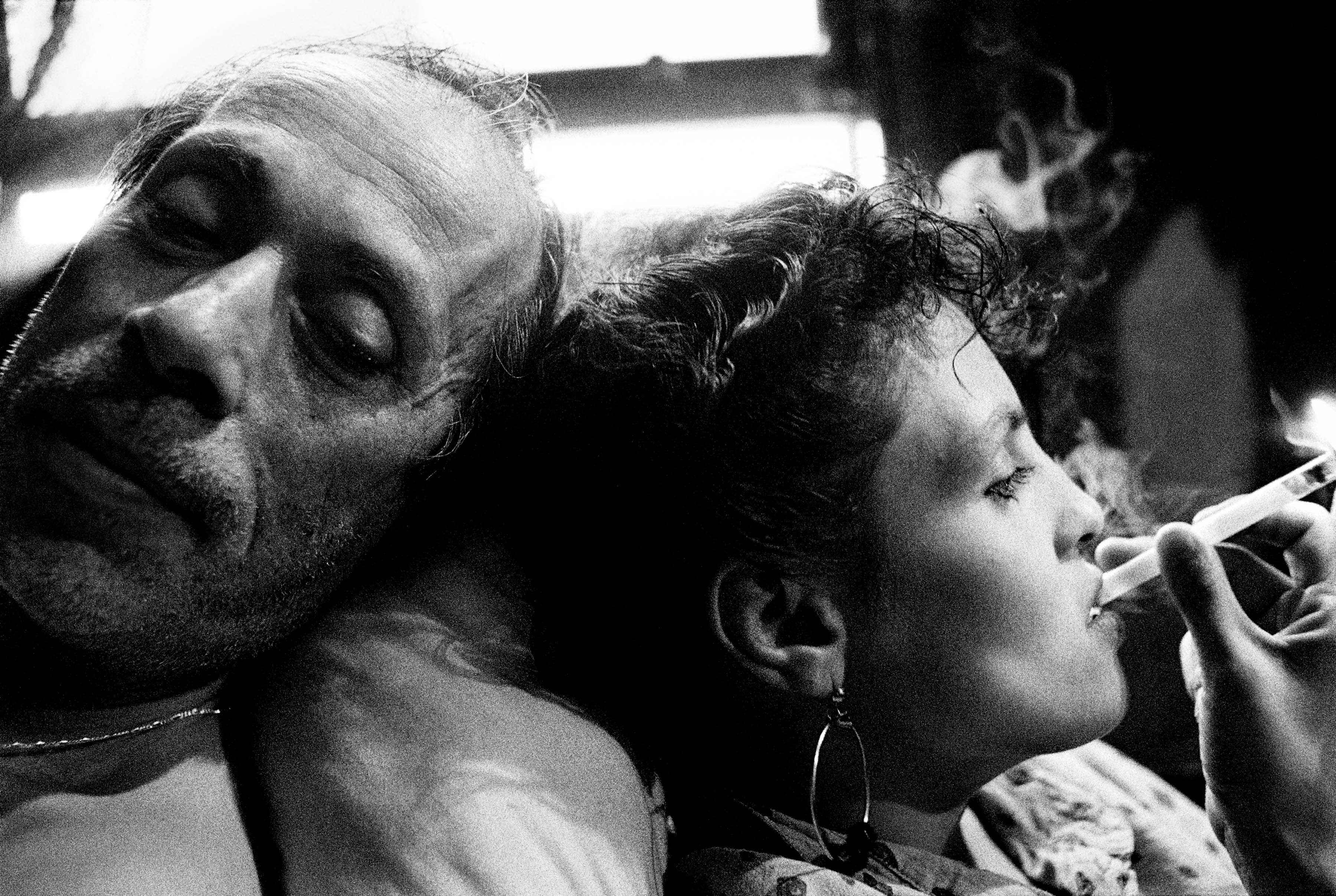
For 31 years, photographer Marc Asnin documented his maternal uncle, Charlie Henschke, creating a raw and unflinching series he edited into a book titled Uncle Charlie, published last year by Contrasto. It’s a journey that began during Asnin’s freshman year of college, when the photographer-nephew still felt hero-worship for his uncle and discovers the many problems his uncle faced.
As a boy, Asnin admired his uncle and his rebellious nature: Henschke was tattooed, kept a gun in his glove compartment, and knew the streets. Although Asnin knew everything wasn’t perfect behind that façade, the complexities behind the image began to emerge as the project advanced. … The book, which features Henschke’s commentary on his own life, is startlingly honest. Although Asnin warned Henschke that he might not want to share specific parts of his life, Henschke refused, saying, “No, that’s how I feel, and I want everyone to know that, including my children.”
(Caption via Behold: “After his second marriage dissolved, Charlie started a new relationship with Blanca, a woman 25 years younger than him. In this photo, Blanca is smoking crack.” Photo by Marc Asnin. More about his book, Uncle Charlie, is here.)
Focusing on the Discovery Channel’s new series Naked and Afraid – which chronicles the experience of “one man and one woman [who] are stranded nude in hostile wilderness without food or water for 21 days” – Joan Marcus examines how she is both drawn in and repulsed by the genre:
Over the years I’ve watched everything from the 2004 makeover show The Swan, in which normal-looking women undergo radical plastic surgery and then compete in a freakish beauty pageant, to Here Comes Honey Boo Boo, that grotesque excuse to mock the taste level and dietary habits of the working poor in rural Georgia. I teach a college pop culture seminar, and I like to write about pop culture, which gives me a handy excuse to indulge in reality dreck ad infinitum.
Shows are always upping the ante — increasing the shock factor, finding new ways to traffic in the risqué, the humiliating, the dangerous and disgusting. The more morally questionable a show is, the more likely I am to tune in on the excuse that anything this excessive has to be examined. I do like to think about how, in affording us the pleasure of judging real people in stressful and potentially humiliating situations, these shows palliate us — situating us comfortably in our own realities, reaffirming our cultural norms and making us more satisfied with our own lot in life. But of course my interest is not just intellectual. I’m as rabid a consumer as anyone, and shows like Naked and Afraid that push the boundaries of ethics and decency are on some primal level just a really, really good time.
Obviously I’m not alone here.
4.15 million viewers tuned in for the series premier of Naked and Afraid. The finale was the number one original cable show among women and men ages 25-54; a new two-hour special episode is set to air on December 8. The success of the first season isn’t surprising considering the provocative premise: a man and a woman who have never met, forced to partner up for survival and companionship without one stitch of clothing other than what they can find or make. They have to sleep in close quarters, in makeshift shelters, perhaps huddled together for warmth. They are survivalists, so most likely superior physical specimens who should make for pleasant TV viewing as they bathe in streams and lagoons, haul wood and tend fire and thrust handmade spears into the vitals of wild animals.
But Naked and Afraid turns out not to be particularly sexy. Those of us who tuned in for the nudity probably stuck around for something more troubling: The experience of seeing people at their most vulnerable under constant risk of bodily harm. It’s cringe-worthy, all that unprotected human flesh exposed to every threat imaginable, from sand flies and leeches to caimans and pit vipers.
“We’re just warm, pink, soft bodies,” Billy Berger complains in episode six as he slogs crotch-deep through the Louisiana bayou. “Everything … wants to take a bite of us.” Pinkness does appear to be a distinct disadvantage on this show. In episode three, filmed on a sun-scorched scrap of land in the middle of the Indian Ocean, Jonathan Klay burns brick red and spends days lying in the sand and moaning. His partner Alison Teal fairs better, suffering only debilitating menstrual cramps and the standard starvation and dehydration routine. I feel for Teal — two days of crippling dysmenorrhea would have me out of the game for sure — but all in all she does well in the Maldives compared to cast members in other episodes. E.J. Snyder steps on an acacia thorn in Tanzania and gets a gruesome infection in the sole of his foot — we see a stomach-churning close-up of the medics slitting the wound and draining the suppuration while he screams his head off. Laura is covered head to toe in sand fly bites, her entire body miserably swollen. Billy and Ky get trench foot. Kim falls deathly ill from bad turtle meat. Puma drinks contaminated water and is carted away on a stretcher. It’s like a live action version of Edward Gorey’s Gashlycrumb Tinies, so macabre it’s hard to believe all of this is really being served up as entertainment.
Meanwhile, the Pulitzer Prize-winning writer Edward P. Jones describes his fascination with reality TV and lurid Internet news stories:
INTERVIEWER: You’ve said that TV was a kind of company for you.
JONES: People pooh-pooh it, but on the court shows there’s something wonderful at times, and also awful. There was one episode, I remember, on Judge Judy. This handsome mother and her teenage daughter were suing another woman over two cell phones. They had seen them on eBay and what the woman ultimately sent them was a page showing two cell phones. The woman’s defense was that that’s what they were looking at, that’s what they got. The utter gall of people in life!
Other things I like to watch are true-crime shows—Dateline, 48 Hours. I’m fascinated by the awful, awful things that human beings do to each other. Just the other day, on Huffington Post—AOL is the page that my computer opens up to—a father took his six-week-old infant, because the child was crying, and he put her in the freezer. Luckily, she was saved.
I have been trying to help a friend of mine with her novel over the past few years, and what I noticed, and told her, is that she was failing to show the awfulness of human beings. I’m just fascinated by that father. Because I’ve never done a thing like that, could never conceive of doing that. To see people do these things—I don’t know, I feel blessed.
Ken Budd describes the challenges of writing and researching in the wake of his father’s death:
Writing a memoir is a selfish act. For the memoir to work, to truly be alive, the honesty of the writing must outweigh the feelings of your subjects. As the central figure, you have to write what scares you: the drama resides in the dark places where you’re least comfortable. And that means exposing yourself. It’s like ripping off the front of your house and saying, “O.K., here we are, take a look — I’ll be in the shower if you want a closer view.” If you can’t do that — if you’re unwilling to bleed, naked, on the page — why write memoir?
This honesty isn’t easy for friends and family, who probably weren’t eager to be “characters.” But the living can at least retaliate. A fellow writer once told me about a friend who released a memoir. “It’s really good,” she said. “He shares all these wonderful stories about his family. None of them will speak to him anymore, but it’s a really good book.”
The dead can’t retaliate. And I didn’t just write about my father’s life — I probed that life. Our relationship was strong, but parts of him were unattainable to me. He was a workaholic. He spent long hours at the office. Like me, he internalized his thoughts. So I compensated by interviewing his friends and co-workers, who told me stories I’d never heard. A former boss revealed how he and my father laid off 30 workers, agonizing over the horrible task. … Once that narrative goes from the mind to the page, the dead can’t correct you; they can’t say, “Wait — that’s not how I remember it…”
Though disabled gamers may still be cut off from traditional gaming systems to some degree, a growing number of developers are using the built-in accessibility features of mobile devices like the iPhone and iPad—voiceover, assistive touch, and guided access—to create games for physically disabled and visually impaired players that don’t require the specialized hardware that living-room gaming consoles often do.
BlindSide is one of those games. It’s a survival horror setup, about an assistant professor named Case who wakes up next to his girlfriend, Dawn, in their apartment, after what initially appears to be a power outage. But Case, Dawn, and everyone else have actually inexplicably become blind. At the same time, scary-sounding monsters roam the city. Because Case is new to the feeling of being blind, one of the objectives of the game is to teach players to navigate the environment using audio cues, both from Case, who yells when he bumps into things—“The door is to my left, the kitchen is to my right”—and subtler hints, like the way sound travels in a particular environment. For example, if you’re facing an open window, you hear traffic noise in both speakers, but if you turn to the right, you only hear the noises in the left speaker. Other sounds—a dripping faucet or a noisy TV—also help you get around. …
[A] large part of BlindSide’s success seems tied to the fact that it doesn’t feel like a game that’s been designed for disabled players. A game with no visual stimulus can be just as engrossing for players who can see as for those who cannot, it seems.
Daniel Mendelsohn, the classicist and essayist, reflects on the rudiments of good criticism:
One of the courses I like to teach is a Great Books course that’s mandatory for first year students, and after I read their first papers it’s always very clear to me that they have no model, no template for what a critical essay is supposed to do—what (or how) you’re supposed to be arguing when you’re writing about a text or a movie or anything. They don’t understand there is a rhetoric of criticism—that there’s a stance you have to have, that you have to position yourself, that you don’t just blather about your impressions or your “opinions” or, worse, your “feelings” about a work. They literally have no idea, at first, what the point of being critical is—no doubt because, in part, they are being raised in a culture where a bland, everything-goes, multi-culti niceness is the paramount virtue. You have to know who you are—as a person, but also as a member of a given civilization—in order to speak about a work.
I always tease them at the beginning of the semester about their writing—I say, “Whenever you write me at 11 o’clock on a Thursday night begging me for an extension on the paper, the prose is always so beautiful and the email is so wonderfully structured.”
It’s a joke, but it’s also not a joke—in that situation they understand the rhetoric of the form to which they’re committing themselves: They understand who they are as a writer and a beseecher, they understand who I am as the person in charge, they understand what evidence to adduce in their favour—their dog died, their computer broke or whatever. Which is why the email begging for the paper extension is always a well-written piece. But whenever they have to write three paragraphs about women in Genesis or whatever—when they have to make an argument—it’s basically “word salad,” because they’ve never read anything that presents a text, wrestles with it and comes up with some conclusions. For that reason, I think it’s better that they should be reading Pauline Kael reviews in the New Yorker than Derrida.
Mairead Case contemplates Beckett’s 1958 work Krapp’s Last Tape, a one-act play “about power, ritual, sound, and men, set on a ‘late evening in the future'”:
It is small, a punch: Krapp, a desk, a banana, a closet with a light, a tape recorder, some reels, and some fart jokes. Every year on his birthday, Krapp records a tape about his thoughts and whatever’s happening in his life. Then he listens to it and the ones he made earlier. The play is very funny and very sad and still beautiful. It is barely half an hour — all power, no clutter. There is no one else, not even a dog or a landlady, and since Krapp doesn’t seem cold or hungry or locked in we think yes, okay this is how he wants it. …
The first five minutes — or ten or fifteen — of the play are silent. Krapp shuffles around the stage; he eats a banana, pours himself booze. When he finally speaks — “spool” — it’s funny, like blowing a raspberry at a funeral to make a baby laugh. First Krapp listens to older reels — here he is, throwing a ball for a little white dog; and there in a boat, with a lady who has gooseberry scratches on her thigh — and next he records a tape for this year, his sixty-ninth. He has to restart it a couple times. He is freaking out about his dogs loose in the desert. “Everything there, everything on this old muckball, all the light and dark and famine and feasting of… the ages!” Krapp says. “Yes! Let that go! Jesus!” He is passionate and so crabby.
Case imagines a conversation between Krapp and Gertrude Stein:
In all ten years I’ve been reading it though, Krapp never once gets up from that table for real. I want to put Gertrude Stein next to him. Maybe her head is in her hands, or maybe her chin is out, defiant. “If everybody did not die the earth would be all covered over,” Stein tells Krapp, like she says in Wars I Have Seen (quoted also in Claudia Rankine’s Don’t Let Me Be Lonely). “And I, I as I” — I as I! I can be someone else a while — “could not have come to be and try as much as I can try not to be I, nevertheless, I would not mind that so much, as much as anything, so then why not die, and yet and again not a thing, not a thing to be liking, not a thing.” I don’t think Krapp would get up, even then.
A long excerpt from David Foster Wallace’s “The Depressed Person” (pdf), which first appeared in the January 1998 issue of Harper‘s:
The feelings of shame and inadequacy the depressed person experienced about calling members of her Support System long-distance late at night and burdening them with her clumsy attempts to describe at least the contextual texture of her emotional agony were an issue on which she and her therapist were currently doing a great deal of work in their time together.
The depressed person confessed that when whatever supportive friend she was sharing with finally confessed that she (i.e., the friend) was dreadfully sorry but there was no helping it she absolutely had to get off the telephone, and had verbally detached the depressed person’s needy fingers from her pantcuff and returned to the demands of her full, vibrant long-distance life, the depressed person always sat there listening to the empty apian drone of the dial tone feeling even more isolated and inadequate and unempathized–with than she had before she’d called. The depressed person confessed to her therapist that when she reached out long-distance to a member of her Support System she almost always imagined that she could detect, in the friend’s increasingly long silences and/or repetitions of encouraging cliches, the boredom and abstract guilt people always feel when someone is clinging to them and being a joyless burden. The depressed person confessed that she could well imagine each “friend” wincing now when the telephone rang late at night, or during the conversation looking impatiently at the clock or directing silent gestures and facial expressions communicating her boredom and frustration and helpless entrapment to all the other people in the room with her, the expressive gestures becoming more desperate and extreme as the depressed person went on and on and on.
The depressed person’s therapist’s most noticeable unconscious personal habit or tic consisted of placing the tips of all her fingers together in her lap and manipulating them idly as she listened supportively, so that her mated hands formed various enclosing shapes – e.g., cube, sphere, cone, right cylinder – and then seeming to study or contemplate them. The depressed person disliked the habit, though she was quick to admit that this was chiefly because it drew her attention to the therapist’s fingers and fingernails and caused her to compare them with her own.
You have until noon on Tuesday to guess it. City and/or state first, then country. Please put the location in the subject heading, along with any description within the email. If no one guesses the exact location, proximity counts. Be sure to email entries to contest@andrewsullivan.com. Winner gets a free The View From Your Window book or two free gift subscriptions to the Dish. Have at it.

 The Dish