Fighting HIV Without Condoms?

Condom

About fifteen years after most gay men figured it out, Mark Joseph Stern stumbles onto the truth that, with HIV no longer a death sentence in developed countries, the era of simply scaring gay men away from unprotected sex is over. And, unlike so many well-meant public health campaigns, he is prepared to tell the obvious truth:

Bareback sex feels better for both partners. At some point, almost every gay man will learn this fact—so why lie about it?

Indeed. That one fact combined with one other – that middle-class gay men can suppress the virus indefinitely with the cocktail – has to be integrated into a sane, safer sex message. I’ve been banging on about this for years, of course, and there have been initiatives, in San Francisco particularly, where these insights have indeed been integrated into public health campaigns. And they’ve been among the most successful in restraining infection. But Stern goes one step further:

If we don’t give gay men the promise of the reward, a foreseeable end to the hassles of condoms, they’re bound to get frustrated and either slip up or give up. Giving men the goal of a committed relationship—and with it, the perk of unprotected sex—might convert barebacking from a forbidden fruit to a reward worth working toward.

Yes, and no. First off, can we retire the term “barebacking” and simply refer to it as sex without condoms, i.e. the activity formerly known as sex? Stigmatizing latex-free sex as “barebacking” may have had some logic in the plague years, but it can be psychologically toxic today. It renders the most intimate of sexual interactions a pathology, and that can’t be right.

Second, the prize of non-rubbered sex in a monogamous relationship is a little more fraught than Stern makes it out to be. It makes huge sense if both men are HIV-positive. In that case, there is no danger that sex outside the marriage – sometimes lied about, or hidden, or unspoken – can lead to indirect infection, because both men are infected already. But if both men are negative, it puts much more pressure on monogamy and on a marriage than might be wise. One slip and you’re not only betraying your partner, you could also be deeply damaging his health. Although it’s noble as an ideal, the standard here may be simply practically too high, certainly over a lifetime, for most men to achieve. And the consequences of failure can be terrible for a relationship.

I think we should leave it to married couples or committed lovers to figure their way through this – and avoid harshness and easy judgment. We’re all human and in sexual desire, more human and flawed than in most other areas. But, as a practical matter, you don’t have to restrict non-rubbered sex solely to monogamous married couples to have an impact on infection rates.

The more important goal is for HIV-positive men to have sex mainly with other HIV-positive men, restricting the virus to a pool of the already infected. This is called “sero-sorting” and it has happened for years (it was my strategy back in the day for making sure I never put anyone at risk). It has cut infection rates markedly where it has prevailed. But for the HIV-negative, sero-sorting is a lot trickier. You simply cannot know if your sex partner is positive or not. He may not even know. Leaving rubbers behind is a big risk always in this context, even though it is far, far smaller than it once was. A more practical option for HIV-negative men is to go on Prep – take preventive HIV drugs to make infection far less likely even without condoms, and to use condoms outside a truly monogamous relationship or marriage.

So add it up: tout the intimacy of rubber-free monogamy for some; encourage HIV-positive men to have sex with other HIV-positive men; get as many HIV-negative men onto preventive drugs that can drastically lower the risk of infection; and, above all, encourage disclosure and testing so that gay men, rather than being treated like children, can assess all the information and make informed choices. This wouldn’t be a panacea, but it would be a constructive way forward.

(Photo: By BSIP/UIG Via Getty Images.)

Now France Is Rolling Back Prostitution?

-

It’s moving in that direction:

On December 4th, the lower house of parliament voted [268 to 138] to make prostitution a crime for those who pay for sex, subject to a fine of €1,500 ($2,030) for a first offense and €3,750 thereafter. “I don’t want a society in which women have a price,” said Najat Vallaud-Belkacem, the women’s minister. She wants nothing less than to “abolish” prostitution in France.  With Germany having second thoughts about its decision over a decade ago to liberalize the world’s oldest profession, the French have decided to follow Sweden, Finland and Norway in restricting prostitution. Paying for sex is not now illegal, although brothels, soliciting and pimping are.

The bill must still pass the Senate and be signed by the president before it becomes law, a process that could take several months. Christopher Dickey calls the debate “ferociously ideological in ways that are very French indeed”:

While just about everyone denounces the trafficking of women and men treated as virtual slaves, much of the most passionate debate has focused on the cases of independent sex workers, a relatively small minority, and whether they have the right to use their bodies – and sell their services – as they see fit. The free-wheeling publication Causeur provoked sensational headlines when it issued a manifesto signed by hundreds of self-proclaimed “bastards” – all men – warning the government, “hands off my whore.” “We love liberty, literature and intimacy,” it claimed, “and when the state concerns itself with our asses, all three are in danger. … Against the ‘sexually correct,’ we intend to live like adults.”

But the most intense debate is not so much with or against macho posturing, it is among France’s feminists. The daily Le Monde discerned four or five distinct currents:

the prohibitionists, who want to forbid prostitution and consider everyone involved to be criminal; the abolitionists, like Vallaud-Belkacem, who want to do away with prostitution but don’t want to treat the prostitutes themselves as criminals; the libertarians, who argue that the state has no business interfering with whatever a woman wants to do with her own body; and the rule-makers, who take a similar position but think some regulation is necessary.

As Le Monde points out, these positions start to get confused when the same feminists are asked to address other issues. Thus Elisabeth Badinter, one of France’s wealthiest citizens and one of its most influential intellectuals, defends the right of women to sell their sexual services but opposes the right of Muslim women to wear the veil if they choose. (Merteuil of STRASS, by contrast, proclaims that her organization is “pro-sex, pro-porn, pro-whores, and for the freedom to wear the veil.”)

Feargus Sullivan looks at the trend across Europe:

France’s neighbor Germany, meanwhile, will be watching its plans closely. … The incoming coalition government plans to revise prostitution laws, and have just agreed to ban flat-rate brothels, where customers can purchase unlimited sex during a single visit for a fixed fee. They are also making it a crime to buy sex from someone who has been trafficked.

Meanwhile in Ireland, a consortium called Turn off the Red Light is campaigning for law changes similar to France’s. Irish public opinion is being swayed by a series of high profile exposés of the sex trade’s international reach, pushing the issue up the public agenda. Even in the famously permissive Netherlands, Amsterdam is reining in its red light district.

The issue seems to be human trafficking:

According to a EU-funded report, over 23,000 people were trafficked in Europe between the years 2008 to 2010, and 62 percent of them for were destined for sexual exploitation. While pro-prostitution debate often focuses on a hypothetical free woman making an entirely unforced choice, the reality is that many European prostitutes have no such freedom. According to anti-trafficking campaigners, legal prostitution is making this situation worse, giving pimps and traffickers ways to operate further and hide their victims in plain sight.

Abolishing legal prostitution does seem to reduce trafficking. In Sweden, prostitution has plummeted since a 1999 ban on buying sex. In 2007, Der Spiegel reported a maximum of 130 prostitutes working in Stockholm, compared to 5,000 in its smaller Norwegian neighbor Oslo (which in 2009, followed Sweden’s ban with its own). And while an estimated 600 women are believed to be trafficked into Sweden every year, this number pails in comparison to the 15,000 trafficked annually to Finland, a country with a population half the size.

But of course, no one can verify how much prostitution and trafficking continues undetected. The amount may have drastically fallen, but occasional cases such as that of a judge fined for visiting a brothel suggest that a prostitution underworld does persist in Sweden.

Recent Dish on prostitution in Europe here.

(Photo: A prostitute dances during a demonstration of sex workers in Paris on December 4 after French lawmakers approved a controversial bill that will make the clients of prostitutes liable for fines starting at 1,500 euros ($2,000). By Joel Saget/AFP/Getty Images)

The View From Your Window

Cape Town-SA-540am

Subscriber here, in South Africa for an AIDS conference.  It was quiet late last night as Cape Town was soaking in the news of Mandela’s death. I snapped this pic of Greenmarket Square and Table Mountain from my hotel room at 5:40am – the first dawn in South Africa without Nelson Mandela in 95 years.

New Dish, New Media Update, Ctd

A subscriber writes:

I want to give more money, but I can’t. I e-mailed a few months back that I want to give more money on a bi-monthly basis or so, but that your current configuration won’t let me, since I’m already a subscriber. You have been on fire lately, so I was ready to slap down another $150, but I can’t. CAN YOU HELP ME GIVE YOU MORE MONEY?

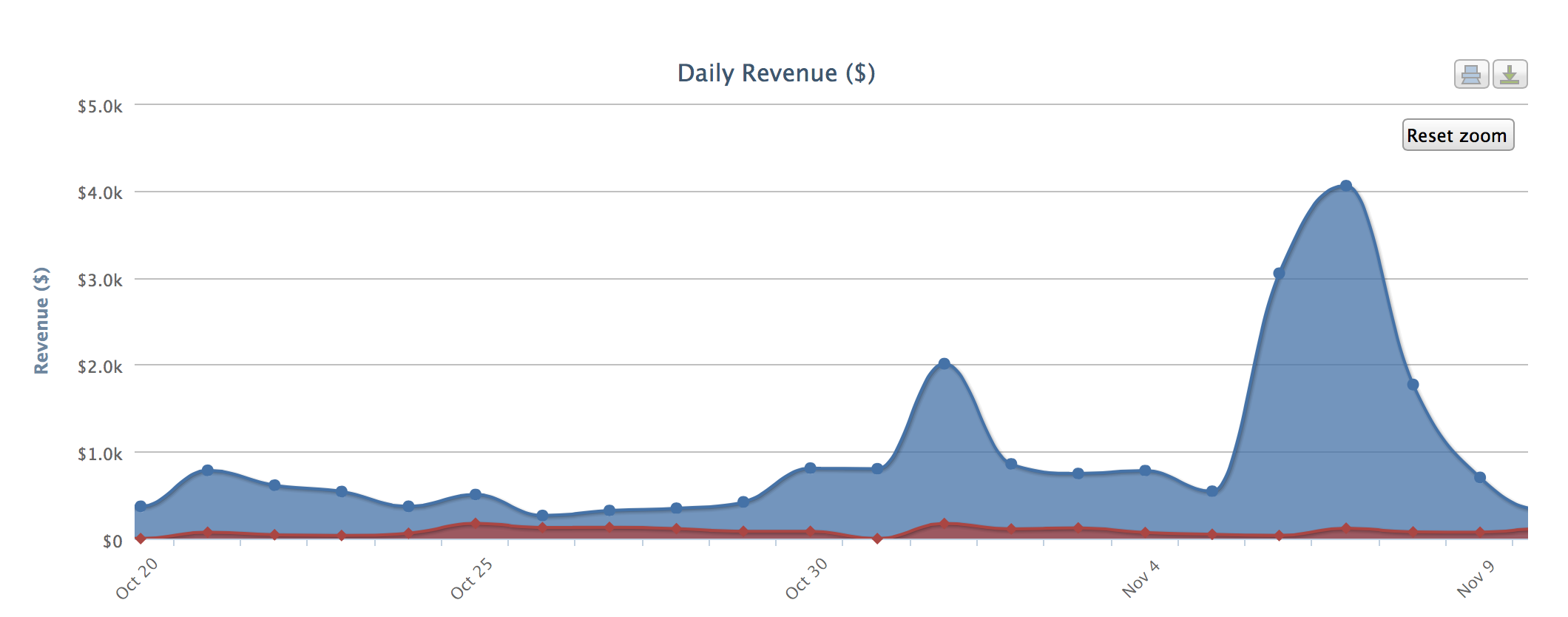
You bet we can. Our core plea to readers like you is to renew your subscription next year at a higher level. What we need is a stable source of income – and the best way to support us structurally is to subscribe as generously as possible. Remember that you can set your own price – and if you want to say thanks for a year of hard work and innovation, just give us more when renewal comes due. The more you give, the more we can do. We have no venture capital, except our readers. And that’s good enough for us. But if you’re as eager as the reader above, an option to help us right now is to purchase a Christmas gift subscription for a friend, a family member or a colleague – for any amount, $19.99 or above. (And remember, gift subs will not auto-renew, so don’t worry about getting charged again next year.) We suggested that option last month and the response was overwhelming:

Screen Shot 2013-12-05 at 9.10.24 PM

In fact, that spike was our biggest one since early February, when we rolled out the new site. So a huge thanks to all our gift-giving readers. (And drop us an email if you end up following suit, so we can thank you individually.) Another reader on yesterday’s update:

Reading your end-of-the-year discussion of how the business model has been going, and then getting to the figure of 41,000 of us who have exhausted all of the free reads, I am SO busted. I can say for certain that I look in here many times a day.  And true confession, I’ve run out of free on my laptop, iPad, Kindle and phone. I thank you and your staff for the fabulous energy I get here, for the intellectual thoughts, for helping me to broaden myself.  I owe more than the money I kicked in.

Another:

Sorry it took so long, this is why I finally subscribed: You pay your interns.

Another new subscriber:

Writing to let you know that your final subscription push has supplied the motivation to get this longtime reader to pay my dues. I check your site several times a day, and am always amazed at the range of topics and depth of coverage. I think what most keeps me coming back is the deep connection you and your team seem to have to humanity and the universal experience. You zoom in and zoom out, from window views to global climate change. I don’t always agree with your take on things, but the Dish always gets me thinking – I dig that.

The feeling is mutual. One of the wonderful things about this blog is how much the readers teach us every day about the world. That kind of constant, immediate interaction is unique to the web, and we’re really proud to have found a way to harness it to curate an informed, quirky and human conversation. We try to explore topics sometimes a little too controversial for other sites dependent on corporate advertizing – rape, pot, miscarriage, abortion, circumcision, race, sex and religion. We aim to be as honest and as balanced as we can, while still having a distinctive point of view.

What we’ve got is that rare privilege of a truly independent perch, answerable only to you, our readers. It’s close to unique online, and it’s only made possible by you. If you are part of this conversation and haven’t yet subscribed, we need you. Two minutes: less than $2 a month or less than $20 a year. Ask yourself if what you get out of the Dish is worth that. If it is, please [tinypass_offer text=”subscribe!”]

Update from a new subscriber:

My guilt about not subscribing finally overwhelmed me. I have been reading your site nearly every day since 2005 (I think I found you through the once great Oxblog) and I’ve never once emailed you, which makes this “relationship” a bit fraught as I’ve been looking through a one-way mirror in a creepy voyeuristic manner. I feel as though I know so much about you and you’ve never heard of me. I’ve always enjoyed reading your long-form work and I admire your team’s ability to aggregate, two skills that I don’t often find to be symbiotic, but it works with the Dish. In working through my guilt (I was brought up a Catholic) about not subscribing after you’ve given so much to me, I was thinking about the early 2000s when I graduated from college and your blog was a big part of my life.

One more:

Okay, okay, for fuck’s sake, I finally subscribed. Happy to do it, too – I enjoy your virtual voice, whether or not I agree with you (I’m a screaming liberal, and remarkably, I usually do agree with you. That’s more a comment on the state of “conservatism” than much else, but still). Cheers. And here’s to a great new year with The Dish.

Ask Rick Doblin Anything: The Myths Of Psychedelics

Our first video from psychedelic researcher and MAPS founder Rick Doblin:

From his bio:

Rick Doblin, Ph.D., is the founder and executive director of the Multidisciplinary Association for Psychedelic Studies (MAPS). He received his doctorate in Public Policy from Harvard’s Kennedy School of Government, where he wrote his dissertation on the regulation of the medical uses of psychedelics and marijuana and his Master’s thesis on a survey of oncologists about smoked marijuana vs. the oral THC pill in nausea control for cancer patients. His undergraduate thesis at New College of Florida was a 25-year follow-up to the classic Good Friday Experiment, which evaluated the potential of psychedelic drugs to catalyze religious experiences.

His professional goal is to help develop legal contexts for the beneficial uses of psychedelics and marijuana, primarily as prescription medicines but also for personal growth for otherwise healthy people, and eventually to become a legally licensed psychedelic therapist. He founded MAPS in 1986, and currently resides in Boston with his wife and three children.

Our extensive coverage of the spiritual and therapeutic benefits of psychedelics is here (or, in chronological order, here).

The ACA’s Missing Pieces

The part of Healthcare.gov that pays insurers won’t be built by January:

The administration is planning a “workaround” for payments, said Daniel Durham, vice president for policy and regulatory affairs at America’s Health Insurance Plans. Health plans will estimate how much they are owed, and submit that estimate to the government. Once the system is built, the government and insurers can reconcile the payments made with the plan data to “true up” payments, he said “The intent is to make sure plans get paid on time, which is a good thing,” Durham told Reuters.

The fix puts an additional “burden” on insurance companies, already taxed by having to double-check faulty enrollment data from the HealthCare.gov system. Now, companies need to quickly put together financial management systems to make the payment estimates, so they can be paid beginning in January, he said. “They have to recognize that plans are already quite stressed and introducing this at the last minute just adds substantial burden for plans to deal with,” Durham said.

Suderman takes the administration to task:

The core service that health insurers provide is paying for eligible claims by beneficiaries. But if insurers don’t get paid themselves, they can’t cut checks for those claims.

Some of the larger insurers could finance delays, at least for a little while, but as former Medicare official Kevin Lucia tells Reuters, smaller insurance plans, which are heavily represented in the health law’s exchanges, aren’t well equipped to do so. Plan providers need that money, and they need it soon if they’re going to be able to actually provide insurance to their plan members.

The fact that these critical systems haven’t been built—months after the launch of the exchanges and with just weeks to go until insurers need to start being paid—makes it clear that the implementation effort still lags far behind. And if the rollout of portions that remain incomplete resembles the rollout so far, that means there are lots of new problems still to come. But it’s not just that there’s a lot of work still to do. The insurer payment workaround also highlights how much of Obamacare’s buggy implementation is still being managed on a temporary, ad hoc basis. The administration is flying a broken vessel without a flight plan.

Meanwhile, Beutler parses recent enrollment numbers:

[T]he latest numbers — which administration officials are all of a sudden so eager to leak for some reason — really demonstrate three things. One is that it’s easy to torture scarce and selectively leaked data to fit just about any preconceived narrative. Another is that Healthcare.gov’s terrible rollout didn’t completely discourage people from giving the site a second look, let alone destroy the demand for health insurance across the country. Third is that, simply by leaking, administration officials demonstrated some degree of confidence that the worst of their implementation woes are behind them.

That’s all basically good news. But it’s really all we can say for now. And it doesn’t prove that the Affordable Care Act is completely out of the woods yet.

Mandela’s Legacy

A group of American and South African students, aged from 11 to 19, met with Nelson Mandela at the Nelson Mandela Foundation in Johannesburg, on 2 June 2009. This is part of a series of activities ahead of Mandela Day on 18 July.

Massie pays tribute:

We lapse into cynicism all too easily and sometimes cynicism is an appropriate response to the daily degradations of ordinary politics. But there are other times – and this is one – in which cynicism is best put aside. If we can – and we do – recognise greatness in other fields of human endeavour we should be prepared to countenance the idea it can exist in politics too. Few may be admitted to the pantheon but the pantheon exists.

Nelson Mandela was a great man. The greatest man of my lifetime. No-one else these past forty years has had such an impact. There were many heroes who helped tear down the Berlin Wall but none of them as individuals played as decisive or transformational role as Mandela did in South Africa.

Mark Gevisser reflects on yesterday’s news:

The words “Nelson Mandela is dead” feel strange in the mouth today, almost impossible to say, given the unique way he was both martyred and canonised during his lifetime. He embodies a paradox: on the one hand we love him for his humanity; on the other, he already passed long ago from the world of the flesh. He is a peak of moral authority, rising above the soulless wasteland of the 20th century; he is a universal symbol for goodness and wisdom, for the ability to change, and the power of reconciliation.

Gevisser considers how his halo affected South Africa:

Mandela’s perceived sanctity has had a powerful effect, not always positive, on the growth of the democracy he played so great a role in nurturing. Certainly, it has conferred on South Africa a moral heft that has enabled the country to punch significantly above its weight in the global arena, and it has accorded us South Africans an internal moral voice, even if we have not always heeded it: “What would Madiba do?”

But the Mandela legacy has also given South Africa a distorted sense of exceptionalism. We were, the world had us believe, the “world’s greatest fairy tale.” We were, our own beloved Archbishop Desmond Tutu told us, “the rainbow children of God.” How could we ever live up to such hype? How could we be as good—as forgiving or as a noble—as Mandela? And how could we ever deliver to the expectations of a global community that used Mandela as its measure? With every massacre, every national strike, every corruption scandal, we were found wanting, not least by ourselves.

Richard Stengel compares the man Mandela was before prison to the one he was after:

In many ways, the image of Nelson Mandela has become a kind of fairy tale: he is the last noble man, a figure of heroic achievement. Indeed, his life has -followed the narrative of the archetypal hero, of great suffering followed by redemption. But as he said to me and to many others over the years, “I am not a saint.” And he wasn’t. As a young revolutionary, he was fiery and rowdy. He originally wanted to exclude Indians and communists from the freedom struggle. He was the founder of Umkhonto we Sizwe (Spear of the Nation), the military wing of the African National Congress, and was considered South Africa’s No 1. terrorist in the 1950s. He admired Gandhi, who started his own freedom struggle in South Africa in the 1890s, but as he explained to me, he regarded nonviolence as a tactic, not a principle. If it was the most successful means to the freedom of his people, he would embrace it. If it was not, he would abandon it. And he did. But like Gandhi, like Lincoln, like Churchill, he was doggedly, obstinately right about one -overarching thing, and he never lost sight of that.

Prison was the crucible that formed the Mandela we know. The man who went into prison in 1962 was hotheaded and easily stung. The man who walked out into the sunshine of the mall in Cape Town 27 years later was measured, even serene. It was a hard-won moderation. In prison, he learned to control his anger. He had no choice. And he came to understand that if he was ever to achieve that free and nonracial South Africa of his dreams, he would have to come to terms with his oppressors. He would have to forgive them. After I asked him many times during our weeks and months of conversation what was different about the man who came out of prison compared with the man who went in, he finally sighed and then said simply, “I came out mature.”

Max Boot has high praise for Mandela:

[T]he largest part of the explanation for why South Africa is light years ahead of most African nations–why, for all its struggles with high unemployment, crime, corruption, and other woes, it is freer and more prosperous than most of its neighbors–is the character of Nelson Mandela. Had he turned out to be another Mugabe, there is every likelihood that South Africa would now be on the same road to ruin as Zimbabwe. But that did not happen because Mandela turned out to be, quite simply, a great man–someone who could spend 27 years in jail and emerge with no evident bitterness to make a deal with his jailers that allowed them to give up power peacefully and to avoid persecution.

Mandela knew that South Africa could not afford to nationalize the economy or to chase out the white and mixed-raced middle class. He knew that the price of revenge for the undoubted evils that apartheid had inflicted upon the majority of South Africans would be too high to pay–that the ultimate cost would be borne by ordinary black Africans. Therefore he governed inclusively and, most important of all, he voluntarily gave up power after one term when he could easily have proclaimed himself president for life.

Beinart recalls that many Americans didn’t always view Mandela so favorably:

They called him a “terrorist” because he had waged armed resistance to apartheid. They called him a “communist” because the Soviet Union was the ANC’s chief external benefactor and the South African Communist Party was among its closest domestic allies. More fundamentally, what Mandela’s American detractors understood is that he considered himself an opponent, not an ally, of American power. And that’s exactly what Mandela’s American admirers must remember now.

We must remember it because in Washington today, politicians and pundits breezily describe the Cold War as a struggle between the forces of freedom, backed by the U.S., and the forces of tyranny, backed by the USSR. In some places—Germany, Eastern Europe, eventually Korea—that was largely true. But in South Africa, the Cold War was something utterly different. In South Africa, for decades, American presidents backed apartheid in the name of anti-communism. Indeed, the language of the Cold War proved so morally corrupting that in 1981, Reagan, without irony, called South Africa’s monstrous regime “essential to the free world.”.

Moynihan wants a clear-eyed understanding of the civil rights leader’s flaws:

[H]ere is where one must bring the knives out for Mandela. For a man imprisoned for his political beliefs, he had a weakness for those who did the very same thing to their ideological opponents, but were allowed a pass because they supported, for realpolitik reasons, the struggle against Apartheid. So Mandela was painfully slow in denouncing the squalid dictatorship of Robert Mugabe. He was rather fond of Cuban dictator Fidel Castro (it won’t take you long to find photos of the two bear-hugging each other in Havana) and regularly referred to Libyan tyrant Muammar Qaddafi as “Brother Leader of the Revolution of the Libyan Jamahariya.” It was on a return visit to Robbin Island, when Mandela, as president, announced with appalling tone deafness that he would invite both Castro and Qaddafi to South Africa.

Eve Fairbanks highlights the continued economic inequalities between blacks and whites in South Africa and wonders, “How much truth is there to the perception that the terms worked out by Mandela and his fellow negotiators during South Africa’s democratic transition enriched a few blacks at the expense of the masses?”

I asked Pierre de Vos, a University of Cape Town–based constitutional scholar. “If you look at the final constitution, the African National Congress”—the ANC, Mandela’s party—“got about eighty percent of what they wanted,” de Vos told me over the phone. “I think the ANC out-negotiated the [Afrikaner] National Party completely.” However, there was also “a deal that was made outside” the constitutional negotiations, de Vos added, a “gentleman’s agreement” between Mandela and “the commanding heights of the economy.”

Adam Roberts also wants people to acknowledge Mandela’s flaws:

His achievements are the greater because he himself admitted to errors, at times bungling policy. Those failings matter. He was more likely to learn from mistakes than the haughty sort of leader who refuses to accept he made any. Others should pay as much attention to his slip-ups as to his achievements.

Take the great post-apartheid misery that South Africa suffered in the first two decades of democracy: the AIDS epidemic. Mandela failed as president to tackle the spread of HIV, even as terrifyingly large numbers of South Africans became infected. As early as 1991 he had grasped (judging from one of his private notebooks from that year) that the disease threatened a “crisis for the country.” Yet in office he did almost nothing to stop its spread. …

To his immense credit, however, Mandela conceded his early error. After leaving the presidency, he became a significant part of a campaign for a new AIDS policy. In retirement, he would speak up for effective education and treatment, especially when his own son succumbed to the disease in 2005.

Burroway recognizes Mandela’s strong support for gay equality:

He was also a strong supporter for human rights generally, including those of LGBT people. Mandela was President of the African National Congress when it added an LGBT-rights plank to its platform in 1993. That same year, the interim constitution included a provision banning discrimination on the basis of sexual orientation, making South Africa the first nation in the world with such a constitutional provision. The discrimination ban remained in place when South Africa formally adopted its permanent constitution in 1996. Soon after Mandela became President in 1994, he appointed Edwin Cameron, an openly gay, HIV-positive judge, to South Africa’s High Court of Appeal. That set the stage for South Africa to become the first (and, so far, only) nation on the African continent to provide marriage equality for its LGBT citizens.

All of this reflected Mandela’s view in which all human rights were linked together: “I am not truly free if I am taking away someone else’s freedom, just as surely as I am not free when my freedom is taken from me. The oppressed and the oppressor alike are robbed of their humanity.”

How Charlayne Hunter-Gault ends her post on Mandela:

I am reminded of something else I learned during my years in the country—which is probably why South Africans, though sad now that the Father of the Nation has closed his eyes forever, will not be desolate. It is the tradition that takes South Africans to the gravesite of a departed one to speak about whatever problems they may be having, in the belief that wisdom will come from one who is now an ancestor, and who lives forever.

(Photo: Media24/Gallo Images/Getty Images)

Yglesias Award Nominee

“Like many other anti-Communists and Cold Warriors, I feared that releasing Nelson Mandela from jail, especially amid the collapse of South Africa’s apartheid government, would create a Cuba on the Cape of Good Hope at best and an African Cambodia at worst … Far, far, far from any of that, Nelson Mandela turned out to be one of the 20th Century’s great moral leaders, right up there with Mahatma Gandhi and Dr. Martin Luther King Jr. … So, I was dead wrong about Nelson Mandela, a great man and fine example to others, not least the current occupant of the White House. After 95 momentous years on Earth, may Nelson Rolihlahla Mandela rest in peace,” – Deroy Murdock, National Review.

Detecting Anti-Semitism

photo (33)

There’s an app for that:

German police have developed a smartphone app that allows them to identify far-right rock songs by playing just a brief sample. … The interior ministers of the country’s 16 regional states will meet this week to discuss a new method dubbed “Nazi Shazam,” in reference to the mobile phone-based music identification service Shazam, which can identify music bands and song titles from a short sample picked up via the phone’s microphone. The new software would let police quickly identify neo-Nazi rock music.

“The whole situation sounds pretty insane to an outsider,” Victoria Turk says, “but apparently far-right music is a big problem in Germany, where it’s considered a ‘gateway drug’ into the neo-Nazi scene”:

The Guardian reported that in 2004, far-right groups even tried to recruit young members by handing out CD compilations in schools. That sort of action is illegal in Germany, where neo-Nazi groups are outlawed and the Federal Review Board for Media Harmful to Minors is tasked with examining and indexing media – including films, games, music, and websites – that may be harmful to young people. Just last year, the board indexed 79 songs for being too racist or neo-Nazi-ish, which means that under-18s can’t buy them. It’s also illegal to make those songs accessible to under-18s, hence the need to track music being played where young people might be present. With the app, a police officer’s smartphone microphone could detect the illegal track and help launch a quick investigation.

Alex Madrigal worries how similar technologies could be used in the US:

Perhaps you’ve heard of ShotSpotter? It’s a system that police have deployed in Oakland and many other places that provides “gunfire awareness” to police. Basically, a series of microphones listen for loud noises and use algorithms to provide police with all kinds of information. … Let’s imagine that police in one city or another start to correlate certain rock or hip hop groups with an increase in gunfire incidents in an area. Perhaps they might make the predictive leap to saying, “If we hear this kind of music at this time of night, we’re X percent more likely to see a gunfire incident.” After all, many people already think there’s a connection between Chicago’s homicide rate and Drill, the rap music that rose from the city’s South Side. Put machine intelligence (Shazam for Neo-Nazi music) and persistent surveillance (ShotSpotter) together, and you would have a powerful system that presents some very difficult problems for fairness and civil liberties.

In some countries, as the above photo from a reader demonstrates, detecting anti-Semitism doesn’t need an app:

Driving to a concert in Beirut tonight, we encountered this car. My wife took the picture. Bizarrely, next to the swastika is a for-sale sign.

Quote For The Day

“While the earnings of a minority are growing exponentially, so too is the gap separating the majority from the prosperity enjoyed by those happy few. This imbalance is the result of ideologies which defend the absolute autonomy of the marketplace and financial speculation. Consequently, they reject the right of states, charged with vigilance for the common good, to exercise any form of control.

A new tyranny is thus born, invisible and often virtual, which unilaterally and relentlessly imposes its own laws and rules. Debt and the accumulation of interest also make it difficult for countries to realize the potential of their own economies and keep citizens from enjoying their real purchasing power. To all this we can add widespread corruption and self-serving tax evasion, which have taken on worldwide dimensions. The thirst for power and possessions knows no limits. In this system, which tends to devour everything which stands in the way of increased profits, whatever is fragile, like the environment, is defenseless before the interests of a deified market, which become the only rule,” – Pope Francis.