Yes, It Gets Worse

US-POLITICS-CPAC

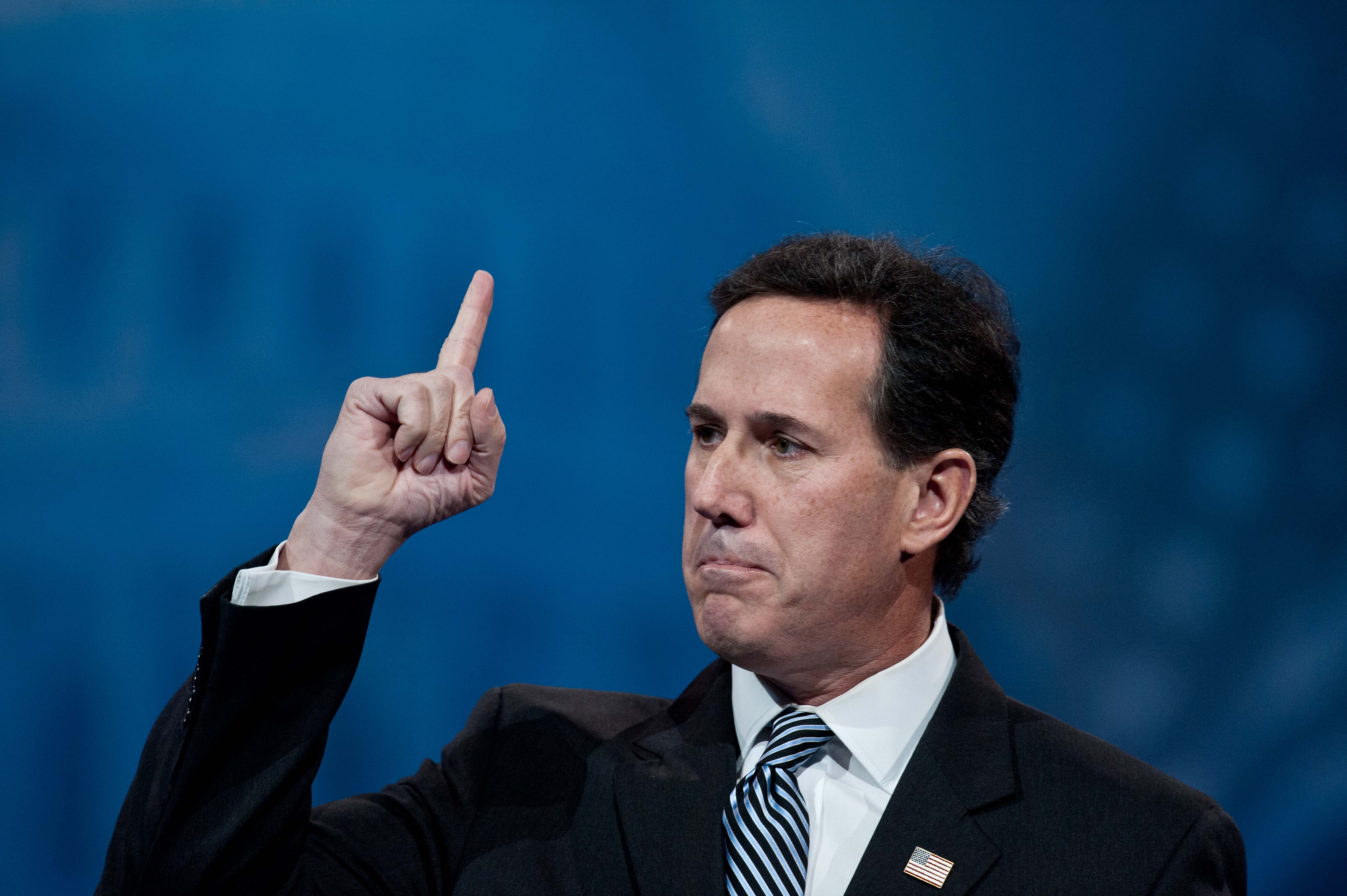
Rick Santorum, a Catholic fighting against universal healthcare, compares the Affordable Care Act with … apartheid:

[Mandela] was fighting against some great injustice, and I would make the argument that we have a great injustice going on right now in this country with an ever-increasing size of government that is taking over and controlling people’s lives — and Obamacare is front and center in that.

I just don’t know what to say about that. I really don’t. Except that Santorum’s mind is simply unhinged, and that the reflexive need to describe anything that this president has done as pure evil has become a kind of sickness of the mind and soul on the right. It has abandoned any connection to the real world. It lives in a narcissistic, warped, ideological echo-chamber of victimhood and utter obliviousness to the real tragedies of human history.

(Photo: Former US Republican Senator from Pennsylvania Rick Santorum speaks at the Conservative Political Action Conference (CPAC) in National Harbor, Maryland, on March 15, 2013. By Nicholas Kamm/AFP/Getty Images.)

Obama’s Nuclear Focus

David Kenner contends that the president’s foreign policy is best understood as a drive toward nonproliferation:

Obama’s non-proliferation agenda got off to a fast start in its first year, as the administration negotiated the New START treaty; held the Nuclear Security Summit, which included delegations from 47 countries across the world; and released a new Nuclear Posture Review, which called for reducing the role of nuclear weapons in U.S. national security strategy. In some of the global hotspots that concerned the United States, the focus on nuclear non-proliferation also took precedence over concerns about human rights or democracy promotion.

In Russia, Obama prioritized non-proliferation over concerns about Vladimir Putin’s crackdown on his domestic political opponents. “The nuclear issue is really important to his background,” Michael McFaul, the current U.S. ambassador to Moscow, told Mann for The Obamians. “He thinks you need a New START treaty, no matter whether the Russians are a democracy or an autocracy, because these are dangerous weapons and we’ve got to control them-and in a way, that’s a legacy from this 1980s era.” …

With the wind at the back of the president’s nuclear agenda, the stakes could extend far beyond Damascus or Tehran. The one notable exception to Obama’s non-proliferation agenda — so far – has been Israel, where this administration’s refusal to push for nuclear disarmament has led to charges of hypocrisy among both Arabs and Iranians.

Zachary Keck adds that it looks as though, despite some scary cases, nukes are not spreading very quickly:

[T]here has been an undeniable decline in the number of states interested in acquiring nuclear weapons.

Harald Muller and Andreas Schmidt have documented this well. In their comprehensive study of states with nuclear weapons activities between 1945 and 2005, they find that “states with nuclear weapons activities were always a minority, and today they are the smallest minority since 1945.” Specifically, in 2005 they identified 10 states as having nuclear weapons activities (including those with nuclear weapons), which constituted less than six percent of UN members. Today the only non-nuclear weapon state (NNWS) that might be interested in an atomic weapon is Iran.

The fact that states have by and large been uninterested in nuclear weapons is somewhat perplexing from a historic perspective. After all, what other revolutionary military technology hasn’t elicited strong interest from most states competing in the international system? At the same time, when one examines the properties of nuclear weapons more closely, the lack of interest is easier to understand. Nuclear weapons have basically served one purpose for states possessing them; namely, they have deterred others from challenging that state’s survival and other fundamental interests. But the nuclear era has also been characterized by a sharp decline in warfare and today fewer states face fundamental external threats to their existence. Given the high costs of building and maintaining a nuclear arsenal, it makes little sense to acquire nuclear weapons without such an existential threat.

The Story Behind A Shirt

This embed is invalid


Planet Money had t-shirts made so they could better understand where such clothing comes from:

The Planet Money men’s T-shirt was made in Bangladesh, by workers who make about $3 a day, with overtime. The Planet Money women’s T-shirt was made in Colombia, by workers who make roughly $13 a day, without overtime… With a long tradition of apparel manufacturing and better technology, the Colombians can make T-shirts much, much faster than the Bangladeshis can. In Bangladesh, on one sewing line for our T-shirt, 32 people can make about 80 shirts per hour. One sewing line in Colombia has eight people and can make about 140 T-shirts per hour. The two lines aren’t perfectly parallel — the Bangladeshi workers are completing a few more details of the shirt than the Colombians are. But the difference is striking nevertheless.

Yet Colombian manufacturers are losing business. Why? Labor costs, mainly:

Colombia’s economy has been growing like crazy for the past decade, and wages have been rising. That’s good for the country as a whole, but it may wind up driving away the T-shirt industry. ”There is a saying that is going to sound horrible,” Crystal’s CEO, Luis Restrepo, told me. “Our industry follows poverty.” It’s an industry “on roller skates,” he said, rolling from Latin America to China, to Bangladesh — wherever costs are lowest.

No Shelter For Gay Syrians

Haley Bobseine documents their plight, which includes horrific threats from both sides of the civil war:

As the violence in Syria continues unabated, many have retreated into their ethnic and religious communities for protection. Unlike other minority groups — such as Christians, Kurds, and Alawites — sexual minorities, notably gay men, do not enjoy the protection of any political, ethnic, or religious institutions. For gay Syrians, nowhere is safe: Across the country, they have been the target of attack by pro-regime militants and armed Islamist militias alike — at times because of their sexual preference; at other times simply because they are perceived as weak and easy to extort in the midst of a chaotic war …

Gay Syrians still in the country must not only evade discovery themselves — the capture of one of their acquaintances can also present a mortal threat. Amir recounts how one of his gay friends, Badr, was kidnapped this summer by Jabhat al-Nusra, which extracted information from him about other gays before executing him. “Several days later, Jabhat al-Nusra gathered people in the square and denounced another guy as a faggot,” says Amir. “They chopped his head off with a sword.”

Last month, Hannah Lucinda Smith interviewed gay Syrian refugees living in Beirut:

Life as a gay man in Beirut, where the gay scene is far more visible than in Syria, may be easier in many ways, but the city’s open and, at times, extravagant scene can also come as a culture shock. “Although Syria and Lebanon are neighboring countries, they are very different socially,” [psychologist] Patricia [el-Khoury] told me. “These guys have suddenly found themselves in a completely different environment. They are in a freer place, but often they are not prepared for it, so there is a tendency to go to extremes. There is a lot of prostitution on the gay scene in Lebanon, as well as drug use.”

What Climate Change Will Change

NASA’s Tom Wagner has a good primer:

Brad Plumer provides more details by digging into the new climate change report from the National Research Council:

The upshot? Earth is already seeing some abrupt changes, like the fast retreat of summer Arctic sea ice. There’s also a real risk that other rapid and drastic shifts could soon follow if the Earth keeps warming — including widespread plant and animal extinctions and the creation of large “dead zones” in the ocean. But other apocalyptic scenarios once thought plausible “are now considered unlikely to occur this century.” That includes shifts in Atlantic ocean circulation patterns that could radically alter Europe’s climate, as hyped in the disaster flick “The Day After Tomorrow.” Also unlikely this century: Collapsing ice sheets in West Antarctica that would push sea levels up very quickly, as well as sudden methane eruptions from the Arctic that could heat the planet drastically. Those problems are left to future generations.

What The Hell Is Happening In Ukraine? Ctd

As the tug of war over Ukraine continues to unfold, Raymond Sontag wonders why Western leaders were so surprised that a country decided to balk at EU membership:

The problem is that many in the West see “balance of power” and “spheres of influence” as antiquated and less-than-legitimate concepts and therefore largely ignore them. Rather than viewing international politics as driven by competing interests, they see it as driven by the process of ever more countries adopting Western-style democracy. Accordingly Western leaders assume that East European states integrating with the West is a natural process in the post-Cold War world and that anything running counter to this integration is a perversion of that process. This disregard for traditional power politics and the assumption that European integration is a natural development are significant blind spots for Western leaders. And these blind spots hamper their ability to realize the very worthy goals of European integration and democratization.

Larison argues that Western analysts have the opposite problem:

This may apply in some cases, but my impression is that American and European advocates for the eastward expansion of Western institutions and alliances are only too happy to see everything in eastern Europe and the former Soviet Union in terms of balance of power and spheres of influence. Many Westerners may ridicule the concepts by name, but they think in these terms just as much as anyone else. If that were not the case, there would not have been so many overwrought Western reactions to Ukraine’s decision.

If Ukraine turns down a deal with the EU that wouldn’t have given it very much in the near term, many Westerners treat this as an extremely meaningful event rather than the perpetuation of the status quo that it actually is. As Western institutions seek to expand their sphere of influence, Westerners are annoyed that there is any resistance to this, and they complain about Russian efforts to retain influence with lectures about the obsolescence of spheres of influence.

Tim Snyder zooms out and suggests that “the desire of so many to be able to have normal lives in a normal country is opposed by two fantasies, one of them now exhausted and the other extremely dangerous”:

The exhausted fantasy is that of Ukraine’s geopolitical significance. Ukrainian president Viktor Yanukovych seems to believe, and he is not alone, that because Ukraine lies between the European Union and Russia, each side must have an interest in controlling it, and therefore that smart geopolitics involves turning them against each other. What he does not understand is that these are two very different sorts of players. For the EU even to reach the point of offering an association agreement, creative European leaders (Carl Bildt of Sweden and Radek Sikorski of Poland) had to make an insistent push to gain support from member states, and hundreds of constituencies had to be satisfied. Yanukovych seems to have thought he could simply ask the EU for cash, on the logic that Putin was offering him the same. There is a point where cynicism turns into naïveté. …

The dangerous fantasy is the Russian idea that Ukraine is not really a different country, but rather a kind of slavic younger brother. This is a legacy of the late Soviet Union and the russification policies of the 1970s. It has no actual historical basis: east slavic statehood arose in what is now Ukraine and was copied in Moscow, and the early Russian Empire was itself highly dependent upon educated inhabitants of Ukraine. The politics of memory of course have little to do with the facts of history. Putin unsurprisingly finds it convenient to ignore Russia’s actual regional rival, China, and play upon a Russian sense of superiority in eastern Europe by linking Kiev to Moscow.

A School Without Walls

This embed is invalid


Emily Bazelon thinks American parents and educators could learn a thing or two from an outdoor school in Switzerland for children ages four to seven, profiled in the new documentary School’s Out: Lessons from a Forest Kindergarten:

It’s autumn. A few kids splash through a muddy creek. One boy falls down in the water, gets up, squawks, keeps going. A larger group sits and jumps in a makeshift-looking tent that consists of a tarp hung over a pole, with low walls made from stacked branches. A teacher tootles on a recorder. Later, the teacher describes the daily routine: Singing, story time, eating, and “then the children can play where they want in the forest.” … This is so intuitive to me, given my own kids’ need to move their bodies every other minute, that begging for more outside time is my main refrain at my 10-year-old’s school. I’m mystified by the Atlanta superintendent who said, in scrapping recess, “We are intent on improving academic performance. You don’t do that by having kids hanging on the monkey bars.” Actually, yes you do.

Rupert Neate talked to an educator in Germany, which has 1,500 such schools, about safety concerns:

Ute Schulte-Ostermann, president of the German Federation of Nature and Forest Kindergartens (BVNW), says there have been no serious injuries beyond the occasional broken leg in the organization’s 20-year history. “There are far fewer accidents than at regular indoor kindergartens because we have fewer walls and softer floors — leaves and mud,” she says. Schulte-Ostermann, who is also a teacher trainer at Kiel’s University of Applied Sciences, says life outdoors toughens the children up, reducing incidents of colds and flus. Head lice outbreaks are also significantly reduced because the children are not confined in an enclosed space. There is however, a much greater risk of contracting Lyme disease from tick bites. Schulte-Ostermann says the risks are outweighed by the “massive” mental and physical benefits of playing outside. “Children who have attended a Waldkindergarten have a much deeper understanding of the world around them, and evidence shows they are often much more confident and outgoing when they reach school.”

Public Pensions On The Chopping Block, Ctd

A reader writes:

I have mixed feelings on the bankruptcy situation in Detroit. On the one hand, I don’t want retired public workers to be thrust into poverty because their pension vanished or was severely cut. On the other hand, it has always bothered me when some retiring public employees were able to game the system by working tons of overtime the last three years on the job to up the salary on which their pension was then based. I also feel for the current residents of Detroit who are currently paying the pensions for a pool of retired public works that is vastly disproportional to the current size of the city.

In the end, it will all depend on how humanely and rationally the cuts to the pensions are made. Go back and recalculate the pensions based on non-overtime and bonus pay. Figure out a minimum pension amount for everybody and then apply a percentage cut on pension amounts over the newly set minimum. I’d even say they should reduce the pension amounts less than other kinds of debt, but there will have to be some cuts, especially for those who are living well on the defaulting city’s dime.

A critic of the cuts points out:

Your post didn’t mention the big, glaring issue behind these pension cuts:

1.  Public school teachers weren’t covered by Social Security until the late ’60s.
2.  Firemen and policemen still aren’t covered by Social Security.

Which means that these former municipal employees aren’t getting a pension in addition to Social Security and living the high life – the pension, for many of them, is all they have.

Another elaborates on the Social Security factor:

Those who want to cut pensions should consider a few things. First, pension plans are usually presented in the recruitment phase as an incentive to work for an employer. Pension benefits are part of an employee’s compensation. Many who earn pensions are not paid especially well, despite the whopping, headline-catching pensions of former fire and police chiefs and other top city, county, and state officials. The average worker gets something like half their average salary at full vesting after 25 to 30 years, with the benefit pro-rated based on their years of service and typically a three-year average of their top salary. Pension benefits are taxable like any other income.

At the same time, the Social Security Administration imposes on pensioners the Windfall Elimination Provision, which reduces Social Security benefits by 60 percent if a person has a pension. This is probably fair if a pensioner has worked many years for the pension, but in many systems you can vest in the pension plan for partial benefits at, say 10 years. By doing so, you forfeit 60 percent of your Social Security benefits even if you worked much longer at a Social Security-eligible job.

Cutting benefits across the board punishes people who had no say in how municipal or county or state budgets were planned and executed. Many pensioners will be reduced to penury if broad cuts in pensions are permitted by the courts when local governments are so badly managed that they wind up declaring bankruptcy. Better to cap pension benefits at the higher end while leaving lower-end pensions minimally impacted. Penalizing pensioners for the incompetence or misbehavior of others is the height of unfairness.

An expert on the subject sounds off in detail:

As a law student currently staring down the barrel of a bankruptcy exam, I have to take issue with Heather Long’s characterization of the “best interest of creditors” test. Although Section 943(b)(7) says that the plan must be in the best interest of creditors, this test isn’t as rigorous as it sounds. In other sections of the Bankruptcy Code (the sections applying to private parties) the “best interest of creditors” is determined by reference to what the creditors would get in a Chapter 7 liquidation proceeding – that is, if all the debtor’s assets were sold, how much would the creditors get? Usually this isn’t much – if it’s anything at all – since secured creditors are allowed to take the full value of their secured claim, and very often so much of the debtor’s property is used as collateral for secured debt (by security agreements placing a lien on all the debtor’s unencumbered property, or on the debtor’s inventory or equipment) that there’s virtually nothing left to sell. Even then, there are priority claims – listed in Section 507(a) – that must be paid in full to the extent possible before any general unsecured creditors get paid. Except for benefit-plan contributions to be paid out for services rendered in the 180 days before filing [under Section 507(a)(5)], pensions are not priority unsecured debts and can only be paid after priority debtors are fully satisfied.

What this means is that the “best interests of creditors” in most private bankruptcy plans is “the creditors receive more than nothing.”

Now, I could be wrong – the part of Chapter 9 incorporating provisions of Chapter 11 by reference specifically excludes Section 1129(a)(7), which specifically states that the plan must be better than Chapter 7 for each particular creditor, and replaces it with the much vaguer 943(b)(7), so there is room for the court to improvise there. On the other hand, the idea that “the best interests of creditors” test requires a comparison with a hypothetical liquidation is firmly entrenched in the precedent of the Bankruptcy Courts.

Bottom line: “Best interest of creditors” may prove to be of much less value to Detroit’s pensioners than it sounds.

The Best Of The Dish Today

People Around The World React To News Of Nelson Mandela's Death

It was a veritable blizzard of epiphanies today. George Will returned to Toryism in opposing the reflexive rush to war against Iran; the former head of Shin Beit argued powerfully that the occupation of the West Bank was a far more existential threat to Israel than Iran; Pete Wehner urged conservatives to care about poverty and inequality (but he has always believed that); Americans expressed the view in record numbers that the US should mind its own business in world affairs; readers revisited my calamitous misjudgment in Iraq. All in all, that’s quite a shift from 2003, isn’t it?

I didn’t quite expect a thread on lying to your kids to end up with a “shitting log“, but that’s Dish readers for you. The Face of the Day should easily win the year’s award for best in blog 2013. And liberal magazines were caught with their exploitative pants down.

The most popular post of the day remained my critique of Rush Limbaugh on Pope Francis; runner-up was Always Tell Kids The Truth?.

See you in the morning.

(Photo: A newscaster broadcasts from under the marquee at the historic Apollo Theater, which announces the death of former South African President and civil rights champion Nelson Mandela, on December 5, 2013 in the Harlem neighborhood of the Manhattan borough of New York, United States. By Andrew Burton/Getty Images.)

New Dish, New Media Update

[Re-posted from earlier today]

It’s hard to believe that only a year ago, Patrick was busy cramming LLCs for Dummies, as we jumped off the cliff to independence. This will be the last update this year – completing a promise I made to readers of maximal transparency about this experiment – before we hit the acid test of annual renewals next month.

When asked what our goal was for 2013, for want of any better measurement, I suggested our editorial budget at our last corporate home, The howler beagleDaily Beast. That was $900K in 2012. Well, we’re now at $818K – still agonizingly short of our goal, but plenty good enough to survive for now. I haven’t taken any profits or salary this year to make sure we have a sturdy fiscal ballast for whatever comes (or doesn’t) on renewal day next January 2. We’ve also added staff we didn’t have at the Beast – a technology wizard (former intern Chas Danner aka Special Teams) and a general manager for the whole enterprise (Brian Senecal) – and for the kind of posts on culture, religion, philosophy and art that are rare on the web but integral in my view to any civilized conversation. Almost everyone on the team started out as an intern; and everyone has health insurance from the internship on.

I can honestly say I’ve never worked with a more talented and decent crew of colleagues and friends than I do now. In our little boat on a very choppy media sea, we’ve been remarkably happy this past year. We’ve had a hell of a lot of fun and we’ve worked our guts out, as I’m sure you can see. Putting out this blog every day, while also finding a way to add Deep Dish, has not been not easy, even though my brilliant young team make it seem so.

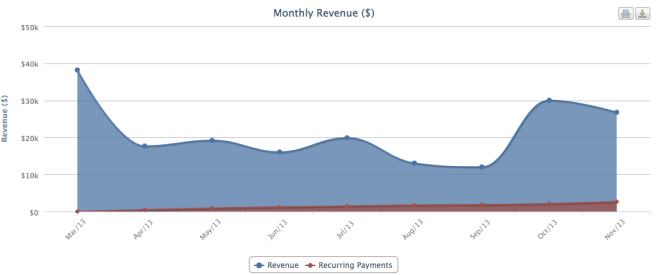
You’ve also come through for us throughout the year after a spectacular start, for which we’re immensely grateful. Here’s the month by month revenue chart from March onward:
Screen Shot 2013-12-04 at 9.17.32 PM

You can see the late surge, which we really need to continue if we want to make our goal. But we now have a total of 32,100 subscribers – a pretty staggering number in just one year with no business department and no marketing. If we can achieve a solid rate of renewals next month, we’ll be able to plan and budget in a way we haven’t been able to in this first ice-breaking, nerve-wracking year.

But this last update of 2013 is really about those of you who have read the Dish regularly all year and have yet to get around to subscribing. We know these are tough times, and we know procrastination runs deep in human nature. But our readers are our only revenue source – in stark contrast with almost every other site on the web. That keeps us honest and prevents us from sinking to the desperation of “sponsored content” or the page-view seeking gimmicks you see in so many other places. If you want this model to succeed, we need all of you. And we need you now.

So take a moment if you haven’t subscribed yet, get that credit card out of your wallet, and [tinypass_offer text=”join the experiment”]. 41,000 of you have used every one of your free read-ons – which means you really are a Dishhead (sorry, you’re busted) but haven’t yet actually put your money where your eyeballs are. We need you; and, more to the point, we want you to be fully part of this, to join the 32,000 others who have made this year (and the next) possible.

It takes a couple of minutes and costs only $1.99 a month or $19.99 a year. Click [tinypass_offer text=”here”] to subscribe. And have a great Christmas season from all of us to all of you.