The Lost Reels

Most of America’s silent films have disappeared:

A new study unveiled by The Library of Congress notes that a scant 14 percent of the feature films produced and distributed in the U.S. from 1912-29 exist in their original 35mm format. That’s only 1,575 of the 11,000 or so features made during this nascent era of cinema, according to “The Survival of American Silent Feature Films: 1912-1929,” the first comprehensive report of its kind. Meanwhile, 5 percent (or 562 films) of those that have survived in their original 35mm format are incomplete, and 11 percent of the films that are complete (1,174) only exist as foreign versions or in lower-quality formats.

As Katey Rich puts it, “early film history was basically a perfect storm for terrible preservation practices:

Films were shown on highly flammable nitrate stock, which meant not only that storage vaults would routinely catch fire, but that projection booths would, too – with projectionists still in them. You may remember the giant pile of film that started the blaze at the end of Inglourious Basterds – yup, it was nitrate stock. And especially in the early days, film was considered about as disposable as a blog post – studios would melt down films to extract the silver, and as shown in Hugo, films by early master George Melies were confiscated by the French army, melted down and turned into shoe soles.

Alyssa zooms out:

It may be too late to recover many of the silent films that [historian David] Pierce has identified as lost – in some cases, the deterioration of film and negatives make it impossible to recapture viable prints of long-neglected movies. But he and the Library of Congress are absolutely right to call for vigorous efforts to step up film preservation, including repatriating the 76 percent of silent features that exist only in foreign release formats, to work harder with rights-holders to preserve movie master copies, and to preserve movies on poorer-grade formats so they will be more accessible. Preserving and restoring silent film history isn’t just a way of putting more entertainment back in circulation. It’s an attempt to recover our dreams of ourselves and our position in the world.

Cannabis Isn’t So Green, Ctd

Brian Anderson investigates the energy and environmental costs of commercial pot grows. He flags a 2011 study (pdf) by researcher Evan Mills:

Mills looked at energy consumption within the cannabis industry, and found that indoor pot production uses about $6 billion worth of energy annually, or enough electricity to power two million average-sized homes. That accounts for one percent of total national energy usage, and spews as much greenhouse gases as three million cars.

But LEDs could be changing that:

Cary Mitchell, a horticulture professor at Purdue University whose heading up a $5 million project to audit and improve LED lighting capabilities in America’s “specialty crop” (see: greenhouse grown fruits, vegetables, nursery plants, etc.) industry, thinks mainstream commercial agriculture has a lot to learn from the pot industry’s gradual embrace of LED tech. He tells the Guardian that specialty crops net about $50 billion a year, and that their growers are seeking out ways to slash energy costs while increasing yields, much like cannabis farmers.

“They’ve undoubtably been doing this for years and years,” Mitchell explains, referring to pot grower’s LED usage. “Since they don’t publish their research, we don’t really know how far they’ve taken the optimization. They probably are ahead of the specialty crop commercial production industry.”

Earlier Dish on marijuana’s environmental impact here.

The UN’s Robotic Peacekeepers

The UN launched its first drones on Tuesday to aid in surveillance as part of its peacekeeping mission in the Democratic Republic of the Congo. Allen McDuffee covers on the development:

“It is another validator of the new ‘normal’ of this technology and its use,” said Peter Singer, director of the Center for 21st Century Security and Intelligence at the Brookings Institution. ”Some 87 countries are using military robotics of some sort, so why should we be stunned that the organization they are members of and supply its forces would use them too?”

“Drones are a technology that are here to stay,” said Singer. “There are so many ‘debates’ now where the people call themselves ‘pro’ or ‘anti’ drone, which is like being pro or anti computers, quaint but irrelevant. Its all about how you use the technology, not the widget itself.”

The drones are unarmed, but Adam Clark Estes calls the move “a bit of an about face”:

Despite having expressed skepticism over some countries’ use of drones—albeit often the ones used for targeted killings—the UN now feels like the technology is necessary. “This is a first in the history of the United Nations that such an advanced technological tool has been used in peacekeeping mission,” Hervé Ladsous, Under-Secretary-General for Peacekeeping Operations, said at the unveiling. “The UN needs to use these kinds of tools to better perform its mandate.”

Simon Allison has mixed feelings about the announcement:

Deploying drones in the DRC does make a good deal of common sense. In the areas where the drones are to be deployed, roads are poor or non-existent; the terrain affords plenty of cover; and foreign peacekeepers trying to gather information don’t exactly blend in. This makes it exceptionally difficult to gather accurate information – a problem that drones, with their all-seeing monitors, could solve, or at least alleviate. …

It’s difficult, however, not to feel some unease at the introduction of a new and possibly dangerous element into the Congolese conflict, which has reached a (still very tentative) détente over the last couple of months. ‘Surveillance’ sounds relatively innocuous, but that’s exactly how America’s drone warfare program started life. It’s worth remembering what that has become: a widespread, unaccountable series of targeted killings (some would say assassinations) in foreign countries, responsible for the deaths of at least 2,227 people in Pakistan alone.

Updating Our Family Tree

Human Family Tree

A DNA analysis of a 400,000-year-old femur from the Sima de los Huesos excavation site in northern Spain revealed an evolutionary surprise. Carl Zimmer explains (NYT) :

In a paper in the journal Nature, scientists reported Wednesday that they had retrieved ancient human DNA from a fossil dating back about 400,000 years, shattering the previous record of 100,000 years. The fossil, a thigh bone found in Spain, had previously seemed to many experts to belong to a forerunner of Neanderthals. But its DNA tells a very different story. It most closely resembles DNA from an enigmatic lineage of humans known as Denisovans. Until now, Denisovans were known only from DNA retrieved from 80,000-year-old remains in Siberia, 4,000 miles east of where the new DNA was found. The mismatch between the anatomical and genetic evidence surprised the scientists, who are now rethinking human evolution over the past few hundred thousand years.

Joseph Stromberg runs through various theories:

To explain how a Neanderthal-looking individual could come to have Denisovan mtDNA during this time period, the scientists present several different hypothetical scenarios. It’s possible, for instance, that the fossil in question belongs to a lineage that served as ancestors of both Neanderthals and Denisovans, or more likely, one that came after the split between the two groups (estimated to be around 1 million years ago) and was closely related to the latter but not the former. It’s also a possibility that the femur belongs to a third, different group, and that its similarities to Denisovan mtDNA are explained by either interbreeding with the Denisovans or the existence of yet another hominin lineage that bred with both Denisovans and the La Sima de los Huesos population and introduced the same mtDNA to both groups. …

For now, the researchers believe the most plausible scenario (illustrated [above]) is the femur belongs to a lineage that split off from Denisovans sometime after they diverged from the common ancestor of both Neanderthals and modern humans.

In a follow-up post, Zimmer unpacks that finding:

The combined evidence from fossils and DNA suggests that Neanderthals, Denisovans, and Homo sapiens share an ancestor that lived in Africa about 500,000 years ago. Our ancestors stayed in Africa while the ancestors of Denisovans and Neanderthals moved out to Europe and Asia. Homo sapiens evolved in Africa about 200,000 years ago, and then humans expanded out of Africa 60,000 years ago, after which they interbred with Neanderthals and Denisovans. So, yes, many people on Earth today are have direct ancestors that were Neanderthals. Some have direct ancestors that were Denisovans. But in both cases, most of these people’s ancestors were Homo sapiens.

Ewen Callaway passes along other speculation:

“I’ve got my own twist on it,” says [Chris Stringer, a palaeoanthropologist at London’s Natural History Museum], who has previously argued that the Sima de los Huesos hominins are indeed early Neanderthals (C. Stringer Evol. Anthropol. 21, 101–107; 2012). He thinks that the newly decoded mitochondrial genome may have come from another distinct group of hominins. Not far from the caves, researchers have discovered hominin bones from about 800,000 years ago that have been attributed to an archaic hominin called Homo antecessor, thought to be a European descendant of Homo erectus. Stringer proposes that this species interbred with a population that was ancestral to both Denisovans and Sima de los Huesos hominins, introducing the newly decoded mitochondrial lineage to both populations (see ‘Family mystery’).

This scenario, Stringer says, explains another oddity thrown up by the sequencing of ancient hominin DNA. As part of a widely discussed and soon-to-be-released analysis of high-quality Denisovan and Neanderthal nuclear genomes, Pääbo’s team suggests that Denisovans seem to have interbred with a mysterious hominin group (see Nature http://doi.org/p9t; 2013).

The situation will become clearer if Pääbo’s team can eke nuclear DNA out of the bones from the Sima de los Huesos hominins, which his team hopes to achieve within a year or so.

The Stigma Of “Diet Doctors”

There’s evidence that FDA-approved diet drugs actually work, so why don’t physicians prescribe them very often? The answer may have to do with our complicated views about obesity:

Obesity is potentially, in part, a neurological disease. Jeffrey Flier, an endocrinologist and dean of Harvard Medical School, has shown, like others, that repeatedly eating more calories than you burn can damage the hypothalamus, an area of the brain involved in eating and satiety. In other words, Big Gulps, Cinnabons, and Whoppers have altered our brains such that many people—particularly those with a genetic predisposition to obesity—find fattening foods all but impossible to resist once they’ve eaten enough of them. Louis J. Aronne, director of the Comprehensive Weight Control Program at New York-Presbyterian/Weill Cornell Medical Center, explained to me, “With so much calorie-dense food available, the hypothalamic neurons get overloaded and the brain can’t tell how much body fat is already stored. The response is to try to store more fat. So there’s very strong scientific evidence that obesity is not about people lacking willpower.”

But this message has not found its way into society, where obese people are still often considered self-indulgent and lazy, and face widespread discrimination.

Several obesity experts told me they’ve encountered doctors who confide that they just didn’t like fat people and don’t enjoy taking care of them. Even doctors who treat obese patients feel stigmatized: “diet doctor” is not a flattering term. Donna Ryan, who switched from oncology to obesity medicine many years ago, recalls her colleagues’ surprise. “I had respect,” she says. “I was treating leukemia!”

George Bray … of the Pennington Biomedical Research Center, thinks that socioeconomic factors play into physicians’ lack of enthusiasm for treating obesity. Bray points to the work of Adam Drewnowski at the University of Washington, who has shown that obesity is, disproportionately, a disease of poverty. Because of this association, many erroneously see obesity as more of a social condition than a medical one, a condition that simply requires people to try harder. Bray said, “If you believe that obesity would be cured if people just pushed themselves away from the table, then why do you want to prescribe drugs for this non-disease, this ‘moral issue’? I think that belief permeates a lot of the medical field.”

The recent Dish thread on weight loss is here.

Quote For The Day

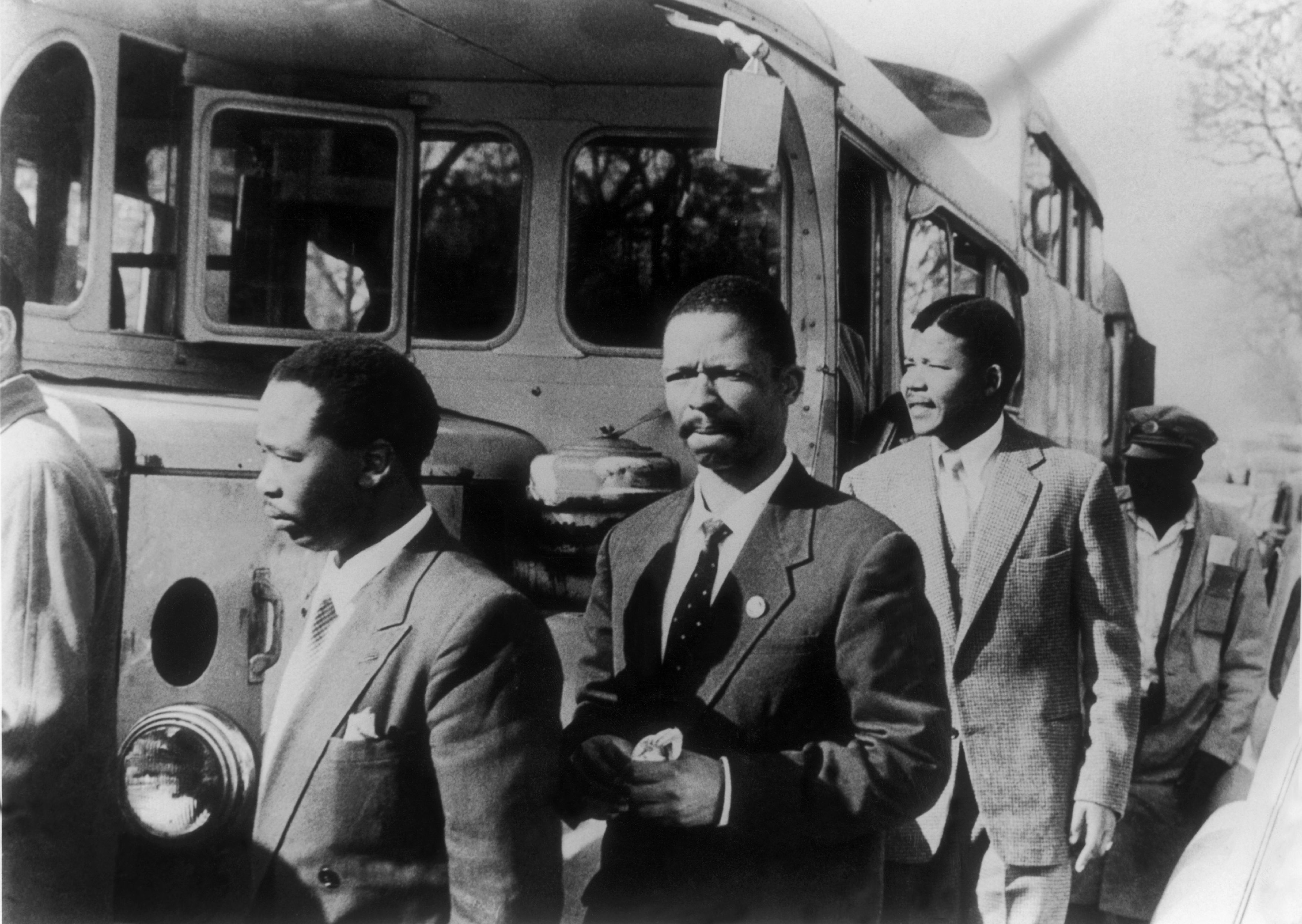
Mandela Accused Of Treason In 1956

“As I walked out the door toward the gate that would lead to my freedom, I knew if I didn’t leave my bitterness and hatred behind, I’d still be in prison,” – Nelson Mandela, proof that the final form of love is forgiveness.

It is rare that one soul can impact all of ours – and make us more patient, more powerful and more human. Mandela was such a soul. And he will never leave us.

Update from a reader:

Nelson Mandela is the greatest public figure of my lifetime – greater than FDR, Churchill, JFK, Popes John XXIII and John Paul II. Upon hearing of Mandela’s death my memory instantly went to his speech to the Irish Parliament and subsequently to the Irish people whose history is also filled with oppression and sadness:

It could have been that our own hearts turned to stone. It could have been that we inscribed vengeance on our banners of battle and resolved to meet brutality with brutality. But we understood that oppression dehumanizes the oppressor as it hurts the oppressed. We understood that to emulate the barbarity of the tyrant would also transform us into savages. We knew that we would sully and degrade our cause if we allowed that it should, at any stage, borrow anything from the practices of the oppressor.

Words every leader should contemplate.

(Photo, with the original caption: Nelson Mandela (3rd From Right), Leader Of The African National Congress And Other Militants Charged With Treason By The South-African Union Walked To The Room Where Their Trial Was Being Held In 1956. By Keystone-France/Gamma-Keystone via Getty Images.)

Where Government Is And Isn’t Gridlocked

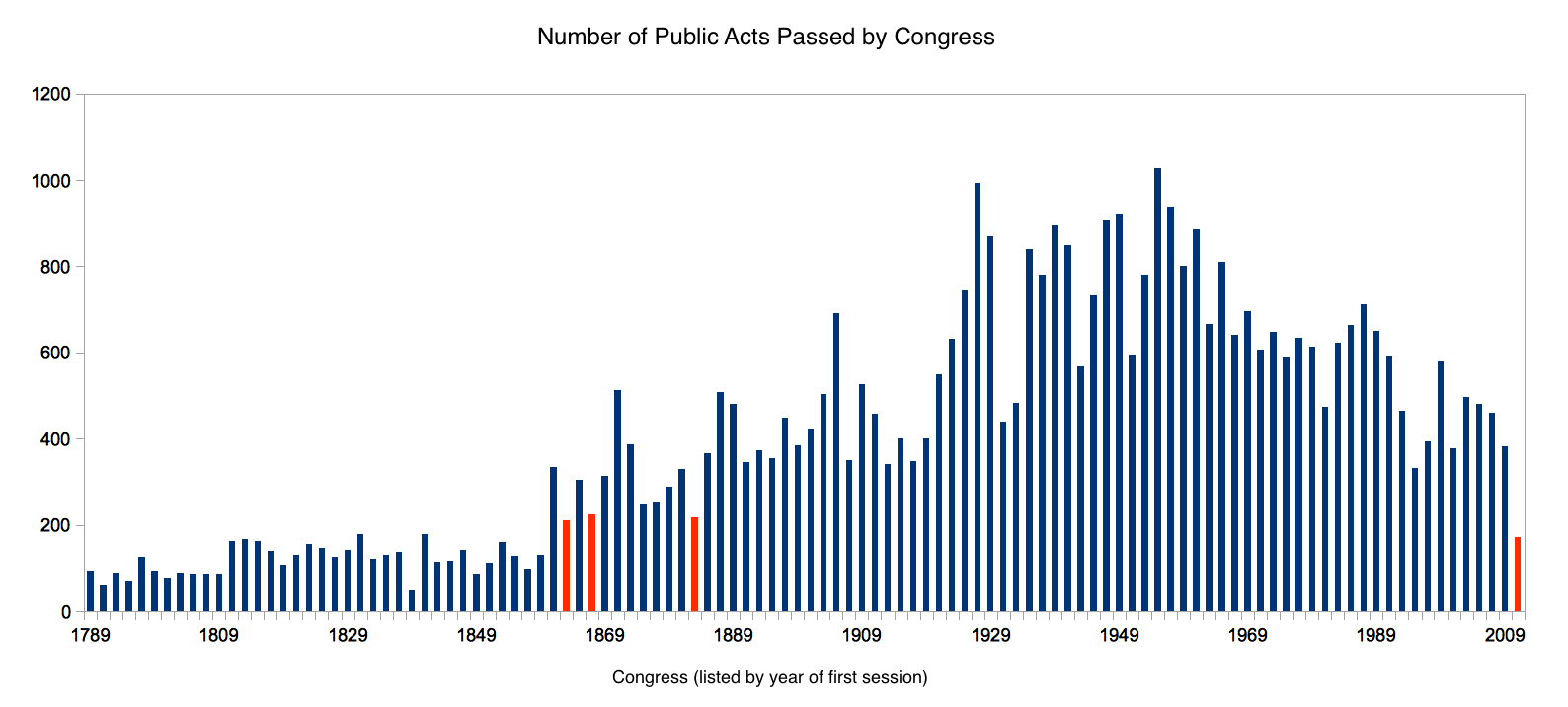
This Congress has been among the least productive ever:

Laws by Congress

Why this has happened:

Polarization is important but I would argue that it should take a back seat to another explanation: inter-chamber disagreement. Research has shown that House and Senate ideological differences are probably the most important indicators of gridlock. Even in instances of unified congressional control policy differences between the chambers can significant increase gridlock. In Binder’s book, Stalemate, she illustrates that bipartisan context is the largest substantive indicator of gridlock and productivity – outperforming both polarization and traditional divided government. The further the chambers are from one another, the more difficult it is for Congress to pass bills.

The state level is a very different story:

[S]tatehouses are the place to watch the battles that will be dominating the country’s political discussions in the coming years. Health care reform, campaign finance laws, gun ownership rules and other contentious political issues all started at the state level before they became subjects of national debate. This is why state governments have often been referred to as laboratories of democracy: They are the testing grounds for new ideas.

One of the main reasons those laboratories have been so busy lately is that the 2012 elections produced a record number of state governments under single-party control. As The New York Times reported, there are now the fewest states with mixed-party governments (split-chamber control or a governor of one party and a legislature of another) since 1952. According to Governing magazine, which reports on state governments, one party controls both legislative chambers in 43 states — the most since 1944.

Why this is important:

One consequence of all this activity is that life in one state is starting to look really different from life in the next state over. If you are considering moving to another state for a job, you need to pay attention to the public-policy climate of that state more than you used to. If you want access to Medicaid to help pay for your health care, if you are gay and want to enjoy marriage and parenthood, if you are Latino and are concerned about being harassed as a possible undocumented immigrant, if you want your teenage daughter to have full access to reproductive health services — or not — politics is not just a distant Capitol Hill exercise. It is something that will materially and directly affect your life.

Fighting The Cocoon, Ctd

A reader writes:

I saw your sharp words about TNR’s Israel coverage. Without getting into the substance of those pieces, I have to disagree with the idea that there’s some monolithic TNR take on the region. In general, the magazine has downplayed the notion of an editorial line – far fewer opinion pieces in print – and among the diversity of voices TNR runs online are a bunch that never ran under the previous ownership. On Tuesday, this piece attacked the neocons and Netanyahu over the inaccurate, knee-jerk evocations of Munich following the Iran deal (and every other recent foreign-policy development). And last week, before those pieces you didn’t like, TNR had this and this. There’s more, but you get my drift.

None of this means you have to like – or even refrain from dissing! – any of the stories you cited. But I don’t think it’s fair to call the mag one sided anymore.

It’s certainly good to have John Judis in the mix. Another reader:

If your husband were running for Congress in New York, would you confront Israel in your magazine? What better way to get a solid commitment from Schumer to help your husband’s campaign than to run a puff piece on him in your magazine? And it is a puff piece.

Where Space Aliens Are More Believable Than Climate Change

The GOP-controlled House:

Lawmakers held a free-ranging and sometimes bewilderment-inducing hearing Wednesday on the search for extra­terrestrial life, gradually working around to the question of whether humans are alone in the universe. At the end of the 90-minute session, that issue remained unresolved. Called “Astrobiology: The Search for Biosignatures in Our Solar System and Beyond,” the House Science Committee’s hearing featured three PhD-credentialed witnesses who are prominent in a scientific field that once was considered speculative.

Rebecca Leber rolls her eyes:

Rep. Lamar Smith (R-TX), House Chair of the Science, Space, and Technology Committee, has no tolerance for climate change science but he is willing to talk about aliens. … One day before discussing extraterrestrials, Smith blasted the Environmental Protection Agency’s rules for carbon pollution from new power plants for lacking scientific grounds. In a letter to the EPA, Smith wrote that the proposed standards are “based more on partisan politics than sound science.”

Still, George Dvorksy describes the hearing as “refreshingly pro-science,” while Alex Rogers notes that “rarely in this Congress are there moments of childlike wonder, and members seemed to enjoy the break from partisan sniping.” Meanwhile, committee chair Lamar Smith noted that space exploration “attracts bipartisan interest and bipartisan support,” leading Tom McCarthy to dub outer space “the ultimate purple state.” Abby Ohlheiser defended the hearing as “the best thing Congress has done in months”:

Because the House has just seven days of work left before the end of the year, this hearing idea has generated some pretty harsh criticism. But laments about an unproductive Congress finding time to look for aliens of all things are sadly misguided. [The] hearing is a great idea, and it’s doing something remarkable: getting the Republican-led, scientifically challenged committee to seriously discuss an important field of research – and the funding needed to keep it going. So stop making fun of it.

She adds:

The subject matter of the hearing was so cool, it seems, that the Republican committee members forgot to grill the panelists on why it deserves money in the budget at all. Rep. Chris Stewart, a Republican, asked the scientists “Let’s assume that we find life? What do we do then? How does that change things with us in the way we view ourselves?” Rep. Bill Posey, also a Republican, noted, “You’ve pretty much indicated life on other planets is inevitable. It’s just a matter of time and funding.” … These are not the most sophisticated questions and statements in the world. But they are exciting ones, and ones that betray a curiosity and engagement with what science does that is not customarily seen in this wing of Congress.