Among Germans, the formal “you” (Sie) is spoken less and less:
Foreigners are well advised to begin with Sie, but they should not be surprised at how quickly Germans may now switch to du. Just after my first lunch with the press spokesman for a big German company, for example, I was surprised to hear, as we said goodbye, “by the way, my name is Thomas.” We’ve been du ever since.
Robert Lane Greene sees Sie going the way of “thou”:
This spreading informality has been slower in Asian languages (which often have more elaborate systems of pronouns and honorifics than the mere formal “you”). But in Europe, the change may be unstoppable. This is a result of the breakdown in respect for traditional authority (elders, the upper classes, the church, etc), which began in the 1960s. But also it is probably accelerated by the more recent breakdown in the distinction between private and public. In age of share-everything social media, when everyone has hundreds of “friends,” it’s little surprise that formality is falling from fashion.
Jathan Sadowski uses flimsy logic in being against kids learning computer programming. Of course, illiteracy is a problem and should be addressed, but nobody is arguing to sacrifice the study of history, music or gym to tackle the problem. Assuming it is a matter of allocating time and resources, I truly believe that most Americans would be better served learning coding basics, in both a practical and educational way, rather than any math beyond basic algebra and geometry.
Another:
I’m not sold on the idea that coding should be mandatory in K-12 education, but I do think it is important. Actually, I think it’s important enough that it should be a included in the core curriculum requirements for any college graduate. I say this because, as a recent college grad, an overwhelming percentage of jobs I’m looking to apply for require some coding experience. I’m going back to school next semester to take two coding classes. The hope is my new knowledge will open up job opportunities I might otherwise have missed out on.
Another:
I learned some basic coding in Matlab during undergrad, and I thought I would hate it, but it was great.
Learning to code requires thinking through the steps of a problem and figuring out how to solve it most efficiently. Laying out the steps in coding is the same as building evidence for an argument in the liberal arts, you just use different pieces. So while it’s great that learning to code might lead to better job prospects, it also teaches you how to think and solve problems, which I think is the greater value of learning to code.
Another:
The obvious question is: Code what? And the fact that it apparently isn’t being asked suggests that those pushing this are massively ignorant of the IT field they are trying to prepare their kids for.
In my IT career, I have learned to code in several languages: FORTRAN, CoBOL, Assembler, SAS, html, etc. There is a little overlap, in that writing a program in any of them require a certain amount of ability to think thru a process. But as far as actual coding goes, the overlap is nonexistent.
To give you an analogy, how much does it help you to learn to read and write Japanese that you already know German? Different sentence structure, characters rather than an alphabet, one gives genders to every noun while the other does not, one has separate verb systems for formal and informal usage, etc. – not a whole lot of transfer there. Or does learning one of the click-languages of southern Africa help you to learn a tonal language like Chinese?
In addition, there are new computer languages appearing every year. Some of them will catch on; others never will. And any language that is currently in use is subject to massive obsolescence as new ones come along – quite possibly before the kids are even out of school. So how do you decide which one to teach the kids? Until someone can answer that question sensibly, any argument for teaching coding is built on sand.
A victim of both domestic abuse and vengeful former assistants, the British chef Nigella Lawson found herself on trial today for past use of cocaine and pot. It’s a gruesome story, and the tabloid vultures were circling when I was over in London last week. I can’t help but feel for any woman held hostage by a bullying husband. You can read the full story here. Money quote:
In five hours of testimony, she painted a picture of a 10-year marriage to Saatchi that was “difficult at many stages and also deeply happy at some stages”. She said it included moments of “intimate terrorism” and spoke of Saatchi’s “emotional abuse that was very wounding and difficult”, “bullying” and how she believed he had set his lawyers onto her with a simple instruction: “get her”.
Lawson described how Saatchi held her by the throat in a photographed incident at Scott’s restaurant in Mayfair, not because he believed she had been taking cocaine but because she remarked she was looking forward to being a grandmother. “He grabbed me by the throat and said ‘I am the only person you should be concerned with. I am the only person who should be giving you pleasure'”.
That’s a rather brilliant description of domestic abuse, isn’t it? “Intimate terrorism.”
American officials plan to present the Israeli prime minister, Benjamin Netanyahu, with detailed ideas about security arrangements on the West Bank under a possible peace agreement with the Palestinians, senior State Department officials said on Wednesday.
That suggests a newly confident Obama administration willing to knock a few heads (at last) to get a two-state solution in Israel-Palestine. As with the potential Iran detente, such a detailed proposal would call Israel’s bluff about a two-state solution and unite almost all the great powers in favor of a sane, sensible partition instead of Greater Israel’s demographic and democratic suicide. Again, it’s worth looking at the long game here. Obama will likely get nothing out of the Congress but obstruction and nihilism and maybe impeachment in the rest of his term; but he has the ACA under his belt and the Iranian rapprochement abroad to concentrate on. Both, as I’ve argued before, are historic shifts in US policy, domestic and foreign. And both remain potentially huge legacies for the first black president. Do not be surprised if the last meep is on Netanyahu.
Today, I compared Obama’s pragmatic response to an obvious second term failure with Bush’s rigid intransigence; I wondered again if Buzzfeed really is something we can truly call journalism; and I made the conservative case for the permanence of racism in the human soul. Mike Allen powered along, sucking up to public figures in mutual media back-scratching and still evading any accountability for the conflicts of interest in Politico’s lucrative Playbook. But the money keeps rolling in – and that’s all Politico seems to care about. The good news about healthcare.gov’s surge of enrollment wasn’t quite so good when you looked at the back end; and a reader thread on whether it’s kosher to lie to your kids about Santa really took off.
(Photo: Nigella Lawson leaves Isleworth Crown Court after giving evidence on December 4, 2013 in Isleworth, England. Italian sisters Francesca and Elisabetta Grillo, who worked as assistants to Nigella Lawson and Charles Saatchi, are accused of defrauding them of over 300,000 GBP. By Peter Macdiarmid/Getty Images.)
This time around they gave another meh performance (NYT) on the Programme for International Student Assessment, a standardized test administered every three years to 15-year-old students around the world:
[Americans] score in the middle of the developed world in reading and science while lagging in math, according to international standardized test results being released on Tuesday. While the performance of American students who took the exams last year differed little from the performance of those tested in 2009, the last time the exams were administered, several comparable countries – including Ireland and Poland – pulled ahead this time. As in previous years, the scores of students in Shanghai, Hong Kong, Singapore, Japan and South Korea put those school systems at the top of the rankings for math, science and reading. Finland, a darling of educators, slid in all subjects but continued to outperform the averages, and the United States.
Joshua Keating is one of many bloggers calling out China for gaming the exam:
The three “countries” at the top of the PISA rankings are in fact cities – Shanghai, Singapore, and Hong Kong – as is No. 6, Macau. These are all big cities with great schools by any standards, but comparing them against large, geographically dispersed countries is a little misleading. Shanghai’s No. 1 spot on the rankings is particularly problematic. Singapore is an independent country, obviously, and Hong Kong and Macau are autonomous regions, but why just Shanghai and not the rest of China?
As Tom Loveless for the Brookings Institution wrote earlier this year, “China has an unusual arrangement with the Organization for Economic Co-operation and Development (OECD), the organization responsible for PISA. Other provinces took the 2009 PISA test, but the Chinese government only allowed the release of Shanghai’s scores.” As you might imagine, conditions in a global financial capital are somewhat different from the rest of China, a country where 66 percent of children still live in rural areas. … Despite this, we’re likely to see quite a few headlines, as we did in past years, about “Chinese” students outperforming Americans.
An exasperated Rick Hess calls the international tests “a triennial exercise in kabuki theater”:
[T]he whole things provides a depressing excuse for the usual suspects use PISA as an excuse to shill their usual wares. Common Core boosters cheered for that. Dennis van Roekel said it’s all about poverty. Arne Duncan touted the need to embrace Obama administration reforms. Yawn.
TIMSS [The Trends in International Mathematics and Science Study], which came out last year, told a fairly different story – it showed the US scoring better than the global average in math and science, and it had fourth graders improving in math. So maybe US students are improving more in the early grades and hitting a wall in high school – or maybe all of these results should be taken with a grain of salt.
[W]e shouldn’t be surprised that our 15-year-olds are stagnant on PISA. Our best American exam, the National Assessment of Educational Progress, already shows that the performance of our older teenagers has been flat since 1971, even as our elementary school kids – especially poor kids – have improved. Our kids do OK when they’re young, but then stall in high school, time and time again. This fact is backed by two other big international exams that get less airtime, TIMSS and PIRLS, which show that American fourth- and eighth-graders are improving in math, science, and reading, and are actually above average internationally.
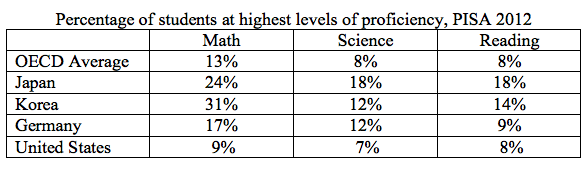
Why do our little kids do better than our older ones? Ability tracking may have something to do with it. The PISA results show that in higher-performing nations, all students younger than 15 are exposed to the most challenging math concepts. Nations that track their math instruction by ability, like the US, do worse on these tests, because fewer kids – especially poor kids – are exposed to the deeper conceptual thinking that becomes more important as the grades progress and tests get harder. This helps to account for why, despite the vast privilege of our most affluent students, only 9 percent of American students perform in the top two categories in math, compared with the global average of 13 percent.
Meanwhile, Mark Schneider fears that gifted students have been left behind:
While much of the press coverage will no doubt zero in on our middling performance and the bleak economic future it foretells, a far more disturbing pattern in the data is more likely to hurt us in the long run than will our mediocre average scores. What should scare us is the low percentage of students in the highest levels of performance (PISA level 5 and above).
Even a quick look at these numbers shows how far below some of our major economic competitors the U.S. is. Having such a small percentage of super-performers poses a far greater threat to our economic security and future than being “average” overall does. And it signals the need to reconsider some of the nation’s basic priorities in education policy.
Stephanie Simon reports that poverty explains some, but not all, of the US’s stagnation:
[H]igh-poverty schools in the US posted dismal scores on the PISA tests, akin to countries such as Kazakhstan, Romania and Cyprus. Wealthy schools, by contrast, did very well on all three tests. Students in the most affluent U. schools – where fewer than 10 percent of children are eligible for subsidized lunches – scored so highly that if treated as a separate jurisdiction, they would have placed second only to Shanghai in science and reading and would have ranked sixth in the world in math.
But poverty alone does not explain the lagging results in the US. Vietnam is a poor nation, yet it outscored the US significantly in math and science.
Jonathan Coppage argues that the US shouldn’t worry itself over countries like Vietnam:
We have had our troubles in the intervening years to be sure, but it’s not like the French have overtaken us and are now running away with the world thanks to their superior education. Some scholarly experts warn that even so, we’re in a new era now and decline is once again just around the street corner. The Times quoted Stanford professor Eric A. Hanushek as saying, “Our economy has still been strong because we have a very good economic system that is able to overcome the deficiencies of our education system … But increasingly, we have to rely on the skills of our work force, and if we don’t improve that, we’re going to be slipping.”
With due deference to Dr. Hanushek, I rather suspect things may be the other way around. More rigorously organized cultures like Germany, China, South Korea, France, etc. have crafted their educational systems around the primacy of the test, and have driven their students to excel in it. They also often use these tests to sort their students into the tracks determining what further education they will receive. The United States has a much more free-wheeling system that industrial employers lament is failing to sufficiently supply them with diesel engine experts. What we do have, though (and regular readers brace yourselves), is Silicon Valley. The entrepreneur may be overrated in the GOP at the moment, but a creative culture that fosters innovative risks shouldn’t be taken for granted.
“What Democrats know keenly — and Republicans seem never to learn — is that positive beats negative every time. Thus, we see MSNBC’s clever montage of Republican negativity: A series of unfriendly faces decrying the Affordable Care Act (ACA) with apocalyptic language. Which would any everyday American prefer? The healer or the doomsayer? The elves or the orcs?” – Kathleen Parker.
Perhaps the most important development of the last year – and it overlapped with Benedict’s ill-fated regnum – is that the question can now actually be discussed. Here are some practical, modest reforms on the table:
Expand the number of women in professional roles in each dicastery. Increase the number of women who serve on advisory councils to each pontifical congregation and council, and expand the pool of candidates who are called to serve in such advisory roles. Restore women to diaconal ministry. Appoint women to the diplomatic corps and to the communications apostolate. Ensure in the selection of bishops that criteria include a candidate’s ability to relate well to women. Review the current Lectionary and reclaim the many Scriptural passages with women as protagonists that have been left out of the readings heard at Mass. Ponder the effect and impact such exclusion has had over time in the catechesis and participation of women and girls in the life of the church. We also address the perceptions many have of the church with regard to its treatment of women. One suggestion is to consider as a theme for the pope’s next celebration of the World Day of Peace on Jan. 1, “The Church in Solidarity with Women and Girls.” Perceptions matter.
America magazine – which scored the exclusive interview with Francis – recently devoted an entire issue to the question of women in the church. It’s a rich, challenging read.
Derek Thompson, who recently lost his mother to a 16-month battle with pancreatic cancer, reflects on the emotional toll of watching her die:
We never spoke of the food she couldn’t eat, the thick hair she couldn’t grow back, or the weight she couldn’t keep. Instead, riding home from New York once a month and bounding onto her bed, I’d serve a feast of happy stories harvested from a life spent trying not to worry. I cried often, but privately, in the stairway at work, on the train behind a pair of sunglasses, and in my apartment, indulging a memory behind a locked door. But I only lost it twice in front of her, both times trying to say the same thing: What makes me saddest isn’t imagining all the things I’ll miss, but imagining all the things you’ll miss. The wedding dances, the wine-fueled parties, her birthday cards, each emblazoned with ludicrously incorrect ages. For Mom, who drew kinetic energy from every drip of living, as if by photosynthesis, and braved the winter of life with spring in her heart, smiling like a sweet little maniac all the way to the end, cancer was such cosmic robbery.
Two weeks ago, transcribing [grief researcher George Bonanno’s] interview in a coffee shop in New York, I was typing this passage:
“In the Asian cultures, the idea is that the person isn’t really gone. You honor them. You appease them. You can still make them happy, elsewhere.”
Tears burned in the gutters as I reread those words. “You can still make them happy.” It would be so nice to think so. But for those of us who cannot believe in God and afterlives, this is just one of the things you lose forever when you lose a person: the ability to make them happy.
This year the US ranked 19th out of 177 countries and territories, with an overall score of 73. Scores range from zero to 100, with a higher score indicating less corruption. While the US score remained unchanged from last year, other countries have improved their performances relative to the US. The UK, for example, which was ranked 17th in 2012 with a score of 74, has now climbed to 14th place. Denmark and Finland share the top spot.
Afghanistan’s score on the CPI also remains unchanged in 2013 – as does the fact that it continues to be one of the most corrupt countries in the world, according to the index. Afghanistan scored an 8 on the CPI this year. This is the lowest score listed on the index, and is shared by Afghanistan, Somalia and North Korea.
Myanmar jumped from #172 in 2012 to #157 in the index, the largest single change in this year’s report. This leap in the rankings largely stems from positive perceptions of the country’s democratic reforms as it shifts away from its recent history of authoritarianism. But, as the report notes, those perceptions are not reflective of an actual decrease in corrupt practices, which is all but impossible to measure given the deliberately obscure nature of corruption. …
Lowered rankings for the Philippines, China, and India also suggest that perceptions of administrative and political corruption increase when economies grow, according to the report. Similarly, Libya and Syria’s slide on the index illustrates the effects of political conflict on public perception of corruption risk. With a six point decrease, Spain fell the furthest in this year’s ranking after what the report describes as “a summer blighted by political scandals indicating a lack of accountability and fading public trust.”
Some have attacked the CPI’s reliance on the opinions of a small group of experts and businesspeople. This, says Alex Cobham, fellow at the Centre for Global Development, “embeds a powerful and misleading elite bias in popular perceptions of corruption” and can lead to inappropriate policy responses. In an article for Foreign Policy, entitled Corrupting Perceptions, Cobham suggested earlier this year that Transparency International should drop the CPI and said it would be more useful to collect better evidence of actual corruption or information about how corruption is or isn’t affecting citizens. “The index corrupts perceptions to the extent that it’s hard to see a justification for its continuing publication,” he said.
Others argue it is simply impossible to relay in a single number the scale and depth of a complex issue like corruption, and compare countries accordingly. “The index gets much-needed attention, but it overshadows [Transparency International’s] other activities and exposes it to criticism,” said the Economist in a 2010 article that dubbed the CPI the “murk meter”.



 The Dish