The Cheney Principle

Reviewing a number of new books on Machiavelli, Michael Ignatieff argues that the author of The Prince was “hardly the first theorist to maintain that politics is a ruthless business, requiring leaders to do things their private conscience might abhor.” So what set him apart?

He believed not only that politicians must do evil in the name of the public good, but also that Pope Francis Meets Russian President Vladimir Putinthey shouldn’t worry about it. He was unconcerned, in other words, with what modern thinkers call the problem of dirty hands. The great Princeton philosopher Michael Walzer, borrowing from Jean-Paul Sartre, describes the feeling of having dirty hands in politics as the guilty conscience that political actors must live with when they authorize acts that public necessity requires but private morality rejects. “Here is the moral politician,” Walzer says: “it is by his dirty hands that we know him.”

Walzer thinks that we want our politicians to be suffering servants, lying awake at night, wrestling with the conflict between private morality and the public good. Machiavelli simply didn’t believe that politicians should be bothered about their dirty hands. He didn’t believe they deserve praise for moral scruple or the pangs of conscience. He would have agreed with The Sopranos: sometimes you do what you have to do.

But The Prince would hardly have survived this long if it was nothing more than an apologia for gangsters.

With gangsters, gratuitous cruelty is often efficient, while in politics, Machiavelli clearly understood, it is worse than a crime. It is a mistake. Ragion di stato [reason of state] ought to discipline each politician’s descent into morally questionable realms. A leader guided by public necessity is less likely to be cruel and vicious than one guided by religious moralizing. Machiavelli’s ethics, it should be said, were scathingly indifferent to Christian principle, and for good reason. After all, someone who believes he has God on his side is capable of anything.

In other words, Machiavelli’s innovation was not to teach evil, but to remind us that agonizing over it was the real mistake:

He insisted that when tough or risky political decisions have to be made, Christian charity or private empathy simply will not serve. In politics, the polestar must be the health of the republic alone. Following the querulous inner voice or tacking to and fro when moralizers on the sidelines object is just weakness, and if your hesitations put the republic at risk, it is contemptible weakness. Machiavelli’s ethics valued judicious decisiveness in politics over the anguished search for rectitude.

He was the original person who regarded torture, for example, the same way that Dick Cheney did: as “a no-brainer.” Previous Dish on Machiavelli here, here, and here. A reader adds:

I’ve always loved this statue of Machiavelli in Florence, and it’s the very first thing that came to mind when I saw your FOTD of Putin [seen above, via Getty].
The Culture War’s New Front

Beutler compares Obamacare to abortion:

An astute friend remarked to me on Tuesday that the GOP’s position on Obamacare is coming to resemble its position on abortion in one key way: loudly, consistently, uniformly opposed, but ultimately not really driven to eliminate it. The backlash they’d face would be brutal, but they might stand to gain by fighting it on the margins and keeping the issue alive.

The comparison holds at a state level too. The most effective Obamacare saboteurs have been GOP governors and legislatures who resisted the opportunity to create their own exchanges and have refused to expand Medicaid with federal dollars, as the law allows.

More generally, conservatives are wielding Obamacare the way they wielded culture war issues in the 1990s. The particulars are enormously different, but the political objectives are similar: pick an issue that both unites conservative voters and appeals to the discontent of moderates and use it first and foremost to fracture the Democratic coalition.

I don’t think they’re going to fracture the Democratic coalition. But I can imagine the issue remaining an effective mobilizing tool for an otherwise agenda-less party through the end of Obama’s presidency.

The Truthiness Of Buzzfeed

Over Thanksgiving, TV producer Elan Gale live-tweeted a lengthy, outrageous confrontation with a fellow airplane passenger. It became a viral sensation, understandably amped up by Buzzfeed’s viral algorithms. Pity the entire thing was a complete hoax, designed, according to Gale, to prove that whether something is, you know, true or not matters little in the era of lucrative viral posts. He got his proof. Buzzfeed got 1.3 million pageviews on the hoax. Which is why I’m relieved that Dave Weigel is happy to take a tiny bit of time to wonder why no one checked the story at Buzzfeed, and when the hoax became obvious, why they simply switched out their previous story with another post praising the “epic” scam. Weigel notes:

This is fairly fucked. Yes, people on the Internet want to believe salacious stories. Reporters want to publish stories that people read. If there’s a great reward, and little downside, to be had in publishing bullshit, the Internet’s going to get more bullshit. As one of my colleagues put it, “‘Too good to check’ used to be a warning to newspaper editors not to jump on bullshit stories. Now it’s a business model.”

It sure is – and, along with advertizing deliberately designed to deceive readers into thinking it’s editorial, it could bring $120 million in revenue next year for the entertainment and public relations site. In due course, it appears Buzzfeed came up with a response to Dave. Money quote from BuzzFeed news director Lisa Tozzi:

We used the word “claiming” to describe Elan’s tweets, and updated our post several times as it appeared to unfold—but we should have make that skepticism clearer. We’re not in the business of publishing hoaxes and we feel an enormous responsibility here to provide our readers with accurate, up-to-date information.

Well that’s a relief, until you think some more about it. By gleefully running unchecked hoaxes, and then insisting that they really do care about truth, Buzzfeed muddies the waters still further.  What’s striking to me about Buzzfeed is that they haven’t really sufficiently thought through what it means to deliberately deceive readers by running advertizing as editorial, or what it means to be both an instant entertainment provider whose success is measured in jumping on viral waves seconds before their competitors, and to claim to be journalism.

In trying to be both under one brand, they are unwittingly doing a lot of damage both to a generation’s core understanding of what journalism actually is – the viral hoax was “reported” by “reporter” Rachel Zarrell – and to any understanding of how journalism is any different from copy-writing.

There are many excellent reporters at Buzzfeed doing their best, which is often very good. I don’t like writing posts like this that may seem to them like personal attacks. They’re really not. All I can say is that I don’t think they have fully grasped how being part of an entertainment/public relations site whose core mission is making money can in any way be compatible with the profession formerly known as journalism. Just because you wish it to be so does not make it so. Only when they put their actual journalism in a clearly separate space than their entertainment, and only when they stop deliberately blurring advertizing with editorial, will they be able to retain a journalistic soul. But that, of course, would end their business model entirely.

Previous Dish on the Buzzfeed model here, here, here and here.

Paying For A Fairer System

Margaret Talbot’s premiums are increasing significantly:

I’m not happy to be paying more in the short term, and it may be a struggle at times. I wish other self-employed people didn’t have to shoulder so much of the burden. I wish we had a single-payer system, but that seems wildly unrealistic. And the new health-care law exists for the common good, not just the individual consumer. Vaccination provides more effective protection—so-called herd immunity—when more of us are vaccinated. Universal health insurance works in something like the same way: we are better off as a society—more compassionate, but also healthier—when we can all get the care we need.

So yes, I’ll subsidize someone else’s prenatal coverage, in a more effective way than I’ve been doing by default under the current system, in which too many pregnant women show up in emergency rooms without having had such care, creating problems for themselves and their babies, and all sorts of costs for taxpayers. And I’ll remember to be relieved that my own access to health care is guaranteed. But they had better work out the problems with the A.C.A.; if they don’t, and it doesn’t fulfill its promise of insuring the uninsured, I’m really going to feel like a chump.

The Art Of Naked Men

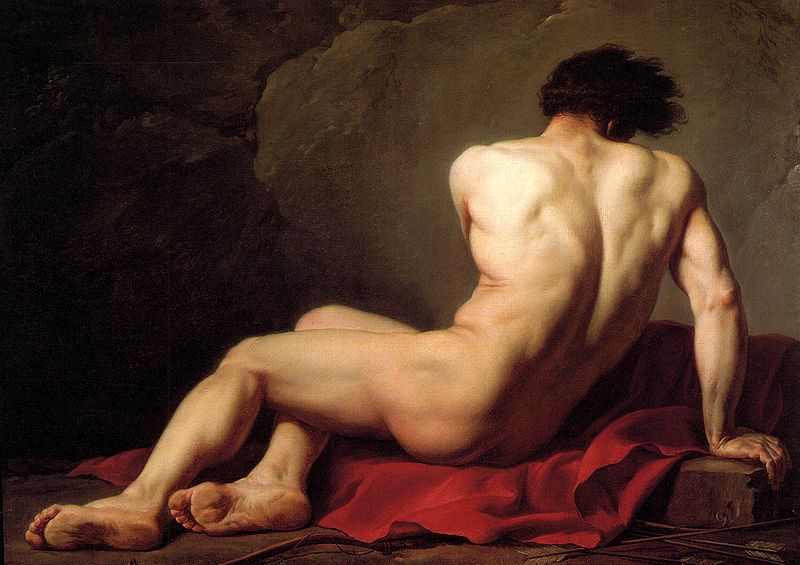
dish_JacquesLouisDavid

Reviewing a Musée d’Orsay exhibition about the male body, James Polchin considers the aesthetics of nudity:

In the 18th and early 19th centuries, the male body was crucial to academic painting, anchoring the ideals of ancient Greek and Roman aesthetics. One of the more compelling works early in this show is Jacques-Louis David’s Patroclus (1780). David, the icon of early 19th century Neoclassical painting, used heroic, naked males in many of his historical paintings, composing large canvases filled with muscled subjects, their crotches often covered in subtle ways, all rendered with realist precision. Unlike David’s more crowded historical scenes, this work offers a quiet intimacy between viewer and the subject sitting on the ground in a weakened state, his torso twisted away from us, leaving us gazing at him from behind. In Homer’s Iliad Patroclus was the comrade of Achilles fighting alongside him in the Trojan Wars where he was killed. Their relationship has often been considered a romantic one. The painting conjures the beauty of Patroclus’ body as something idealized, as if David is asking us to gaze upon the defeated warrior in the same loving way as Achilles himself might have done. But beauty and nakedness here serves another purpose as well: a heroic ideal that captures not just our attraction but also our empathy.

(Image of Jacques-Louis David’s Patroclus, 1780, via Wikimedia Commons)

A Prescription For Bad Medicine

Theresa Brown points out that “every drug with two names — and that means practically every drug in use — is a medication error waiting to happen”:

[W]e have recently seen a proliferation of look-alike, sound-alike meds. For example: Zantac is used to treat heartburn, while Xanax is an anti-anxiety medication. A list of these sound-alikes fills a full eight pages on the Institute of Safe Medication Practices website. Data on medication errors is not collected systematically in the United States, so it is impossible to say accurately how many errors result from such confusion. Whatever the number, and the attendant misery the most serious mistakes generate, it seems undeniable that the potential for error is increased by the dual naming of all drugs.

Her suggestion:

All drugs now being sold could use either their brand name or the generic name. That name, and the manufacture of that medication, would be patent-protected for 20 years. Thereafter, any other producer of that drug would append it with a “-G,” indicating that it is a generic formulation. Acetaminophen sold as a generic would become Acetaminophen-G, and Plavix, a brand name blood thinner, would be sold as Plavix-G in its generic form. Combination drugs like the brand name inhaler Duoneb might have to use generic names (albuterol and ipratropium) to avoid confusion.

Grieving For Famous Strangers

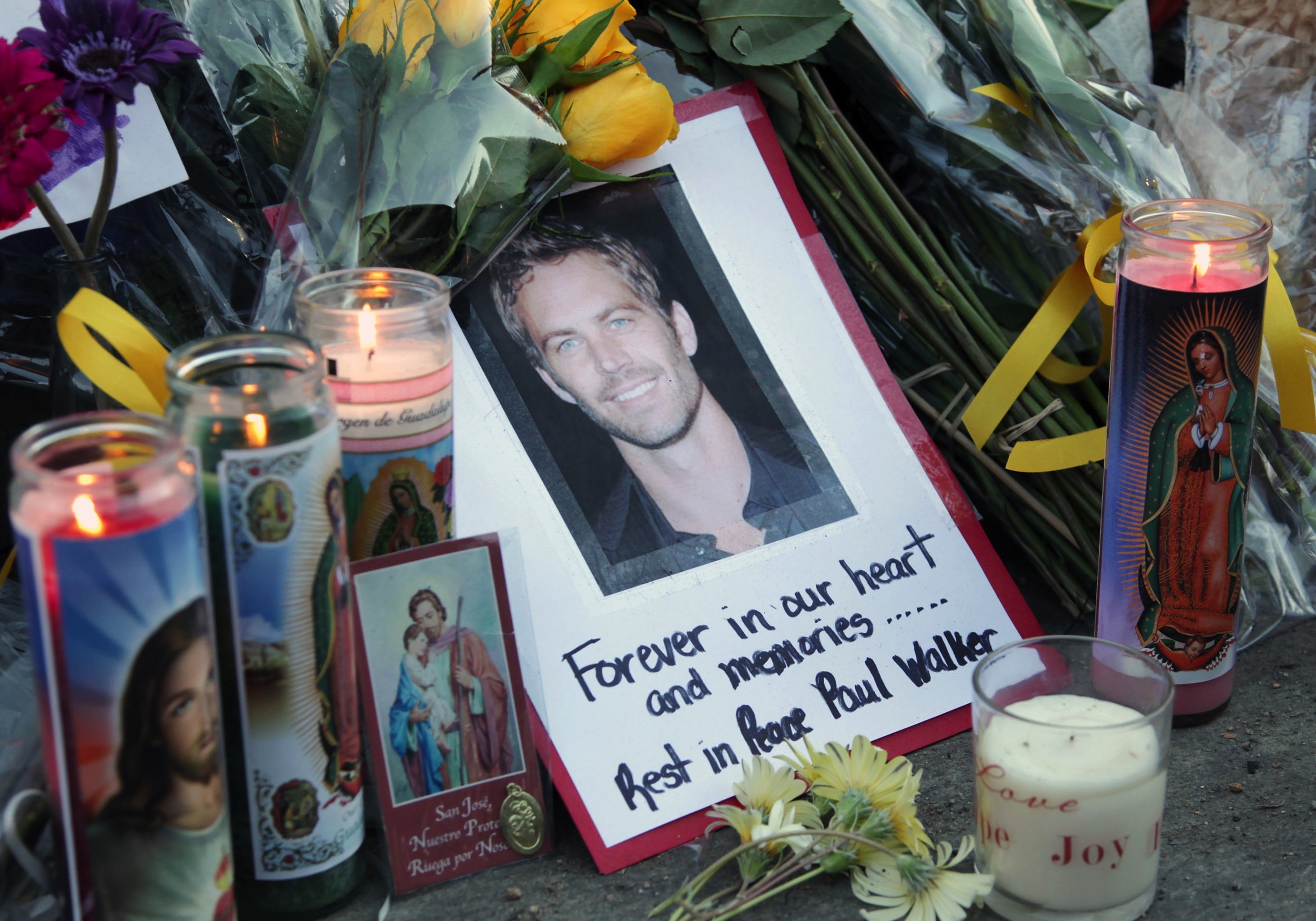
Paul Walker Crash Site Becomes Memorial

Ann Friedman reflects on the sudden death of actor Paul Walker:

Experts say that we mourn celebrities the way we mourn family members because we’ve grown up with these people. They are in our homes and part of our conversations. “When a celebrity passes, the loss is personal — not because we knew the celebrity, but because they were with us as we grew up and as we had our own special moments,” Dr. Alan Hilfer, director of psychology at Maimonides Medical Center in New York City, told U.S. News & World Report. In other words, they’re in emotional proximity to us even if we’ve never met them.

The celebrity objects of our teenage affection were safe vessels for sexual desire at a time when most boys walking the halls of our high schools didn’t quite live up to our ideals. Our celebrity crushes’ movies or music or TV shows are always available to us, so our relationships seemed ever-deepening. We’d have recognized his nose-crinkly smile anywhere; we knew the sound of his voice so well that we could replay it in our minds when we zoned out in class. On some level, the feelings were real. And even after abandoning this sort of obsessive fantasy for more complicated relationships with real humans, some deep-down part of us is still in love with the ideal.

(Photo: Fans pay tribute to actor Paul Walker at the site of his fatal car accident on December 1, 2013 in Valencia, California. Walker died on November 30, 2013 at age 40. By David Buchan/Getty Images)

The End Of DIY DNA Testing? Ctd

A reader writes:

I wonder how many folks, like me, had thought about buying the 23andme kit, hadn’t gotten around to it, and now, because of all the recent FDA publicity and worried they might miss the opportunity, went ahead and submitted their order. My kit should arrive in the mail today, and I plan to get it back to them ASAP, because I suspect they have received a flood of orders, thanks to the FDA. Because the genealogy part of the results are also those of my three sisters, they will be receiving those results from me as their belated Christmas gift.

Another gets an uneasy feeling:

I want to bring up another angle that I think has been under-appreciated. Anne Wojcicki, a co-founder of 23andMe, is married to Sergey Brin of Google (although they are now separated). Her sister Susan is Google’s director of marketing, and was also the person who rented her garage to Larry and Sergey when they started the company. Why is this important? Because 23andMe collects genetic data from people, along with their family and medical histories.

In a recent interview, Wojcicki said they hoped to reach a million customers by next year. Their stated business plan includes using this genetic data to find associations between genes and diseases. To my knowledge, no other entity can come close to amassing this amount of data, and people are voluntarily giving it to them as part of the service. To me, the $99 testing service is almost an inconsequential part of their business. It simply allows them to collect the data and turn it into biomedical discoveries. Despite the recent Supreme Court ruling that genes cannot be patented, there is still plenty of room to monetize therapies using this approach. All they need is a partner with the ability to process huge amounts of data and extract relevant gene/disease associations, and with Google they would have that. Presumably customers’ identities are kept private, and the data are analyzed anonymously. But of course there is always the concern that with big data, nothing is truly anonymous.

Update from another:

One thing that most people probably don’t realize is that the genetic information that 23andMe collects is not covered by federal healthcare privacy laws (HIPAA) because 23andMe’s customers pay out of pocket. For HIPAA to apply, the healthcare provider has to bill for reimbursement electronically. There are probably state laws that apply, but there is not federal protection for that information.

Why Polio Is So Hard To Wipe Out

Afghanistan Struggles to Eradicate Polio

Matthieu Aikins investigates the “all-out, very expensive effort to eliminate the last few problem areas in some of the most troubled and undeveloped parts of the final three countries where polio is endemic: Afghanistan, Pakistan, and Nigeria”:

The poliomyelitis virus has likely been living with humans for millennia. Archaeological excavations of prehistoric burial grounds, as well as paintings in ancient Egyptian monuments, show limb paralysis that is probably the result of polio. The virus, part of the enterovirus genus, is extremely contagious and spreads through two routes—oral-oral, through saliva, or more commonly fecal-oral, like when an infected person’s feces contaminate the water supply. In the crowded, unsanitary cities of antiquity and medieval times, this meant that virtually everyone would have been exposed to the virus in childhood. For most people, this wasn’t a problem:

The virus typically infects only the mucosal tissues of the gastrointestinal system for a few weeks, where the immune system clears it before any harm is done. After that, the infected person would be immune to future infections from the same strain. However, in less than 1 percent of infections, the virus attacks the central nervous system and causes paralysis. Typically this affects just the legs. But in 5 to 10 percent of paralytic cases (that is, 0.05 percent of total infections), polio paralyzes the breathing muscles, meaning that without artificial respiration the patient will suffocate.

All this explains why polio is so difficult to annihilate. For every one person who actually gets sick, nearly 200 are carrying the virus and infecting others.

(Photo: Fawad Rahmani, 11, makes his way home using his crutches and special braces fitted from the ICRC Orthopedic clinic in Kabul, Afghanistan on September 26, 2009. Fawad has had polio since he was two years old. Health care is one of many problems facing Afghanistan, eight years after the war began to oust the Taliban regime, even as the country receives billions of dollars in international aid. Afghanistan is still fighting to eradicate polio to which they are one of the few countries still dealing with the disease. Earlier this month UNICEF launched an immunization campaign targeting 1.2 million children with an aim is to immunize every child under five. By Paula Bronstein/Getty Images)