Is Climate Change Fueling Terrorism?

This embed is invalid


Tristan McConnell and Nick Loomis consider the connection, specifically in the Sahel, a region just south of the Sahara:

“Climate change plays two roles,” says [energy efficiency company] Opower’s [Drew] Sloan. “When you and your family have been living off the same land for generations and all of a sudden that becomes impossible, the first impact is relocation. But there’s a limited amount of land in the world so we’re going to see more and more skirmish zones. … Second, climate change makes people feel small and helpless, and Islamic fundamentalists have been very good at turning helplessness and despair into anger and action. If you give someone who feels small a gun, they stop feeling small,” he adds. Sloan is a former US Army soldier. “If you give them a direction to point that gun they stop feeling helpless.”

[UC Berkeley scholar Marshall] Burke, a resource economist, is more cautious.

He says the evidence does not yet suggest direct cause-and-effect links between climate change and specific conflicts, but that climate change increases the likelihood of conflict in general. “Years of bad climate — in particular, years of unusually hot temperatures or extreme rainfall — substantially increases the likelihood that many different types of conflict might occur,” says Burke. “We cannot say definitively that changes in climate are what has caused the growing conflict across the Sahel but the types of climate change we’ve seen are on average associated with higher rates of conflict.” …

[Burke] also sees glimmers of hope. “There are many other factors that also affect conflict, and many of these things are improving: countries are getting a little wealthier, and developing better institutions. Whether these improvements will outweigh the negative effects of climate change, I don’t think we know yet.”

The Bell Keeps Tolling, Ctd

Judis sees New York going bi-weekly as “the latest indication that high quality print magazines and newspapers are slowly but surely passing from the scene”:

Smaller specialized publications with niche audiences and advertisers have survived the transition to the web. So have smaller political publications that have always depended on sympathetic benefactors to make up their losses. Bigger general interest magazines like New York or Time will, if they survive, become more dependent on the kind of consumer features that have allowedU.S. News to limp along. But the danger here is that the kind of features or reporting for which they were known will become accessories the way they are in airline or fashion magazines. I worry even more about the big newspapers. Who will be around to fund investigative stories into local corruption, or who will have the reporters ready to report on a revolution in Jakarta that threatens to spread through Asia?

James Poniewozik looks on the bright side:

That same Times story noted that New York is not laying off staff; in fact, it will be hiring staff for the magazine’s already busy website. It will plow the savings from printing less often into digital publishing. As a magazine–a physical thing–New York may be cutting back. As a news organization, it is–for now at least–growing. Palpable? Maybe not. But at least potentially thrilling.

All this illustrates something we need to remember when we talk about the media business, its changes, and its (very real) problems paying for itself. The physical form of journalism is not the journalism itself.

Alexander Abad-Santos praises New York’s digital offerings:

The magazine’s spin-off sites Vulture, The Cut, and Grub Street are on fire. The company reports that their online audience was up over 40 percent this October, which translates to about 18 million monthly unique visitors. And they say that their investments will include a new blog focused on human behavior (titled “the Science of Us”), the Daily Intel blog beefing up its political coverage, and more manpower at Vulture and The Cut.

My thoughts here.

After The Gorging And Consuming

Giving Tuesday is on its way to becoming America’s newest holiday tradition:

Already more than 3,400 nonprofits and companies have agreed to push the idea of donating to charity on December 3, and organizers predict the effort will easily attract more than 5,000 participants, double the number of organizations involved last year in promoting charitable donations just after the high-profile shopping days Black Friday and Cyber Monday. Many nonprofits that participated in Giving Tuesday last year say they raised much more that day than they typically do on a day in early December. For instance, nonprofits that raise money through Network for Good, which processes online gifts, reported a 155-percent increase in donations on Giving Tuesday compared with the Tuesday after Thanksgiving in 2011. 

Eileen Heisman of the National Philanthropic Trust says the holiday is a win-win for businesses and charities:

The leaders of these organizations immediately got the concept that the philanthropic community stood to benefit by converging on a day like this, in the same way that retailers (even though they compete aggressively) all take part in and benefit from Black Friday. With every project, they are spreading the word through their networks, and the connection to #GivingTuesday becomes more valuable. At the same time, they appreciated that their participation did not require them to spend on messaging over and above what they had been planning. Because the timing and tagline of #GivingTuesday can easily be incorporated into existing campaigns, even thinly-stretched charities can use it to refresh their message and increase awareness.

Laura Flanders concedes that “whenever haves help have-nots, that’s worthy of praise,” but adds “when massive global corporations want praise too, I get a little queasy”:

Take Verizon. For Giving Tuesday, the Verizon Foundation says it will contribute to three large nonprofits as directed by the votes of Verizon workers. The company calls it giving back and “giving voice” to employees. Call me cynical, but I bet most Verizon workers would have preferred more voice and fewer givebacks in their contracts. Over the last decade Verizon’s forced concessions on everything from wages to pensions to job security and the right to organize. Giving Tuesday’s nice, but Verizon workers give back every day.

Meanwhile, Kelly Kleiman offers a practical suggestion: “Next year will the powers that be who created this quasi-holiday please consider scheduling it before, and not after, Black Friday, Small-Business Saturday, Football-Wagering Sunday and Cyber Monday?”

Before Thanksgiving, everyone’s in the mood to think about things they should be thankful for: the perfect mood from which to give generously. Before Thanksgiving, most people are at home in their regular lives and regular schedules, not packing or unpacking or sitting in airport lounges fretting. Before Thanksgiving, people have eaten normally instead of excessively and therefore will find it easier to believe that other people don’t have enough. There’s nothing like a full stomach to eradicate thoughts of others’ hunger.

Is Thailand Due For Another Coup?

In Bangkok, protests that began over a week ago demanding the resignation of Prime Minister Yingluck Shinawatra turned violent over the weekend. Joshua Keating explains the origins of the protests and points out a curious anomaly:

Thailand’s political predicament appears to contradict the longstanding idea in political science that as populations become wealthier and more educated, they will become more democratic. In Thailand, the wealthy, urban middle class are perhaps the least supportive of democracy. It’s not the only place where this seems to be the case.

Steve Herman notes that Thai democracy “has long been fragile here with the military conducting 18 coups since the end of absolute monarchy rule in 1932.” Jay Ulfelder considers why certain countries are prone to coups:

The most informative factors in thinking about coup risk are a country’s wealth, its form of government, and the recent occurrence of coup activity.

Coup attempts very rarely happen in countries that are rich, either fully dictatorial or fully democratic, and have no coup activity in the recent past. Almost all coup attempts, successful or failed, occur in countries that are relatively poor and have political regimes that mix features of autocracy and democracy. These mixed regimes are especially susceptible to coups when politics within them is sharply polarized, as it has been in Thailand for nearly a decade now.

Bruce Einhorn adds that, with the anti-government forces pressing for the military to step in, the current standoff could end the same way:

Pimpaka Nichgaroon, head of research for Thanachart Securities in Bangkok, warns that the current unrest could end as it often does in Thailand, with the generals intervening. Chances of a military coup are now 50-50, according to Pimpaka. The anti-Yingluck forces “want some kind of national unity government to help reform the political system before the country has a new election,” she wrote in a report published yesterday. However, that kind of regime change is unlikely “without some kind of military intervention or a coup, a risk we see rising from only 5% a month ago to a 50% probability now.”

The Misery Of Miscarriage, Ctd

The remarkable thread continues:

I have had four miscarriages and, at the age of 40, have finally accepted that I will never have my own biological children. Your reader with the PhD in genetics wrote, “When something is very wrong with the genetic makeup of the embryo, it doesn’t develop properly and the body rejects it, as it should. … I wish there was more education about this; I think people would have an easier time accepting this outcome if they understood.”

This reader has obviously never experienced a miscarriage. I guarantee you that when a woman has a miscarriage, the first question she asks is, “What went wrong?” And unless a specific medical cause can be identified, she hears the above explanation. For most people, this in no way will lessen the grief. The loss of the pregnancy means the loss of not just a future baby, but all your hopes and dreams for that baby and your family. It sounds corny, but unless you have experienced the loss of a very wanted pregnancy, it is difficult to express the depth of grief and loss.

And yes, an early miscarriage is very different than a late term miscarriage, a stillbirth, or the death of child. But, to basically tell parents who miscarried early that they should get over it more easily because the baby was just not “meant to be,” biologically speaking, is highly insensitive at best.

By the way, I had an abortion in my early 20s. I have never regretted it, even now. Having a child at that age would have destroyed my sanity and life. My parents are very strict Catholics and I would probably have dropped out of college due to the shame it would have brought on my family. Why should I have destroyed my life just because our contraception of choice failed? Despite my four miscarriages later in life, I have always been, and remain, pro-choice. It’s so very personal.

Several other readers sound off:

I am a childless older gay male, and I have been really interested in reading your posts on the impact of miscarriages on couples. Thank you for bringing this to public conversation. The most important factor to me is how society treats this particular loss – by ignoring it, essentially. I have been guilty of the same ignorance – with my sister and niece, who both miscarried but subsequently had great kids. I was also struck by juxtaposing these comments to an earlier post on your site, “When Children Weren’t Cherished,” which tells the story of how losing young children before the 19th century, not to mention early miscarriages, was treated with as little emotion as the loss of a pet. Of course, many children died early then, so maybe it was so common that it wasn’t as sad as it might be today. However, there’s also the possibility that those older mothers grieved much as we do today, but it wasn’t noted because they were women and women had considerably fewer modes of communication then.

Another male reader:

Thank you for the thread on miscarriages. Because my wife was high risk, we knew we would have difficulty with her getting pregnant. We tried for years and then decided to try IVF. IVF was successful in getting her pregnant, but she suffered five miscarriages (all early on in the pregnancy). They were extremely emotionally painful. She viewed the miscarriages as her weakness (or maybe her fault). That, of course, is understandable, but, as a result, she didn’t want me to talk to anyone about them. She could talk to her trusted friends to help her process the pain, but I was kind of left to suffer in silence. I could, of course, talk to my wife about it, but I didn’t want to burden her with my pain. She was dealing with hers. It sucked.

Well, after the five miscarriages, she got pregnant again (via IVF). All was going well and about four weeks in she went for a routine sonogram. I usually went to all the appoinments, but couldn’t make this one. Our regular doctor was not there and one of the other doctors did the sonogram. He told my wife that the fetus was not viable and that a DNC will be scheduled. Of course, she was devastated and called me very upset. She then said that something did not feel right about the whole thing and she called our regular doctor. He said come in again the next day and he will re-do the sonogram. Of course, I went.

Well, he found the pulsating of a viable fetus. It was a miracle. Well, that little bundle of pulsating cells is now a beautiful six-year-old girl who is the light of our life. To this day, I can’t tell this story (or type it) without tearing up. To know we came so close to ending her life based on a faulty sonogram. Thank God my wife felt something was not right. Thank God!

Another happy ending from a reader:

I am sure that you’ve been inundated with stories in response to this thread. I was a bit reluctant to share, but others’ tales have deeply touched me … as so many of your threads have over the years. My husband and I had been happily married for over 13 years when we mutually decided that we would like to share our lives with a child. At 37, I was older to be trying for the first time. But for some reason, it never really crossed my mind that we might have a tough time getting (and staying) pregnant … even when the doctors warned that it might be.

After trying for several months, we were ecstatic when an early test came back positive. My husband was away on a business trip and I snapped a selfie (before everyone was calling them that) and texted him the great news with a subject line of “congratulations, Papa!” We told everyone, blithely. I went to the first OB visit on my own, figuring there would be many more visits when my husband could join me. The OB performed what we both expected to be a routine scan, but they couldn’t find a heartbeat. He told me not to be overly worried, as it was early on. I cried all throughout a blood draw, as a nurse told me to stop because my tears were “bad for the baby.” The tests indicated that I was still pregnant, but the scare left me shaken and I cried all the way home. I continued to feel pregnant and looked forward to the next visit, but they were never able to locate a heartbeat and eventually I stopped feeling pregnant and began to bleed.

Flash forward a few months and we were again elated when an at-home test came back affirmative. We were far more circumspect this time around and waited to tell even our families until I had a positive test at the OB and we saw a heartbeat on the monitor. We allowed ourselves to get excited and shared our good news. I was told that the signs looked good for us and started working out again. At just over 12 weeks, I was resting at home on a beautiful winter’s day after a workout when I felt a strange pull. I went to the bathroom and to my horror, was bleeding profusely. I called the doctor, asking if I could go to the emergency room. He said there was nothing they could do. He said he was very sorry that I’d miscarried again and that he would see me on Monday and we could talk about next steps. Distraught, my husband asked me what I felt like doing. I replied honestly, “I feel like getting drunk.” We cried over beers at the now-closed Brickskellar and decided that we still wanted to try again. That we truly wanted to be parents. I bled all weekend.

My husband took me to the hospital on Monday, but didn’t come in as we had our beloved dog with us. I cried as I recounted what had happened with the doctor. He sympathized and said that he would still need to do an ultrasound to let him know what we should do next and whether I would need a D&C. He began and then pulled back in surprise. I’ll never forget what he said next, “I don’t know what to tell you, but you have a completely healthy baby here.” He showed me my lovely and lively girl on the screen, with the strongest heart beat clearly visible. Through laughter and tears, I told him I’d gone drinking the night that I thought I had miscarried. He laughed and said not to do that again … but also not to worry. Everything was fine. I ran to the car to share the unbelievable good news with my husband. I burst out laughing again as I said that I had a feeling this was going to be one tough girl.

And she has been. She’s the strongest, funniest, most quixotic child and we know that we are unaccountably lucky and blessed to have her in our lives. Since all of this, I’ve comforted a number of my friends as they’ve dealt with their own miscarriages or pregnancy scares. It amazes me how no one talks of this … until we do. I now know that my own mother miscarried shortly after I was born. Thank you for making the space for this important conversation. It’s been cathartic to write out my own story.

Always Tell Kids The Truth? Ctd

A reader writes:

While I truly despise the parents who followed Kimmel’s Halloween candy prank, I have to disagree with Sam Harris, who only lied to his kid once.  I’m sorry, but I really did enjoy maintaining the fantasy of Santa Claus for my child.  It was not only a lot of fun, but it provided great motivation when her behavior threatened to go to the dark side.  Heck, I expanded the concept to include “Kenny the Birthday Kangaroo” who shared files with Santa.  My best friend claimed to have Santa’s cell phone number on speed dial to report any last minute misbehavior.  The Tooth Fairy paid ransom for teeth in both of our homes.

Those are all lies, and our children trust us. But it’s not the act of lying; it’s the intent behind the lie that determines if our children trust us.  Our children know we would not harm them or cause them unnecessary pain (unlike the children who were tortured about candy so their parents could get a few minutes of fame). That’s what trust is about.

Another:

My wife once told our oldest son a good one.

When he was around 3, we went to Kauai for vacation and he discovered Fruit Loops at the hotel’s breakfast buffet.  He fell in love and would make a beeline for them every morning.  His mom and I weren’t happy about all of that sugar, but let it go as we were only there a week & hoped he would forget about it as soon as he stopped getting his breakfast at a buffet.  Wrong.  The first morning back home in Seattle, he started getting a little belligerent about wanting Fruit Loops.  After a few minutes of firm no’s and trying to reason with him, he was still insisting.  So she told him that unfortunately they were a regional food available only in Hawaii.  He thought about it for a few seconds and that was it.  He calmed down and ate his normal breakfast without further complaint.  I thought it was genius.

Another differs:

I hated being patronized as a kid and always try to “keep it real” with kids. Judaism is my favorite Abrahamic religion because, in addition to revering scholarship and devoting a holiday to all-night Talmudic study, they avoid the Christian tendency to turn religious holidays into occasions for inventing impossible narratives (a flying fat man and a giant bunny delivering toys and candy respectively) and misleading children into believing them.

The Bugs Yet To Be Fixed

David Auerbach assesses the current state of Healthcare.gov:

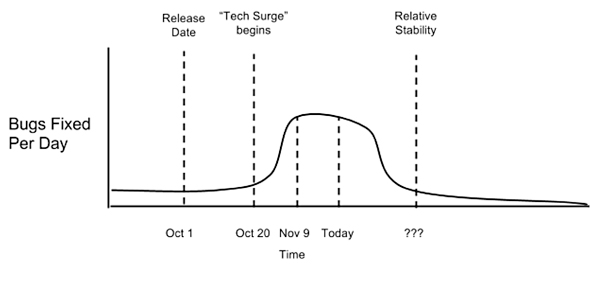
The report says little about what work is ahead of the engineering team, but at least one graph suggests there’s some ways to go:

software fixes.

Aside from confirming that it took the administration until early November just to start making significant progress on functionality fixes, the graph also indicates that engineers are still frantically fixing the site. If the site were anywhere near stability, you would expect the number of fixes to start to level off close to the administration’s self-imposed Nov. 30, signaling that they were ramping down crisis mode and making fewer fixes per day. But it doesn’t, indicating that they are still in the hump of this bug-fixing graph:

Bug fixes.

Suderman worries that fixing these bugs will prevent the rest of Healthcare.gov from being built properly:

With 30 to 40 percent of the site, including critical insurer payment systems, yet to be completed and tested, you can bet these problems will continue. Not only because it clearly takes longer than expected to excise flaws from the system, but because lingering problems with the portion that’s already been built will take time and energy away from constructing and testing the portions of the system that have yet to be put in place. The administration delayed the Spanish language version of site from its initial planned opening, and just last week announced that the federally run small business exchange that was supposed to open last month would be postponed by a year. The team working on Obamacare is already reported to be working around the clock on repairs; even if they don’t burn out from the weeks of long hours, it’s inevitable that building additional functionality and putting it through the paces will fall by the wayside if the existing troubles aren’t fixed.

Update from a reader:

In this post, the data regards bug fixes per day. To understand the stability of the site, however, you need to know how many new bugs are found per day (by end-users and QA staff). If their bug backlog was at 600 on November 1, and no other bugs have been filed, then the fix rate will drop off drastically in a week or two. If their bug backlog is still at 600, however, then the bug-fix trend line could continue to rise for months to come.  To get a true understanding of the stability of the web site, we need to see open bugs over time and/or bugs filed over time.

Does A Company Have Religious Rights? Ctd

Ramesh contends that the ACA violates “our statutory right to act on our religious beliefs”:

Up until 2012, no federal law or regulation required employers to cover contraception (or drugs that may cause abortion, which one of the cases involves). If 2011 was marked by a widespread crisis of employers’ imposing their views on contraception on employees, nobody talked about it.

What’s actually new here is the Obama administration’s 2012 regulation requiring almost all employers to cover contraception, sterilization and drugs that may cause abortion. It issued that regulation under authority given in the Obamacare legislation. The regulation runs afoul of the Religious Freedom Restoration Act, a Clinton-era law. That act says that the government may impose a substantial burden on the exercise of religious belief only if it’s the least restrictive way to advance a compelling governmental interest. The act further says that no later law should be read to trump this protection unless it explicitly says it’s doing that. The Affordable Care Act has no such language.

Amy Davidson has argued against that line of thought:

Hobby Lobby is arguing that it counts as a person whose religious expression, according to the Religious Freedom Restoration Act of 1993, shouldn’t be “substantially burdened” by a law unless there is a “compelling government interest.” (Adam Liptak has written about how this draws on the dubious logic of Citizens United.) But the burden of complying is missing and the compelling interest is clear. The owners of Hobby Lobby aren’t the ones taking Plan B.

The government, in a reply to the company’s SCOTUS filing, quoted the opinion of a judge who, writing about a related case, said that the mandate would not “encourage (the corporations’) employees to use contraceptives any more directly than they do by authorizing (the corporations) to pay wages.” The government, meanwhile, heavily underwrites the entire employer-insurance system through its tax treatment of the money that companies spend on health care. (As my colleague John Cassidy argues, a lot of this would be simpler if Obamacare had been more radical, introducing a single-payer system.) The government also has an interest in women being healthy and having fair access to the care they need.

Scott Lemieux joins the conversation:

One argument that has been made again and again by supporters of the legal challenges is that the religious consciences of employers are being burdened so that employees can get “free” contraception. But this is an erroneous argument that misapprehends the basic concept of employer-provided health insurance. Contraception provided by health insurance isn’t “free,” it’s earned. Companies get substantial taxpayer subsidies for partly paying employees in health insurance instead of cash. In exchange, this insurance has to be comprehensive enough to provide value to the employee. Women getting basic health-care needs covered by insurance they’re receiving as compensation are not receiving any kind of free ride.

This point underscores just how weak the legal challenge to the mandate is. The employers in question are claiming that there’s a major religious freedom issue at stake depending on whether employees obtain contraception through direct wages or through the insurance employers get tax benefits for paying employees with instead. But there isn’t. The “burden” imposed by the mandate is utterly trivial, and the argument that it violates RFRA should be rejected by the Supreme Court.

Meanwhile, Edward Zelinsky believes “this entire controversy is unnecessary”:

The tax law contains devices for reconciling the religious concerns of employers like Hobby Lobby with the policy of expanding medical coverage: health savings accounts (HSAs) and health reimbursement arrangements (HRAs). The current regulatory exemption from the contraception mandate should be amended to include for-profit employers and to exempt from the federal contraception mandate employers (both non-profit and profit-making) who maintain HSAs or HRAs for their respective employees. Compromise along these lines would respect the genuinely held views of religious minorities while implementing the federal policy of broadening access to health care.

Previous Dish on the court case here.