Face Of The Day

UKRAINE-UNREST-POLITICS-EU-RUSSIA

A girl takes part in a rally of the opposition on the Independence Square in Kiev on December 2, 2013. Ukraine’s prime minister on Monday compared pro-EU demonstrations in the country to a coup, branding them illegal and “out of control”. Tens of thousands have been protesting in Kiev, occupying City Hall and blocking entrances to the government headquarters, in an ongoing standoff after the government failed to sign a key EU pact. By Genya Savilov/AFP/Getty Images.

“Beauty Is In The Brain Of The Beholder”

A team of researchers tested a group’s appreciation of artwork before and after delivering a jolt to each subject’s left dorsolateral prefrontal cortex, “a region of the brain previously shown to play a role in aesthetic judgment”:

The results: The brain stimulation “resulted in a modest (around three percent) but statistically significant increase of aesthetic appreciation of representational images (both artworks and photographs),” the researchers write. “Stimulation did not affect evaluation of abstract images, suggesting that the neural mechanisms underlying appreciation of figurative and abstract images may be different, at least in individuals with no strong background in fine arts.” …

This does not mean a jolt of electricity can take the place of a master’s degree in art history. Rather, the researchers suggest, the increased activity in the left dorsolateral prefrontal cortex seems to help people adopt “an aesthetic orientation” toward the object in question. In other words, when this section of the brain is stimulated, either internally (thanks to education and training) or artificially (via electrodes on the scalp), your focus shifts from content (that’s a picture of a tree on a hillside) to context (notice the subtle interplay of shapes and shadings). As Cattaneo and her colleagues put it, viewers disengage “from a habitual mode of identifying objects to adopt an aesthetic perspective.”

Danger On The Tracks?

Metro-North Train Derails In Bronx

Neena Satija hopes politicians start paying more attention to railroads in light of yesterday’s deadly accident in the Bronx:

Investing in basic infrastructure needs like maintenance isn’t a sexy political cause. But it’s necessary. And passenger rail may not even be the biggest concern: freight rail accidents actually could be the most catastrophic. The American Society of Civil Engineers said in 2006 that more than $120 billion will need to be pumped into U.S. rail infrastructure to keep up with increasing demand for freight rail by 2035 – and that was before a major oil and gas boom in the U.S. created a market for rail transport of crude.

Update from a reader, with some key perspective:

Every time there is a tragedy, the usual suspects call for more spending or regulation or both.  However, even a cursory view of the facts reveals that the train was driving 82MPH around a curve rated at 30MPH.

Pareene isn’t optimistic that more rail investment is coming:

This should be the most transit-friendly government in the country: A majority of New York citizens rely on public transit for their livelihoods. The city and state are run by Democrats, many of them among the most liberal in the nation. Our incoming mayor, Bill de Blasio, ran as a left-wing populist. But incoming mayor Bill de Blasio is a driver. Andrew Cuomo has been a driver, or had drivers, his entire life. There are certain richer Manhattanites, accustomed to walking, for whom anti-car policies improve their quality of life, but for most of the political class, everyone they know and interact with owns a car.

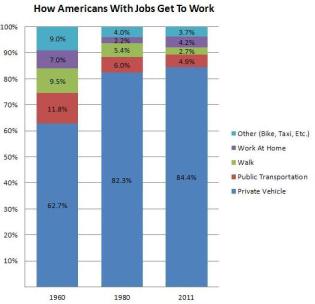
Along those lines, Priceonomics passes along the chart seen below, showing the increase in commuting by car:

commuting

All these commuters could be carpooling, but as Planet Money points out, the percentage of Americans who carpool decreased from 20% to 10% over the past 30 years. (Despite all the new carpool lanes built.) All other forms of commuting became less common from 1980 to 2011 except for working from home. So the only categories that didn’t continually decrease over the past 50 years were “Private Vehicle” and “Work At Home.” We’ll have to wait and see whether the movement for all things green pushes up the numbers of people biking, walking, and using mass transport. But environmental efforts are fighting against longtime commuting trends. 

Meanwhile, Brian Merchant imagines a technological fix:

According to New York governor Andrew Cuomo, the leading culprit in the cause of the accident is excessive speed, likely coupled with human error. The train was moving too fast as it came around a notoriously treacherous bend.  There are a number of reasons that trains end up traveling at excessive speeds. But a common one is that the trains are simply running late, and the conductor is trying to make up for lost time. That lost time is likely incurred by delays. According to a 2010 University of Illinois paper called Determining the Causes of Train Delay, the “operational causes” of delays were primarily due to problems with “acceleration, braking, reduced speed and dwell time.”

And here’s one way to streamline all of the above: Build a train that never stops. That was Chinese designer Chen Jianjun’s idea as far back as 2010, and the idea remains interesting today.

(Photo: In this handout photo provided by the National Transportation Safety Board (NTSB), a Metro North train sits derailed in the Bronx borough of New York City on December 01, 2013. Multiple injuries and four deaths were reported after the seven-car train left the tracks as it was heading to Grand Central Terminal along the Hudson River line. Photo by NTSB via Getty Images)

The Psychology Of Tribal Hatred

Tom Bartlett explores the field of intergroup-conflict scholarship, or research that examines questions like “What makes humans capable of horrific violence?” and “Why do we deny atrocities in the face of overwhelming evidence?” Bosnian social psychologist Sabina Cehajic-Clancy is among the researchers profiled:

In perhaps her most intriguing study, Cehajic-Clancy and her co-authors asked Serbian high-school students to rate their level of agreement with statements like “Although I am not personally responsible for what has happened, I am ready to take on the responsibility for the behavior of my group” and “I think that my group should feel responsible for their crimes.” Before they were shown those statements, some subjects were asked by the researchers to write about a personal achievement, while others were asked to write about a group achievement. A third group, the control, received no prompt. Those who had written about a personal achievement were more likely to acknowledge and take responsibility.

It’s an odd result, but it jibes with previous studies suggesting that admitting group failure is a threat to a person’s sense of self-worth. Perhaps reflecting on a personal achievement makes people feel confident enough to view their group in an unflattering light. Meanwhile, reminding people of the pride they take in their group may make them more defensive and less open.

The Algorithmic Gatekeeper

Don Peck looks at how big data is transforming the labor market:

The application of predictive analytics to people’s careers—an emerging field sometimes called “people analytics”—is enormously challenging, not to mention ethically fraught. And it can’t help but feel a little creepy. It requires the creation of a vastly larger box score of human performance than one would ever encounter in the sports pages, or that has ever been dreamed up before. To some degree, the endeavor touches on the deepest of human mysteries: how we grow, whether we flourish, what we become. Most companies are just beginning to explore the possibilities. But make no mistake: during the next five to 10 years, new models will be created, and new experiments run, on a very large scale. Will this be a good development or a bad one—for the economy, for the shapes of our careers, for our spirit and self-worth?

His conclusion is largely positive:

When I began my reporting for this story, I was worried that people analytics, if it worked at all, would only widen the divergent arcs of our professional lives, further gilding the path of the meritocratic elite from cradle to grave, and shutting out some workers more definitively. But I now believe the opposite is likely to happen, and that we’re headed toward a labor market that’s fairer to people at every stage of their careers.

For decades, as we’ve assessed people’s potential in the professional workforce, the most important piece of data—the one that launches careers or keeps them grounded—has been educational background: typically, whether and where people went to college, and how they did there. Over the past couple of generations, colleges and universities have become the gatekeepers to a prosperous life. …

But this relationship is likely to loosen in the coming years. I spoke with managers at a lot of companies who are using advanced analytics to reevaluate and reshape their hiring, and nearly all of them told me that their research is leading them toward pools of candidates who didn’t attend college—for tech jobs, for high-end sales positions, for some managerial roles. In some limited cases, this is because their analytics revealed no benefit whatsoever to hiring people with college degrees; in other cases, and more often, it’s because they revealed signals that function far better than college history, and that allow companies to confidently hire workers with pedigrees not typically considered impressive or even desirable.

The Conservative Mind At Sixty

Timothy Goeglein marks Russell Kirk’s 1953 “minor-classic,” one of the founding texts of post-WWII American conservatism:

With precision and finesse, Kirk illustrates that, beginning with the British parliamentarian Edmund Burke in the eighteenth century, there is an identifiable, unique, and manifestly conservative 476px-Kirk_1962. tradition in the arts, letters, morals, manners, and politics that is, if not ideologically consistent, singular in its own excellence of shared first principles. Kirk’s conception of tradition is quite distinct from the Whig view of history as a natural, inevitable progression toward centralization and consolidation in a variety of spheres, including government. According to Kirk, this conservative tradition has its own intellectual and imaginative architecture, born of ardor and brilliant writing and thought. It springs from the natural law, integrating variety and mystery with hierarchy and order. The conservative tradition emphasizes the close associations between property and liberty, and custom and prudent change, that favor reform over rebellion or revolution.

The cast of conservative luminaries that filled Kirk’s narrative:

Kirk was particular in choosing his canon, selecting not only Burke, Coleridge, and Eliot, but also a veritable cavalcade of worthies: John Adams, Alexander Hamilton, Walter Scott, Alexis de Tocqueville, Nathaniel Hawthorne, John Henry Newman, James Fenimore Cooper, and Samuel Johnson. Kirk also included two now-obscure Harvard professors, Paul Elmer More and Irving Babbitt; the students influenced by these professors constitute a veritable Who’s Who of American political and literary leadership. Not the least of these students is Eliot himself, who won the Nobel Prize for Literature in 1948. Kirk etches finely wrought mini-biographies of all these great men, with a special emphasis on their ideas.

Bradley J. Birzer emphasizes that Kirk’s conservatism put culture before politics:

Kirk presented almost nothing about defense policy, economic policy, or educational policy.  Instead, throughout the book, he created a list of conservative venerables, from Edmund Burke through George Santayana.  In his definition of conservative, the poetic, literary, and theological superseded the political.  As Kirk explained to [publisher Henry] Regnery in a personal letter in 1952, he did not think a writer or publisher should “exclude political essays.”  Instead, he continued, the author and publisher should “recognize the greater importance, in literature as in life, of religion, ethics, and beauty.”

After the first reviews began to appear, Kirk grew frustrated with the political analysis and emphasis on The Conservative Mind.  Not even the followers of Irving Babbitt had laid “stress enough upon the ethical aspect of” The Conservative Mind, he worried.  “Politics, I never tire of saying, is the diversion of the quarter-educated, and I do try to transcend pure politics in my book.” … Kirk’s attempt to put politics back in its proper sphere was, to say the least, admirable, but even he could not convince the innumerable advocates and reviewers of his work to follow him down a non-political path.  Kirk gave them poetry, history, and philosophy, but they wanted cold, utilitarian social science.

And he was right.

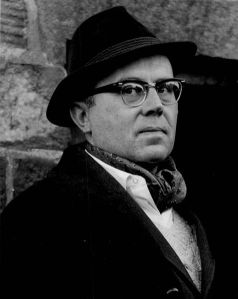
(Photo of Kirk in 1962 via Wikimedia Commons)

Don’t Judge A Baldwin By His Outburst? Ctd

TNC rebuts Wes Alwan’s defense of Baldwin’s bigotry:

The most telling—and bizarre—portion of Alwan’s essay is the idea that “homophobic feelings are no more of a choice than homosexuality itself.” This is a really terrible thing to write, but more importantly it’s false.  And I know it’s false because I was once a homophobic bigot. When I was a teenager, my anger almost certainly manifested itself in the same way as Baldwin’s. Calling someone towards whom you meant violence a “faggot” was what you did. The fact that it was what “you did” doesn’t make it any less bigoted. It means that bigotry was that much more pervasive. “Faggot” littered our understanding of English. Crews who were worthy of beat-downs were “faggot-ass niggas”; when our friends were behaving in weird ways they were “acting like fags”; when a boy shook a man’s hand and it was weak, he was told to not “shake hands like a faggot.”

I have often thought back on those days. How many gay men were actually around, silently watching all of this, fearfully keeping their peace? I never bullied anyone for being gay. But that isn’t because I wasn’t bigoted, it’s because I was an active agent in a world that made it dangerous to be yourself. The couple of kids who tried, who were bravely game, hung out with girls and were the subject of snickers. Those snickers were mine, too. And who knows what else they were subject to that I simply never witnessed?

The only thing that changed in my life was that, as an adult, I was forced to confront gay men on an equal plane. Sometimes it wasn’t even equal. One of my most influential editors was gay. I was 21. He was a great editor. What values did I hold that would allow me to see him as weak? What right had I to be disgusted by anyone? I was kid who’d seen West Baltimore and little else. What did I know about anything?

Alwan responds to TNC and me (my response after the jump):

The problem with these responses is that they redefine “bigot” away from its well-established common usage.

In fact, the primary function of a word like “bigot” is to very precisely exclude more conflicted, doubtful states of mind, as in: a bigot is “a person who is obstinately or intolerantly devoted to his or her own opinions and prejudices; especially: one who regards or treats the members of a group (as a racial or ethnic group) with hatred and intolerance” (Merriam-Webster). The obstinate devotion to certain avowed, intolerant beliefs is critical to the way that “bigot” traditionally has been used. The word has its origins in the general notion of close-mindedness: the idea is that a bigot is someone who is un-persuadable, who cannot be argued out of their beliefs. But accusing someone of being close-minded and un-persuadable requires that they adamantly hold the beliefs in question in the first place: it cannot be the case that they’re conflicted or akratic – that for example they sincerely favor gay rights as a matter of principle yet betray this principle during bouts of homophobic rage. Having unsavory impulses and poor impulse control is simply not the same thing as being closed minded and systematically intolerant. To extend the word “bigot” to someone like Baldwin is just to pervert it in order for the sake of exploiting its toxicity to his reputation.

Perhaps the best synthesis of all of our reactions to a consistent pattern of bigoted statements directed at actual individuals, often with a veiled or implicit threat of violence, is that Baldwin was being a bigot at the time of those incidents, which is not the same thing as saying he is a bigot through and through as some sort of cosmic, ontological reality. The problem I have with this notion is that it doesn’t make sense of a repeated pattern of homophobic slurs directed at actual people, along with a veiled or explicit threat of violence. It also doesn’t make sense of Baldwin’s reflexive lies about his slurs, as in the ridiculous claims that he had no idea that the word “queen” or “cocksucking” had anything to do with homosexuality, or the idea that he said “fathead” instead of “fag.” Why would someone not a bigot not simply confess he lost his temper in ways that made him sound bigoted and he now regrets it? The pattern of homophobic slurs, the refusal to own them, the righteous fury and deception about his own record: all these are not what you’d expect from a man who, like TNC, has learned about his own bigotry and ended it.

Look, as I said before: it’s almost never a good idea to use the word bigot if you are trying to persuade anyone. That’s why I have long been very sparing in the use of the term. And secondly, we’re all sinners, me more than most. But excusing obviously bigotry by euphemizing it or dismissing it because of progressive public positions is not something I’m comfortable with as a public writer. But I do believe in forgiveness and our common brokenness. And in that, my heart and open hand goes out to Baldwin, and to anyone with such a past.


How Much Fun Can Your Workplace Handle?

Rachel Nuwer relates the findings of a recent study:

Researchers at Penn State University decided to investigate employee retention after hearing complaints about high turnover rates in the hospitality industry. … The researchers interviewed 195 servers from an unnamed but popular U.S. restaurant chain to get their take on this issue. The researchers compared the servers’ descriptions of how much fun they had at work and how pro-fun their managers were—including whether they threw company parties, hosted good-spirited sales competitions and acknowledged employee birthdays—with each restaurant’s sales.

Fun-loving managers, it turns out, have the highest employee retention rates. But they also suffer from overall lower sales performance. If employees were broken down by age, however, the data show that older employees actually increase their sales performance at funner jobs. Younger workers, apparently, are less adept at balancing a work-play mix than older ones.

Passive-Aggressive Punctuation

Ben Crair demonstrates how the use of the period has evolved in the age of texting:

Say you find yourself limping to the finish of a wearing workday. You text your girlfriend: “I know we made a reservation for your bday tonight but wouldn’t it be more romantic if we ate in instead?” If she replies,

we could do that

Then you can ring up Papa John’s and order something special. But if she replies,

we could do that.

Then you should probably drink a cup of coffee: You’re either going out or you’re eating Papa John’s alone.

This is an unlikely heel turn in linguistics. In most written language, the period is a neutral way to mark a pause or complete a thought; but digital communications are turning it into something more aggressive. “Not long ago, my 17-year-old son noted that many of my texts to him seemed excessively assertive or even harsh, because I routinely used a period at the end,” Mark Liberman, a professor of linguistics at the University of Pennsylvania, told me by email. … “In the world of texting and IMing … the default is to end just by stopping, with no punctuation mark at all,” Liberman wrote me. “In that situation, choosing to add a period also adds meaning because the reader(s) need to figure out why you did it. And what they infer, plausibly enough, is something like ‘This is final, this is the end of the discussion or at least the end of what I have to contribute to it.’”

Jess Zimmerman reviews her own messages and arrives at a different conclusion:

Crair is totally right that “sorry about last night” is qualitatively different from “Sorry about last night.” and that “no” is definitely worlds away from “No.” A quick scan of my iMessage buffer, though, turned up punctuated texts including “A fat corgi. Super best.” and “OMG burrito.” Surely these are things nobody can be mad about; the period here is not expressing displeasure. … One [messager] is earnest and puts a lot of thought into everything he says (he feels strongly about a burrito, I guess); one is playful but argumentative (he just dares you to disagree that a fat corgi is best). The fact that they punctuate lends weight to the things they say, even if it’s on the subject of food and pups—or at least, it lends the appearance or tone of weight. … The period is the equivalent of banging your fist on the table for emphasis: A fat corgi is the best … PERIOD.

Eschewing the period, then, is avoiding emphasis, dodging declarativeness. It’s declining to speak with a tone of authority. It is, in short, the text equivalent of uptalk or vocal fry, the speech patterns that young people (especially young women) use to introduce a sense of accommodating uncertainty into their statements.

Meanwhile, Matthew J.X. Malady suggests a way that punctuation could reduce typographic uncertainty in English: inverted exclamation points, like the ones used at the beginning of sentences in Spanish:

When you’re reading a sentence the writer intended as an exclamation, by the time the exclamation point comes in, you’ve already read all the information that was supposed to have received emphasis! When your eyes reach the punctuation, you already know your wife got the big promotion, or the Pittsburgh Pirates finally made the playoffs, and you’ve missed the chance to read the relevant sentence from start to finish for the first time with the appropriate tone. … The punctuation marks in these instances function like pseudo-footnotes, coming in after the fact to tell you: By the way, you should’ve gotten excited about that last thing you just read…