Whom HIV Infects Today

INDIA-HEALTH-AIDS

Happy AIDS Day! To mark the, er, occasion, Hugh Ryan argues that statistics about high risk groups can “conceal as much as they seem to reveal.” He wants a more granular approach:

What if we focused more on marginalization (and its real-world effects) and less on identities? What if we understood AIDS not as a disease affecting certain types of people, but rather, as a disease that affects those living at the intersection of a constellation of conditions, such as poverty, lack of access to education, inadequate health care, stigmatized sexual practices, drug and alcohol abuse (legal or illegal), and political disenfranchisement? This would not only reduce the stigmatization of identity groups with high rates of HIV infection, it would also allow us to tailor our health remedies to those who really are most at-risk. For example, in a further breakdown of that statistic regarding rates of infection among MSMs, the CDC notes that the numbers of new infections among white and black MSMs were almost identical—despite the fact that non-Latino whites represent 63 percent of the U.S. population and blacks only 12 percent. Additionally, the greatest number of infections was seen in the youngest age group. Again and again, it is those who sit at the intersection of marginalized identities—those with the least social capital and political agency—who are most at risk. We must discard generic categorical bromides in favor of health remedies targeted to their specific needs.

After reflecting on the plague years, Michael Specter makes related points:

[O]f the more than a million Americans who are infected with HIV (there are fifty thousand new cases a year), many have no decent health care, and nearly a third are not even aware they are infected. Racism, homophobia, and poverty continue to drive much of the epidemic. Minorities have the highest infection levels and are least likely to have access to satisfactory medical attention or drug treatments. Obamacare will help, but how fast or how well, nobody yet knows. This should be repulsive to us all; those people need education immediately, but there is little public funding available to teach young gay African-American men how to have sex with each other safely. That’s the society we seem to have become.

(Photo: Indian volunteers and members of the West Bengal Voluntary Health Association (WBVHA) light candles in the shape of a red ribbon during the closing ceremony of an AIDS awareness campaign on the occasion of World AIDS Day in Siliguri on December 2, 2013. World AIDS Day is celebrated every year on December 1 to raise awareness about HIV/AIDS and to demonstrate international solidarity in the face of the pandemic. By Diptendu Dutta/AFP/Getty Images.)

Delivery By Drone?

Yesterday, Amazon announced its very own drone program:

http://youtu.be/98BIu9dpwHU

John Aziz is excited:

Instead of having to get in your car and go to the store, or ordering something online and waiting a couple days or more for an item to be delivered, people will be able to receive many purchases almost immediately. That isn’t just a useful convenience for the books, batteries, cables, and gadgets that Amazon is known for selling. This kind of system could be used to quickly deliver things like medicine, hot or cold food, or even toilet paper to the elderly or disabled who can’t easily travel. There is potentially a huge social good in home delivery by commercial drone.

Cowen imagines what the drones could change:

Let’s say 30-minute drone delivery to your home were legal, well-run, and, for purposes of argument, free or done at very low cost.  You would buy smaller size packages and keep smaller libraries at home and in your office.  Bookshelf space would be freed up, you would cook more with freshly ground spices, the physical world would stand a better chance of competing with the rapid-delivery virtual world, and Amazon Kindles would decline in value.

Ed Morrissey is skeptical about the service:

First, just how many orders are delivered within 30 minutes drone flight of a fulfillment center? I live in a top 20 metropolitan center, and my Amazon orders almost all come from somewhere else via UPS.  Drones avoid traffic but don’t travel all that much faster than cars do, so a 30-minute radius is not going to be far from a warehouse. Operating a drone air force for such a small slice of the market doesn’t sound like a brilliant financial move, not even for a man who just bought the Washington Post. (Maybe drone delivery of the morning edition makes some sense, though.)

And that’s just the customer end. If this takes place on any scale, the FAA would have fits over the air traffic.

And the drone service can’t launch until FAA regulations are rewritten. Noreen Malone hopes it never gets off the ground:

It’s possible, I suppose, that getting airspace regulated for more and more drones will be a thing we’ll want, or maybe the monitoring required will result in technological leaps and important digital investments by the FAA. But the drones look loud and annoying to me. And what they definitely don’t do is place pressure on the government from a big American company to improve the country’s underlying transportation structure, because the drones say that Amazon is willing to go around that problem.

Yglesias views drones as a danger to Amazon:

On a business level, I think the interesting thing here is not so much the opportunity for Amazon as the threat. Suppose some robotics firm somewhere develops quadrotor drones that can reliably execute parcel delivery missions over the relevant range for a metropolitan area, and the product becomes broadly commercially available. Amazon would be facing a pretty major disaster. Suddenly every Walmart and Target and Macy’s in America would be equipped with a small fleet of drones, and all the hard work Amazon’s done over the past 15 years to be the leader in online ordering and fulfillment would be for naught.

Joshua Gans disagrees:

The first issue is whether this means Amazon will have serious competition. That seems unlikely. The drone mechanism only gets you to the last mile. The goods still have to get to the distribution centre. That is something Amazon has a lock on. Then again, other firms such as Walmart have distribution systems too. So it seems to me that you would need to leverage that. This could, of course, make every local retailer into a drone delivery point. My point here is that Amazon will have no more competition than it already has for what it is good at — getting goods close to consumers and relying on generic delivery from that point. If drones become part of that system, Amazon’s competitive advantage doesn’t change.

Brian Barrett sees this as a marketing stunt. Brad Stone is on the same page:

The aerial drone is actually the perfect vehicle—not for delivering packages, but for evoking Amazon’s indomitable spirit of innovation. Many customers this holiday season are considering the character of the companies where they spend their hard-earned dollars. Amazon would rather customers consider the new products and inventions coming down the pipeline and not the ramifications of its ever-accelerating, increasingly disruptive business model.

Single-Payer Isn’t So Simple

So argue Henry Aaron and Harold Pollack:

The slogan “Medicare for all” was never incorporated in a well-crafted legislative proposal. Had it been, it would have been even easier than Obamacare for Republicans to oppose. And implementation would have been formidably difficult. Had the transition to single-payer ever been specifically mapped out, it would immediately have become apparent that this process requires wholesale replacement or rewiring of employer-based coverage, major changes in the relations between states and the federal government. Hundreds of billions of dollars in transfers and new taxes would have been necessary. Enterprising constitutional conservatives surely would have identified plausible court challenges. What’s more, a phalanx of providers—hospitals, doctors, insurers, drug companies and device manufacturers—opposed single-payer proposals. Even such incremental moves as the public option evoked profound unease among insurers, community hospitals, and other key parts of the coalition that supported the ACA.

Home And Wet

Patriotism is a funny thing, and mine is somewhat complicated. On the one hand, I’m a classic American immigrant, in as much as I tend to idealize this country more than many who were born here, still get enthralled by the idea of going to Dallas or Miami or even Detroit (they’re just so American!), and get very defensive and angry in the presence of dumb-ass European anti-Americanism. But I cannot find it in me not to keep loving the place I was born and grew up in. I remain intensely loyal to England, and the longer I live, the more its quiet, sturdy virtues (and vices) appeal. I was never that comfortable in it – I’m much more characterologically American – but I now find it a crucible of accumulated human wisdom that looms larger than ever in my imperfect understanding of the world. Its stoicism, humor, empiricism, and pragmatism all seem more valuable to me now than when I was an ambitious youngster, chafing against the restraints they all imposed.

But when I go back, it’s the little things that really warm your soul. Of course, my New York experience may have made me more susceptible to London’s charms, and the astonishing idea that a cab might voluntarily stop to let you cross a street is still reverberating around my head. But then you realize this small set of manners is a cumulative collective achievement. Beneath the packed busy streets, there’s a quiet, low-level order that can become so familiar you lose sight of it. On the tube, for example, despite being crammed in like a container of skinny McDonald’s fries, people actually wait for passengers to get off the train before getting on (with some helpful corralling from conductors). On the escalators, people reliably stand on the right, while the left lane is for striders. Parks are ubiquitous, and convey a constant sense of the English countryside in the densest of urban neighborhoods. Buildings, from domestic architecture (I was constantly struck by simple Georgian beauty or Edwardian elegance) to commercial buildings (some of the new structures are breathtakingly good), are not obviously disposable or purely utilitarian. The exceptions are those constructed when post-war austerity met architectural isms – but mercifully those are slowly being demolished. The resulting affect is a constant struggle for a livable city, as well as a workable one. Maybe that is what has made London perhaps the premier global city. The whole world can find a home here and increasingly does, from the newest Polish immigrant and Brazilian dreamer to the Russian oligarch and the American banker.

Perhaps London has honed these habits so relentlessly because it has no serious British competitor. London is it. So people have made the best of it – over twenty centuries of communal living. The level of politeness you see had to be learned through the centuries, as the least disagreeable way of getting along in such close crammed quarters, and passed along to successive generations. It simply makes life easier en masse, even if it can be inconvenient in any one case for the individual. It reminds me of the wonderful and probably apocryphal conversation between a gardener in an Oxford College and an American tourist. The American asks: “Tell me how you get the lawn so amazingly smooth and perfect?” The gardener replies: “Well, you find the best sod, fertilize carefully, weed constantly, and mow religiously. Do that for about three hundred years and you’ll get the same result.” Yes, my dear late Lady Thatcher, there really is something called society. And England played a huge part in creating it.

And then the specifics that never get old: the reliable, crisp proficiency of the theater (now in a boom); the candy (my new love is something called the Twirl, which is essentially a Flake covered in chocolate); the radio (a constant unifying force of middle Britain); the tabloids, recently atwitter with a great story that united the “naughty vicar” staple, the “crooked banker” reliable, and “the decadent gay” classic. Take it away, the Daily Mail! And all propelled by the great power of a simple English pun. Yes, he was the “Crystal Methodist.” Which hack could resist that story … for days and weeks on end?

Other English imperishables:

Hyde Park at dusk at 3.45 pm. A country walk with my brother and a Springer Spaniel. A reunion with old grammar school friends. A fancy awards dinner with the British political establishment. A series of cuppas with my family. A Doctor Who episode that both charts a totally new future for the Doctor and yet is dripping with nostalgia for the past. Two cabbies: one a classic Private Eye cockney who proceeded to tell me how over-run England is by foreigners, especially “gippos” from the new EU states of Romania and Bulgaria; the other a Muslim immigrant in my home town of East Grinstead who peppered me with questions about the mechanics of gay sex. And now with a Starbucks on every corner, and a gluten-free Pizza Express in the Tudor beamed high street.

Yes, as Orwell once noted in far grimmer times:

In whatever shape England emerges from the war it will be deeply tinged with the characteristics that I have spoken of earlier. The intellectuals who hope to see it Russianized or Germanized will be disappointed. The gentleness, the hypocrisy, the thoughtlessness, the reverence for law and the hatred of uniforms will remain, along with the suet puddings and the misty skies. It needs some very great disaster, such as prolonged subjugation by a foreign enemy, to destroy a national culture. The Stock Exchange will be pulled down, the horse plough will give way to the tractor, the country houses will be turned into children’s holiday camps, the Eton and Harrow match will be forgotten, but England will still be England, an everlasting animal stretching into the future and the past, and, like all living things, having the power to change out of recognition and yet remain the same.

It has and it will. And its role in shaping the future of humankind is far from over.

(Thumbnail image by André Zehetbauer)

Would A Military Draft Increase Bipartisanship?

That’s Dana Milbank’s theory:

A Congressional Quarterly count of the current Congress finds that just 86 of the 435 members of the House are veterans, as are only 17 of 100 senators, which puts the overall rate at 19 percent. This is the lowest percentage of veterans in Congress since World War II, down from a high of 77  percent in 1977-78, according to the American Legion. For the past 21 years, the presidency has been occupied by men who didn’t serve or, in the case of George W. Bush, served in a capacity designed to avoid combat. It’s no coincidence that this same period has seen the gradual collapse of our ability to govern ourselves: a loss of control over the nation’s debt, legislative stalemate and a disabling partisanship. It’s no coincidence, either, that Americans’ approval of Congress has dropped to just 9  percent, the lowest since Gallup began asking the question 39 years ago.

Because so few serving in politics have worn their country’s uniform, they have collectively forgotten how to put country before party and self-interest. They have forgotten a “cause greater than self,” and they have lost the knowledge of how to make compromises for the good of the country. Without a history of sacrifice and service, they’ve turned politics into war.

James Joyner finds that notion “absurd”:

Off the top of my head, it’s not even obvious that current Members of Congress who are veterans are more willing to “make compromises for the good of the country” than their non-veteran peers. Certainly, recently-departed Representative Allen West, a former Army lieutenant colonel allowed to retire after escaping conviction for war crimes, didn’t fit that bill. Nor did Todd “Legitimate Rape” Akin, who served in the Army Reserve. Looking at a slightly dated list of veterans in the House and Senate, one sees plenty of firebrands. Spencer Bachus. John Conyers. John Dingell. Louie Gohmert. Duncan Hunter. Darrell Issa. Peter King. Charlie Rangel. Bobby Rush. Joe “You Lie!” Wilson. Jim Inhofe.

Jazz Shaw, a veteran himself, piles on Milbank’s theory by calling it “the worst argument in favor of the draft ever”:

Personally, I find military service to be a significant plus on the resume of any candidate for elected office, but it won’t be my only consideration. The willingness to actually serve your nation, even at the cost of placing your own life in peril, speaks volumes about the person’s character when they come along later asking to serve in a different, less physically dangerous capacity. But I’m equally positive that prior service not only doesn’t need to be a requirement, but that it shouldn’t be. We keep the leadership of the civilian and military worlds separate for a reason, and we keep a very close eye on the one place where they overlap. (That being the dual nature of the President of the United States also being the Commander in Chief of the armed forces.)

Instituting the draft would still only affect a tiny portion of the civilian population under the most optimistic of Milbank’s envisioned circumstances. The odds that any significantly larger portion of the electoral candidate pool would wind up being veterans are too low to calculate.

Larison joins the chorus:

Depending on how Milbank’s expanded military is used, bringing back the draft could produce large numbers of radicalized citizens angry that they were forced to fight in the latest foolish and unnecessary war. Universal conscription guarantees nothing except the diminution of the freedom of Americans. Bringing it back would yield nothing but greater disaffection from and hostility to the government than already exists.

Did Healthcare.gov Meet Its Deadline?

uptime

The administration’s new report (pdf) claims it did. Kliff worries about the problems we can’t see:

If the system’s front end works as smoothly as the Obama administration says it does, that means more applicants will get to the back-end functions of HealthCare.gov, where the insurance company needs to know who signed up for their product. We know a lot less about how prepared those systems are for a possible flood of enrollments and how they will perform in the coming weeks.

Suderman shares Kliff’s concerns:

Given its history, the administration’s claims have to be taken with a cargo ship full of salt—especially since there’s no good way to independently confirm that the website is working as well as the administration claims. You just have to take their word for it.

Even if the website appears to be working on the user end, there’s no guarantee that less visible functions are performing adequately. Insurers have been reporting dropped or incorrectly transmitted enrollment data since the exchanges launched. And according to The New York Times, the repair team prioritized front-end fixes for consumers over accurate insurance-company connections. So the site might appear to be working just fine, until you try to actually use the insurance that you thought you purchased.

Garance explains the above chart:

[T]he Department of Health and Human Services released a report that detailed just how badly the site was functioning in October and early November. According to the Healthcare.gov Progress and Performance Report, the site was offline more than it was online in at the start of November … Zients said uptime in October was similar to what was seen in that first week of  November. That means that by the time President Obama spoke in the Rose Garden on October 21 to urge people to use a 1-800 number instead of Healthcare.gov, the site had been functionally offline the majority of the time during its first three weeks.

Philip Klein puts the uptime numbers in perspective:

What information HHS did provide its new report isn’t very impressive if the comparison is with a typical commercial website rather than against the basket case that was healthcare.gov in October. For instance, an HHS chart – which Zients boasted about – shows system uptime now at 95.1 percent (excluding scheduled maintenance), which compares to 42.9 percent a month ago. But, the industry standard is for websites to be available for users 99.9 percent of the time. Anything below that is considered a failure and 95.1 percent is a disaster.

Bernstein replies:

Overall, I think his criticisms of the consumer experience are not unreasonable, but probably mostly irrelevant; most state DMVs had terrible service, but very few people decided to pass on getting a license because of it. On the other hand, the back-end problems…that’s the critical question, and I agree with him (and Kliff) that we just have very little idea of what’s going on — and there’s a scary possibility that no one will know what’s going on until more people get through the system (which should happen in the next few weeks).

Ezra Klein weighs in:

[H]ere’s what’s indisputable: HealthCare.gov is improving, and fast. Or, to put it differently, HealthCare.gov will be fixed. In fact, for most people, it is probably fixed now, or will be fixed quite soon.

The repair job is likely proceeding quickly enough to protect Obamacare from the most severe threat to its launch: Democrat-backed legislation unwinding the individual mandate or other crucial portions of the law. So long as people can actually purchase insurance through the federal exchanges, congressional Democrats are likely to support the basic architecture of the legislation they passed in 2010.

Republicans realize the Web site is quickly improving, and are planning a multi-phase attack on the law’s other disruptions. There are the insurance cancellations, of course, but there also going to be people who happily buy new insurance only to find their doctor isn’t covered, and there will be people who end up paying higher premiums in the new market, and there will be employers who raise deductibles to keep from paying the 2018 tax on high-value insurance plans, and so on.

Avik Roy attacks the premium prices:

Yes, the website will improve over time. But the cost of insurance on the website will not. And the cost of insurance for everyone else is also going up. And many of the law’s “winners”—mainly low-income people qualifying for subsidies—already vote Democrat, if they vote at all.

If anything, Americans are only beginning to become aware of the fact that they will pay more for health insurance under Obamacare. “I was all for Obamacare until I found out I was paying for it,” said one Californian when she first saw her bill. The President and his Democratic allies have been assuring Americans that they will see no changes to their health coverage under the law. That isn’t true. And one year from now, we’re likely to see voters make their dissatisfaction known.

And Jonathan Cohn has questions:

One more lingering—but very substantial—issue is the status of people who tried to apply during the first few weeks, when the system was at times barely functional. Many of those people essentially got stuck at some point in the process and have been unable to complete the process since. Administration officials said that reaching out to those people, so that they can finish applications and obtain insurance in time for January 1, is at the top of their to-do list.

Will the administration succeed, so that these people get coverage in time? Will those 834 problems be addressed in time, so that people can actually use their insurance successfully? Will new problems materialize in the coming weeks, as more and more people try to use the system?

Those are among the very big questions that remain unanswered—and will for at least a few weeks.

The Pope And The American Right

Pope Francis Visits Sardinia

I borrow the title of the post from Ross Douthat who has a typically nuanced take on the subject. Maybe it’s best to start with where we agree. Pope Francis’ criticism of the market as the core relationship between human beings is not in any way new in Catholicism. Nor is it some form of ideological leftism. It’s simply an orthodox call to remind us of our fundamental duty to the poor and the sick and the vulnerable, our manifest obligation to treat every human we encounter with dignity and worth – both personally and through the social structures we democratically assent to. It is primarily something that only each human soul can accomplish: social justice cannot replace interpersonal caritas, as some theocons have long rightly argued. The former is accomplished via the latter. And yes, a Pope’s treatment of social and economic matters is not doctrinally dispositive. There is room for dissent here, and prudential disagreement in good conscience.

Of course, the theoconservatives were among the last to allow any prudential, conscientious disagreement with papal pronouncements when they held sway in the Vatican. Those of us who dissented on priestly celibacy or the civil equality of homosexual persons or the ban on all contraception or the new and extremist doctrine on end-of-life issues were routinely dismissed as outside the fold. But as the theoconservative project, like the neoconservative one, lies in rubble and manifest failure, there’s no need for tit-or-tat now that the papal shoe is on the other foot (and no longer Prada).

There is, for example, little doubt that the free market has brought more wealth, comfort and health to Israeli Prime Minister Benjamin Netanyahu Meets With Pope Francismore human beings than any other form of economic model in human history. The last 300 years have improved our material lot more than the previous 200,000. Socialism is a grim failure of a system, communism even worse. But what all these systems have in common is a materialist vision of what makes human life worth living. That’s not a criticism in particular. Most such systems do not have within their remit a deeper understanding of human existence, a grounding in something other than prosperity. A Catholic, however, has exactly that grounding, which enables us to examine all such systems from different, higher ground.

And the way in which market capitalism has become a good in itself on the American right is, well, perniciously wrong. As soon as a system ceases to be a means to a human good, and becomes an end in itself, it has become a false idol. Perhaps the apotheosis of that idol worship was the belief – brandished on the degenerate right in the past decade or two – that markets are self-regulating. Of course they’re not, as Adam Smith would have been the first to inform you. Another assumption embedded on the American right is that more wealth is always a good thing. The Church must say no. This is a lie. Wealth is a neutral thing above a certain basic level of non-drudgery. Above that, it can be an absolutely evil, deceptive thing, distorting human souls, warping their dignity, vulgarizing their character. An American right that worships at the altar of both free markets and material wealth, and that takes these two idols as their primary goods, is not just non-Catholic. It is anathema to Catholicism and to the Gospels.

The neoconservative version of American exceptionalism is equally anathema to Catholicism. No country on earth is any more inherently moral than any other. It may achieve great things in advancing human good, as the US has clearly done. But as soon as you identify one country with all human good, and believe that its model, let along its divine providence, is dispositive for the whole of humankind, you are also worshiping a false God. It is that self-worship that allows a country to commit evil and justify it. Torture is such an evil. The American justification of it by the false doctrine of exceptionalism is something the Devil would have celebrated as a great triumph in the Screwtape Letters. And the American Catholic right’s acquiescence to it – including the last Pope’s – is a dark and indelible strain.

This is a critique of English exceptionalism as well, of course, and of colonialism as the purest expression of national self-love. It applies to the lie of communism as well as a global panacea- and to all systems that seek to impose a human set of ideas on mass populations by force of law, and that deny the innate dignity and equality of all of us. So yes, much of the right’s critique of communism, fascism, social democracy and the secular hubris of progressivism endures. But we must add to it the panacea of capitalism.

So in the spirit of conversation, let us get specific about two key issues now on the table: healthcare and Iran.

Now it seems to me that the Church is rightly neutral about the means of achieving the end of universal care. It is not a single-payer Church or an Obamacare Church. But it cannot and is not neutral in any way when it comes to the core moral imperative that each individual in our society, especially the most vulnerable, be able to get care in the wealthiest country on earth. In so far as the Republican party is absolutely indifferent to the millions of Americans without health insurance, in so far as they have relentlessly opposed one feasible plan for universal insurance without offering an alternative that could achieve the same thing, the Republican party simply cannot be supported by Catholics right now. Now there are good-faith proposals for a conservative approach to universal healthcare, as we’ve discussed on the Dish, so this critique does not apply to them. But it sure does apply to the GOP leadership.

Similarly on Iran, there is plenty of space within Christian realism to worry that our current attempt at engagement is foolish, that the Iranian regime is not susceptible to change or any peaceful presence in the world. But to refuse even to try and test the possibility of peace – which seems to be the neoconservative position – is clearly against Church teachings to seek peace at all times whenever possible. Pre-emptive war is just as anathema to Catholic “just war” teaching, as, of course, is torture. How much time have theo-conservatives spent this past decade examining the crime of the Iraq war and the evil of torture? I suspect the Pope’s answer would be: not nearly enough. And it’s high time they did.

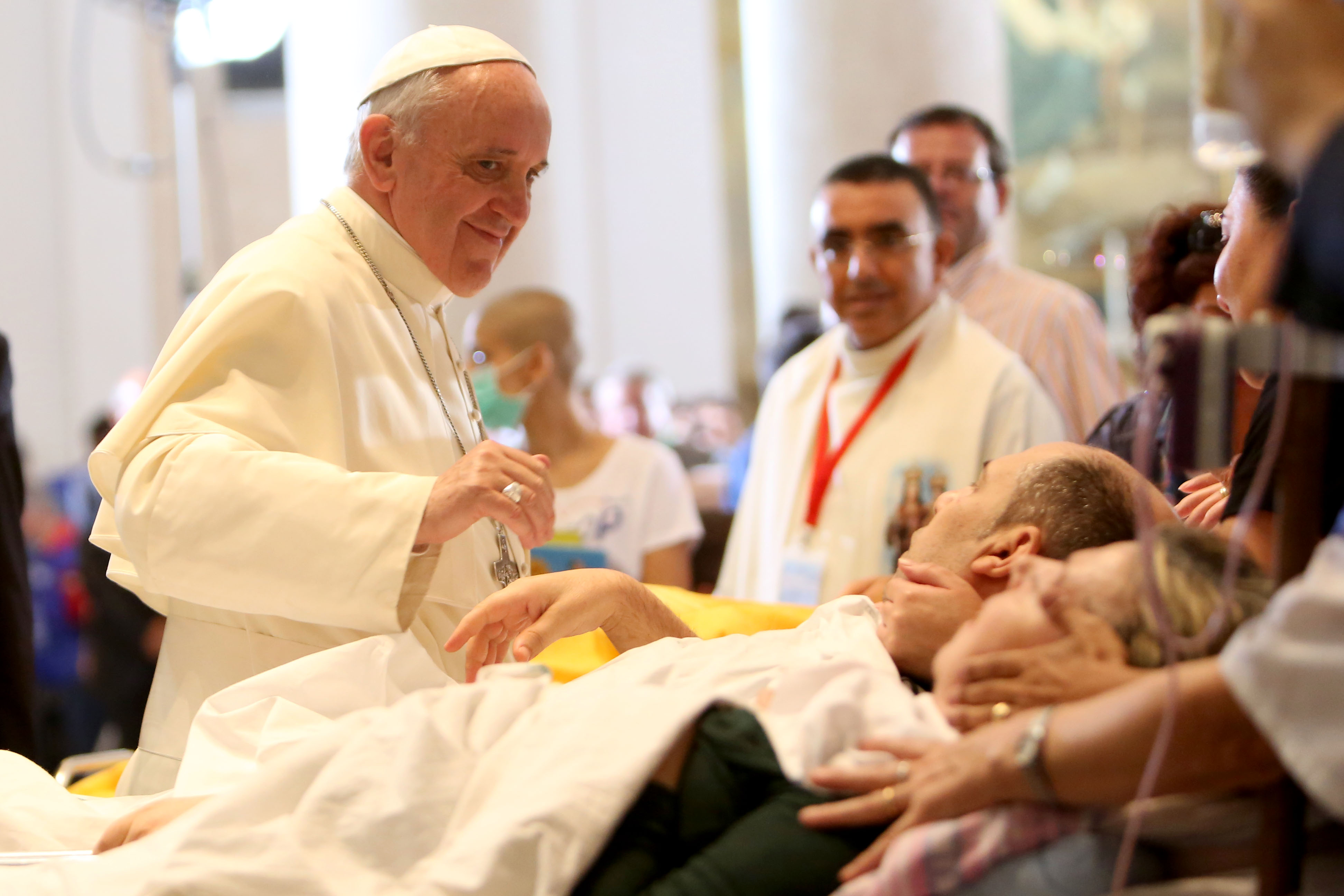
(Photos. Top: The Pope visits the sick on September 22, 2013 in Cagliari, Italy. By Franco Origlia/Getty Images. Right: Pope Francis receives Israeli Prime Minister Benjamin Netanyahu in a private audience at his library on December 2, 2013 in Vatican City, Vatican. By Vatican Pool/Getty Images.)

The Fathers Of Left And Right

In an excerpt from his new book The Great Debate, Yuval Levin traces the lineage of today’s liberals and conservatives back to the political divide between Thomas Paine and Edmund Burke:

The fundamental utopian goal at the core of Paine’s thinking—the goal of dish_paine liberating the individual from the constraints of the obligations imposed upon him by his time, his place, and his relations to others—remains essential to the left in America. But the failure of Enlightenment-liberal principles and the institutions built upon them to deliver on that bold ambition and therefore on Paine’s hopes of eradicating prejudice, poverty, and war seemed to force the left into a choice between the natural-rights theories that Paine thought would offer means of attaining his goal and the goal itself. In time, the utopian goal was given preference, and a vision of the state as a direct provider of basic necessities and largely unencumbered by the restraints of Paine’s Enlightenment liberalism arose to advance it. …

Today’s left, therefore, shares a great portion of Paine’s basic disposition, but seeks to liberate the individual in a rather less quixotic and more technocratic way than Paine did, if also in a way that lacks his grounding in principle and natural right.

Thus today’s liberals are left philosophically adrift and far too open to the cold logic of utilitarianism—they could learn from Paine’s insistence on limits to the use of power and the role of government. Today’s right, meanwhile, shares a great deal of Burke’s basic disposition, but seeks to protect our cultural inheritance in a less aristocratic and (naturally, for Americans) more populist way than he did, if also in a way that lacks his emphasis on community and on the sentiments. Today’s conservatives are thus too rhetorically strident and far too open to the siren song of hyperindividualism, and they generally lack a nonradical theory of the liberal society. They could benefit by adopting Burke’s focus on the social character of man, from Burke’s thoroughgoing gradualism, and from his innovative liberal alternative to Enlightenment radicalism.

Levin’s critique of liberalism is powerful and to be expected. But what makes his book much more interesting is his truly trenchant critique of his fellow conservatives as well. And it is a critique well-taken. I’d be much tougher on them, but this book is a tonic for a new discourse.

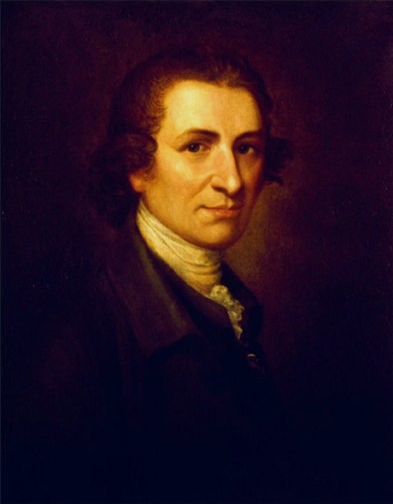
(Image of Matthew Pratt’s Portrait of Thomas Paine, 1785-1795, via Wikimedia Commons)

A President For All Occasions

Observing that “Americans detest inauthenticity above all things, especially in our politicians,” former White House videographer Arun Chaudhary shares his thoughts on the challenges of the presidency:

That the presidency is taxing, grueling, and aging is cliché, but I think one of the most underappreciated parts—and tricky to observe in the veritable flipbook of pool photos of the graying President—is the vast emotional intelligence required to shift between different frequencies for different events, day out and day in, as the schedule veers wildly from a press conference to a major national disaster to a state dinner. When, after the transition, I joined the White House photo department as the official videographer, I grew accustomed to capturing all the dramatic transitions of a president’s day. One minute, I’d be filming a tearful embrace between POTUS and a shooting victim’s family member in the oval office; the next I’d be helping Samantha Tubman, deputy Social Secretary, pep up a drooping sports team unused to standing for hours in suits. When my footage of the Obama Presidency becomes public by law, as all film and photos of the president do, I believe people will be surprised by the sheer volume of these shifts in the president’s schedule.

Our leaders need to keep up an authentic core. This is not something Lee Strasberg can teach you. Our very best actors, to say nothing of politicians, would be unable to sustain that much false emotion. Americans seem to, again and again, send individuals to the White House who are capable of projecting authentic personalities.