“The Pursuit Of Ignorance”

That’s how neuroscientist Steven Firestein describes the meaning of science in the above TED talk, rejecting, as Ayun Halliday puts it, “any metaphor that likens the goal of science to completing a puzzle, peeling an onion, or peeking beneath the surface to view an iceberg in its entirety.” Halliday continues:

Such comparisons suggest a future in which all of our questions will be answered. In Dr. Firestein’s view, every answer can and should create a whole new set of questions, an opinion previously voiced by playwright George Bernard Shaw and philosopher Immanuel Kant. A more apt metaphor might be an endless cycle of chickens and eggs. Or, as Dr. Firestein posits in his highly entertaining, 18-minute TED talk above, a challenge on par with finding a black cat in a dark room that may contain no cats whatsoever.

According to Firestein, by the time we reach adulthood, 90% of us will have lost our interest in science. Young children are likely to experience the subject as something jolly, hands-on, and adventurous. As we grow older, a deluge of facts often ends up trumping the fun. Principles of Neural Science, a required text for Firestein’s undergraduate Cellular and Molecular Neuroscience course weighs twice as much as the average human brain. The majority of the general public may feel science is best left to the experts, but Firestein is quick to point out that when he and his colleagues are relaxing with post-work beers, the conversation is fueled by the stuff that they don’t know.

“Goodbye, Christ”

That’s the title of Langston Hughes’s 1932 poem that caused a scandal when it was published and that continues to provoke scholarly debate. A brief excerpt:

Goodbye,
Christ Jesus Lord God Jehova,
Beat it on away from here now.
Make way for a new guy with no religion at all –
A real guy named
Marx Communist Lenin Peasant Stalin Worker ME –

I said, ME!
Go ahead now,
You’re getting in the way of things, Lord.

Wallace Best argues that the poem has long been misunderstood, and should be considered part of the era’s “proletarian” writing about “the exploits of capitalism, how the Depression disproportionately affected the poor, and about the lives and deplorable living conditions of the working class—often with a strident critique of the religious status quo”:

“Goodbye, Christ” was not a declaration of Hughes’s commitment to Communism, nor was it a statement of his disbelief in God.

That contention is an over-simplification and a distraction. What I am arguing is that more than anything it could say about Hughes himself, “Goodbye, Christ” emerged as a perfect expression of what I call “the culture of complaint and critique” of American religion among black writers and clergy during the interwar period. In the aftermath of the Fundamentalist Modernist controversy of the 1920s, the thirties were a destabilizing time for religion in America as notions of American religious identity were being negotiated and contested. The seemingly anti-religious rhetoric of “Goodbye, Christ” doubtlessly appeared shocking to most people, but a number of black (and white) ministers from across the nation echoed the sentiments of the poem throughout the decade of the 1930s. Indeed, in many ways, the implication of their ideas (and the level of their rhetoric) eclipsed those expressed by Hughes in “Goodbye, Christ.” They critiqued and complained about the capitalist system, American churches’ alliances with capitalism, and about what they saw as an inherent insufficiency in religion itself.

Read the full poem here, or in The Collected Poems of Langston Hughes.

Face Of The Day

dish_fotdsun1

Jill Harness praises Sarah Ernhart’s pictures of dog-owners with their terminally ill or elderly pals:

Photographer Sarah Ernhart has captured a variety of images of dogs spending their final days with their loving humans and while heart-breaking, the series is simply beautiful. It really captures the friendship and love between people and their pets.

(Photo by Sarah Ernhart, who recently published a book, Kittenhood: Life-size Portraits of Kittens in Their First 12 Weeks. For more information on Ernhart’s photography, go here.)

Quote For The Day

“Christ’s resurrection is not an event of the past; it contains a vital power which has permeated this world. Where all seems to be dead, signs of the resurrection suddenly spring up. It is an irresistible force. Often it seems that God does not exist: all around us we see persistent injustice, evil, indifference and cruelty. But it is also true that in the midst of darkness something new always springs to life and sooner or later produces fruit. On razed land life breaks through, stubbornly yet invincibly. However dark things are, goodness always re-emerges and spreads. Each day in our world beauty is born anew, it rises transformed through the storms of history. Values always tend to reappear under new guises, and human beings have arisen time after time from situations that seemed doomed. Such is the power of the resurrection, and all who evangelize are instruments of that power,” – Pope Francis, The Joy of the Gospel.

A Saint, An Artist, A Pope

dish_bacon

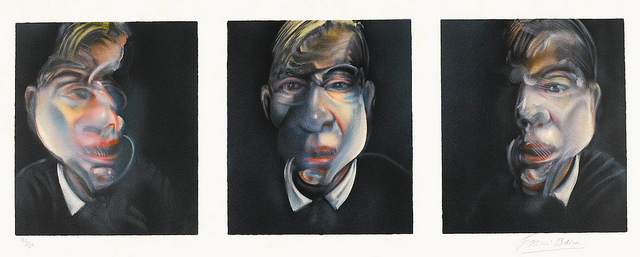
David Griffiths, a Catholic writing professor, broke down in tears when he heard the announcement that the new pope would be named Francis. Looking back, he realized how the experience helped him make the connection between two of his heroes – St. Francis and the artist Francis Bacon, both of whom were “bursting with a desire to embrace the ugliness and spiritual poverty of this world in a way that called attention to it, named it, so that others might see”:

In retrospect, my reaction to Pope Francis’s election makes so much more sense when I consider that during my tenure at the college my artistic guiding lights were St. Francis and the painter Francis Bacon. About as far from a saint as one can imagine, Bacon is infamous for showing us things that perhaps we would rather not see: nightmarish self-portraits, unnerving studies of screaming popes, and writhing and wrestling biomorphic forms.

But Bacon was not interested in merely horrifying us. He was painting, as he said in an interview, to “excite himself”; spreading paint in a way that was expressive of his anger, his lust, and his love of painting. In a rare explanatory moment, he revealed to an interviewer that his numerous paintings that reference crucifixion were not religious but “an act of man’s behavior to another.” Some moralists have said that his paintings are corrupting and harmful, but I’ve always felt that they do no more harm than if one took to hanging around a butcher shop or meat packing plant. To me, his paintings, like all great art, make us confront essential questions about the human condition.

(Image of Francis Bacon’s Three Studies for Self-Portait (1981) from Flickr user Cea.)

A Poem For Sunday

wandasunpoem

“Two Times Baby” by Wanda Coleman:

he’s two nights gone for the second
time. two weeks before that he left
the rehab house and they wouldn’t take
him back. that was two years after he
left the penitentiary and broke two
hearts when he was paroled to my custody
on the condition of marriage. but it
would only take a couple of months before
he started backsliding, picking up the
old habits, old homies, old tracks.
it got to be too much for me and i was
two jumps from killing him when
he split. last time we made love was to
that Doors song of like refrain. now
that he’s gone all I seem to do is
remember how good the two of us got
when we put one-and-one together

(From Bath Water Wine © 1998 by Wanda Coleman. Reprinted by kind permission of Black Sparrow Books and David R. Godine, Inc. Photo by Steve Snodgrass)

It’s Not God That Makes You Give

David E. Campbell, the co-author, with Robert Putnam, of the in-depth study of religion’s place in America’s social fabric, American Grace, reveals a twist to the trope that believers are more charitable than the non-religious:

Having found that religion and charity go hand-in-hand, Robert Putnam and I sought to understand why.  The answer might surprise you. We initially thought that religious beliefs must foster a sense of charity—whether inspiration from biblical stories like the Good Samaritan or, perhaps, a fear of God’s judgment for not acting charitably. However, we could find no evidence linking people’s theological beliefs and their rate of giving—which also helps to explain why the “religion effect” varies little across different religions. The rates for charitable giving according to the Jumpstart survey are: 61 percent of Black Protestants; 64 % of Evangelical Protestants; 67 % of Mainline Protestants, 68 % of Roman Catholics, and 76 % of Jews. By contrast, only 46 % of the not religiously affiliated made any charitable giving.

Rather than religious beliefs, we found that the “secret ingredient” for charitable giving among religious Americans is the social networks formed within religious congregations. The more friends someone has within a religious congregation, the more likely that person is to give time, money, or both, to charitable causes. In fact, even non-religious people who have friends within a religious congregation (typically, because their spouse is a believer) are highly charitable—more so than strong believers who have few social ties within a congregation. Our findings thus suggest that if secular organizations could replicate the sort of tight, interlocking friendship networks found within religious organizations, they too would spur a comparable level of charitable giving.

The First American Book

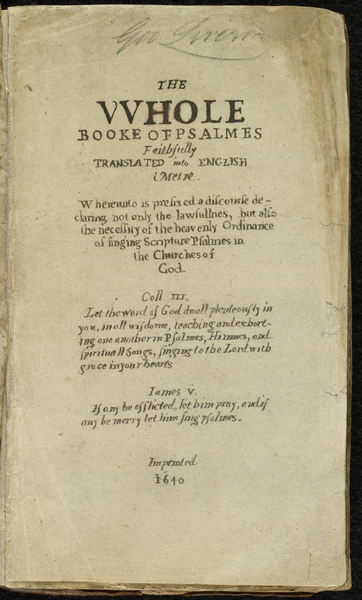
It’s “The Whole Booke of Psalmes,” or the Bay Psalm Book:

Translated directly from Hebrew into English, the Bay Psalm Book was printed in Cambridge, Massachusetts, in 1640, less than twenty years after the Mayflower left dish_psalms Plymouth, England. It was the first book printed on the Puritan minister Joseph Glover’s press, the first such device to make the journey across the Atlantic. Although Glover died during the 1638 crossing, his widow, Elizabeth, inherited the press and saw to its installation. She established America’s first print shop in a little house on what is now Holyoke Street in Cambridge. …

One can scrutinize every verse of the Bay Psalm Book online. The text rewards such study, but it does not explain why the first book printed in America was a Psalter. Psalters are an unfamiliar genre for many, even those who worship regularly. Psalm-singing had for centuries been the demesne of a hand-picked choir, but the English Reformation invited the voices of the entire congregation. This printing of the Psalms in verse, set to meter, allowed them to be sung by all. Thus the Bay Psalm Book is a kind of hymnal. … America’s history spans just a few centuries, but hundreds of hymnals. Colonists came seeking religious freedom, so the first book they printed was not a political tract or even a Bible, but a hymnal: a book to be used regularly in communal and even private worship.

(Image of title page from the Bay Psalm Book via Wikimedia Commons)