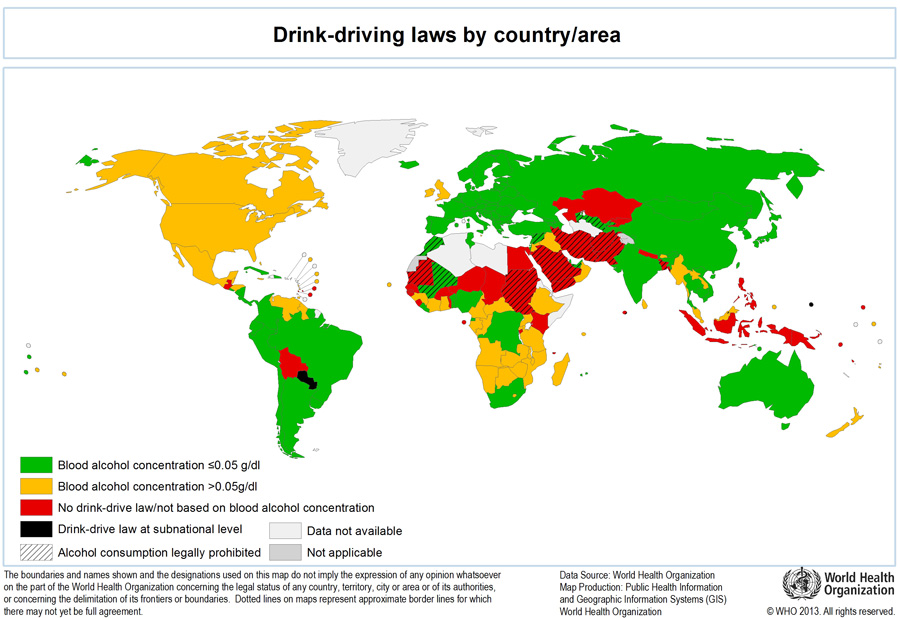
The US has always had a relaxed attitude toward it:
In his 2011 book One For The Road, Barron Lerner explains that Norway’s [blood alcohol content] limit was 0.05 percent by 1936, while Sweden’s was 0.08 percent by 1941. But Americans were much more lenient when it came to drunk driving. Even as late as the 1960s, American courts in many states saw anything less than 0.15 percent as probably not worthy of prosecution, still adhering to guidelines set up in 1939 by the National Safety Council and the American Medical Association. … Fascinatingly, the justice system was especially lenient in part because of the many recent failures of alcohol prohibition in the US during the 1920s. Even organizations like the AMA and the NSC thought it best not to be too harsh on people who drove drunk. Lerner notes in One For The Road:
Well aware of the recently concluded and highly criticized Prohibition experiment, [AMA and NSC] committee members erred far on the side of leniency when it came to the apprehension and prosecution of impaired and drunk drivers. As Stanford University neurologist and alcoholism expert Henry W. Newman later explained, “We would not like to see a parallel to prohibition occur here, with the subsequent revulsion of feeling and the license that followed after prohibition which still prevails to a certain extent at the present time.”
Today, the federal limit in the US is 0.08 percent. That’s much more in line with other countries, but still more liberal than most.
(Map by the World Health Organization)
 The Dish