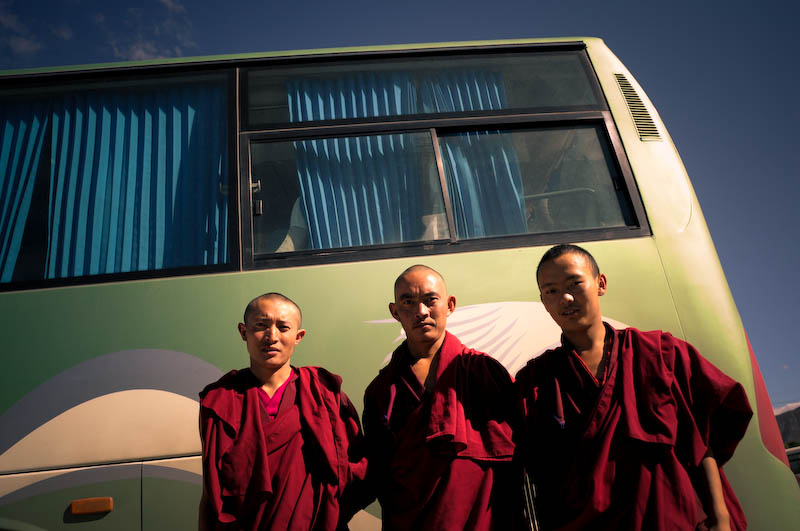
Pearl Sydenstricker reports on the rising number of Han Chinese tourists in Tibet and the politics behind it:
It’s government policy: tourism is an officially designated “pillar of the economy” in Tibet. The goal is to attract fifteen million tourists a year by 2015 in the so-called “Tibetan Autonomous Region,” which has a population of only three million. In the first half of 2013, tourist visits to Lhasa surged by 36 percent, according to state media. Rather than threatening Tibetan monks with army troops, the government is smothering them with throngs of pushy tourists, who show their sympathies with their fashion statements: green camouflage is in. On recent summer and autumn days, they wore camo hats, camo hoodies, and even camo leggings, as if each were playing a part in the paramilitary.
In the Chinese media, Tibetans are always portrayed as the poor beneficiaries of Chinese aid.
Their costumes are funny, their cultural beliefs hopelessly “backward,” tourists tell me. One villager I speak with in Hebei, thousands of miles away, complains that his taxes are going for charity for this distant group. The government seems to have drawn up a caricature—somewhat like Ronald Reagan’s “welfare queens”—depicting Tibetans as lazy. No surprise, then, that Han Chinese carry on loud cell phone conversations in prayer halls and walk counterclockwise against the flow of pilgrims, deliberately interrupting these “superstitious” rituals. As I walk through the Barkhor, the newly reconstructed “Old Quarter” of Lhasa—one of the holiest sites and top tourist destinations in all of Tibet—armored vehicles rumble past souvenir stands. I count forty-seven police stations in half a square mile, all of them clearly marked on the tourist maps set up in the streets, like at Disneyland. Tourists may fulfill their role in the soft-power paramilitary, but it’s no secret that the real paramilitary is here too.
A related Dish thread, “Why Do Chinese Tourists Have Such A Bad Rap?,” is here, with a post specifically addressing Tibet here.
(Photo by Desmond Kavanagh)
 The Dish