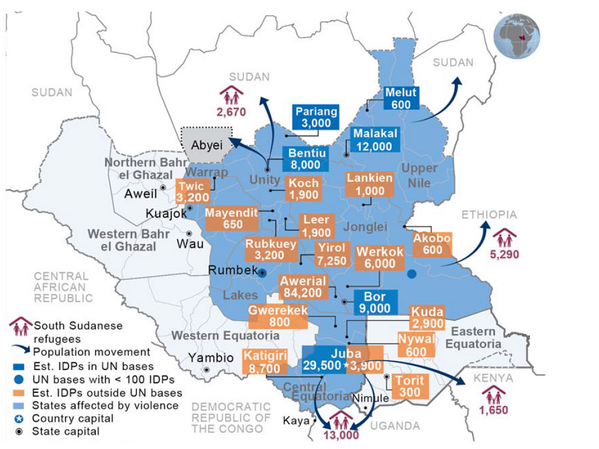
Fisher passes along the above map showing refugee displacement caused by the unrest in South Sudan, noting that “people are getting displaced across huge swathes of the country, suggesting that fighting and instability are spreading wide and fast across the Texas-sized country.” Another ominous observation:
[A]t least a few thousand people have fled into Sudan, the country that the South Sudanese spent decades fighting to break away from, which is not in itself hugely significant except as a depressing symbol of South Sudan’s troubled start as an independent country. South Sudan’s crisis is not yet an all-out ethnic conflict. But there are some awfully worrying signs. That so many people have fled their homes is one indication that people are worried about being targeted for their ethnicity. As NPR’s Gregory Warner reported from the country a few days ago, “People are starting to ask who their neighbors are.” One of the thousand or so people killed so far is Andrew Bith Abui, one of the “Lost boys of Sudan” who had won asylum in the United States but later returned to South Sudan to help build the newly independent country. Abui was killed in what appears to have been ethnic violence in his home town.
Peter Run explains that the conflict is primarily about power politics, not ethnic strife:
Despite its appearance, this conflict is not between the Dinka (South Sudan’s largest ethnic group) and the Nuer (its second largest). In fact, the Nuer are doing most of the strategic and tactical work on both sides. The government’s armed forces, the Sudan People’s Liberation Army (SPLA), is led by a Nuer, General James Hoth. Many of the officers leading the operations in Upper Nile, Unity and Jonglei states are also Nuer. The SPLA has always been an ethnic mix with significant Nuer numbers. Some Nuer soldiers are loyal to commanders who have joined Riek Machar, and others have been with the SPLA since its formation in 1983. The suggestion that this is an ethnic conflict accounts for some facts but leaves out other contradictory ones. For instance, Machar has a lot of non-Nuer support in the ruling Sudan People’s Liberation Movement (SPLM) party, where this conflict began as a political rivalry between him and president Kiir.
When allegations of the attempted coup emerged, those arrested included prominent Dinkas Majak D’Agoot and Chol Tong Mayay. Ethnicity was insignificant at the political level and it does not appear to feature prominently on the military agenda of either the SPLA or the rebels. However, the march of the Nuer White Army rebels to Bor, a city on the Dinka territory, has raised alarm bells. As Sudan researcher Eric Reeves has pointed out, the “White Army” – an ethnic militia, which once threatened to wipe out another ethnic group, the Murle – is unpredictable and indiscriminate.
Josh Rogin wonders what the US could do to help:
The problem for the Obama administration as it tries to influence events in South Sudan is that the United States only has the ability to bring pressure to bear on one side of the dispute—the government that is dependent on hundreds of millions of dollars of U.S. assistance. Experts say the only actor who may have influence over Machar is Omar al Bashir, the indicted war criminal who serves as President of Sudan and has a long history of making deals with Machar. Machar has already indicated he may work with the Khartoum regime to protect oil fields in Unity and Upper Nile states, lands Khartoum has sought to control ever since the country split in 2011.
“Given Riek Machar’s long history of collaboration with the Khartoum regime, it is reasonable to be alert to the potential for reengagement over oilfield security,” said John Prendergast, founder of the Enough Project. “If Khartoum would seek to gain advantage from Juba’s current weakness, it would be like throwing gasoline on a smoldering fire.”
Gregg Zachary wants to revisit the concept of trusteeship for South Sudan:
The best justification for rethinking South Sudan’s sovereignty is the country’s lack of an experienced and effective political elite. Massive corruption in the Kiir government has translated into billions of aid dollars being looted by leaders or (probably to a lesser extent) shared along ethnic lines as a form of political patronage. In 2012, Kiir himself accused government officials of looting $4 billion and (pathetically) asked his colleagues to return the money. Instead of building desperately needed infrastructure and providing crucial services, the South Sudanese government has done little to meet its people’s needs. An assessment by two Brookings Institution scholars in December was blistering. “It is apparent,” they wrote, “that South Sudan, two years after independence, is yet to establish legitimacy as a state with a functioning government that can keep its people safe and provide services to them.”
The solution to these problems is not to send in more peacekeepers to Juba and Bor, or hammer out a power-sharing agreement between the warring parties. Or rather, not only to do these things. The response to South Sudan’s turmoil should be crafted with a set of policy tools that were popular in the 1950s but have been used only selectively in recent years. I am referring to the process known as “trusteeship,” whereby a newly independent nation is granted special forms of assistance and special constraints on sovereignty. In some cases, the former colonial power sought to administer the trusteeship, and in other cases an international coalition or the United Nations did so for a defined period of time. Something along these lines succeeded in the West African country of Ghana, where the British colonial authorities ceded sovereignty to the government of Kwame Nkrumah in stages, culminating in full independence in 1957.
Previous Dish on South Sudan here.
 The Dish