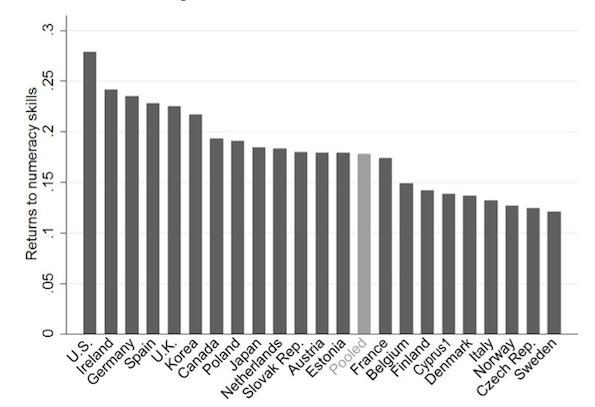
It depends what country you live in:
Overall, the effect of skills on earnings (what economists call “returns-to-skills”) is unsurprising. The authors focus on numeracy and show that people with more skills earn more. A one-standard-deviation increase in numeracy skills is associated with an 18% wage increase among “prime-age” workers (workers between 25 and 54). But there is massive variation in returns-to-skills. Why? The authors conduct a series of regressions and, some would argue, show the limitations of social-democratic policies:
[R]eturns to skills are systematically lower in countries with higher union density, stricter employment protection, and larger public-sector shares. The analysis shows, for example, that a 25% point increase in union density (the difference, say, between Belgium and the United Kingdom) leads to a 3.5% point lower wage increase for each one-standard-deviation increase in numeracy skills.
Looking at the same data from the OECD, Pethokoukis ponders why the US comes out on top:
I find particularly interesting the finding that (a) the return to skills is highest in America and lowest in Nordic-land, and (b) returns are higher in economies with more open, private-sector based labor markets. Wouldn’t this seem to argue that higher US inequality — based on pre-tax, pre-transfer market incomes — reflects 21st century market forces rewarding ability rather than some sort of breakdown in social norms? If so, shouldn’t the policy response favor creating, as much as possible, a labor force better and more broadly capable of flourishing in this environment rather than artificially lowering the return to skills and America’s growth potential?
 The Dish