“Biomimetic” design draws on other species’ architectural habits and adapts them for human constructions. As Lee Billings explains, “those examinations yield surprises not only about the animal being observed, but also the observer”:
A telling example is the comparative architecture of orb-weaver versus tangle-web spiders. Imagine a spider web, and chances are you summon an orb-weaver’s work in your mind: A branch-hung
mesh of silk spiraling around a central hub so orderly and symmetrical you would consider it beautiful, and certainly superior to the irregular skein of strands of a tangle web in a wood pile. An orb web’s beauty comes from the simple algorithm the spider follows to construct it within a single plane. By comparison, a tangle web is the result of a significantly more dynamic behavioral process of trial-and-error construction, methodically stringing and testing silk between any available surfaces until an ideal prey-trapping tension is reached. It looks messy, and primitive.
But the tangle web is actually derived from the more primitive orb web. A tangle web can be built almost anywhere, and it doesn’t require airflow to catch prey. Its marvelous, asymmetric design allowed the spiders that developed it to begin a great radiation into thousands of new species. “Humans like symmetry and order, I think because symmetry and order help us recognize patterns, and we like to think we understand things,” says [entomologist John] Wenzel. … “In my studies I’ve seen things many times that I think are anomalies, pathologies, almost like mutations,” Wenzel says. But what seem like pathologies … can become useful, even essential. And difficult to understand.
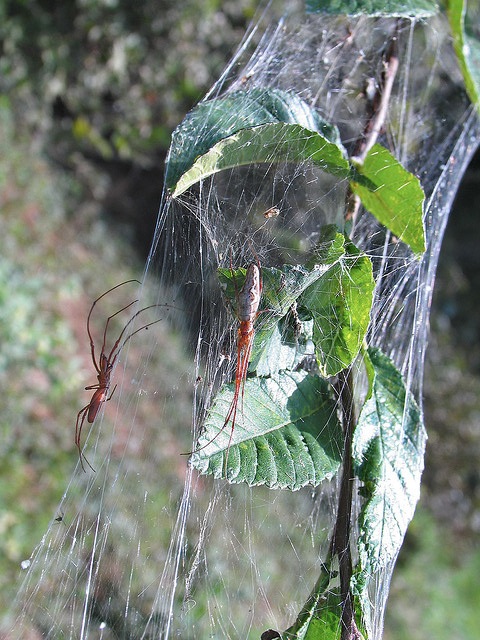
(Photo of a tangle-web spider by Joe Lapp)
 The Dish