Joshua Yaffa explains how Sochi came to cost $51 billion:
Once Russian officials settled on Sochi as a host city … they guaranteed themselves a costly engineering challenge, since organizers didn’t have much choice as to where to put Olympic venues. Sochi, once a place of recuperation for Soviet workers under Stalin, sits on a narrow slope of land between the mountains and the sea, with no wide, flat space for large stadiums and arenas. The only feasible site was the Imereti Valley, a patch of flood-prone lowlands 20 miles from the center of Sochi. … Russia would have to build everything from scratch.
The fact that Putin saw the Olympics as a personal legacy made the problems worse:
Putin’s vow to spare no expense provided cover for sloppiness and mistakes in construction. When a road leading up to Krasnaya Polyana wasn’t finished on time, for example, a helicopter had to deliver the cement needed to build ski lifts. At the same time, the government’s willingness to overspend encouraged organizers to indulge their grandest, most over-the-top visions. At one point the team responsible for the opening ceremonies decided it wanted a closed stadium at Fisht and not the retractable roof that had been originally planned. That left the construction team only three months to procure a quantity of steel that would have ordinarily taken a year to get on-site. Damon Lavelle, an architect at the British firm Populous who worked on early plans for the venue, says it’s no longer so much a stadium as “the world’s largest theater.” The show for the opening ceremonies is said to include six locomotives, the troika from Nikolai Gogol’s Dead Souls, and Peter the Great commanding five ships.
Last month, Sean Guillory pointed out that Olympic laborers are getting shortchanged:
There is an estimated 70,000 laborers working in construction, 16,000 are foreign labor. They work long hours and for little pay. In its detailed report on worker abuses, [Human Rights Watch] reported that workers got typically paid $1.80 to $2.60 an hour with a monthly average salary of $455 to $605. Their pay is routinely delayed, and sometimes they’re never paid at all. One HRW respondent, Yunus, said “I have no written contract. I got paid only in February: 2,400 rubles [$77] for December. I wasn’t paid after that. I worked for 70 full days without pay. We worked from 8 a.m. to 8 p.m. with no days off.” He quit before receiving the wages owned to him.
Fnally, Barry Petchesky emphasizes the geographical unsuitability of Sochi as Olympic venue:
The actual city of Sochi sits on a slope—the only land flat enough to build an Olympic village and stadiums is 20 miles away, on a small slide of flood-prone soil. And flood it has. A new cargo port was destroyed in storms, causing millions in damage and delays, after officials failed to heed scientists’ warnings that the site was vulnerable. Underground streams have caused an embankment near the Olympic park to collapse and be rebuilt multiple times. The ski jump was constructed without geologic testing, and construction crews cleared trees whose roots stabilized the muddy soil. A major landslide occurred in 2012.
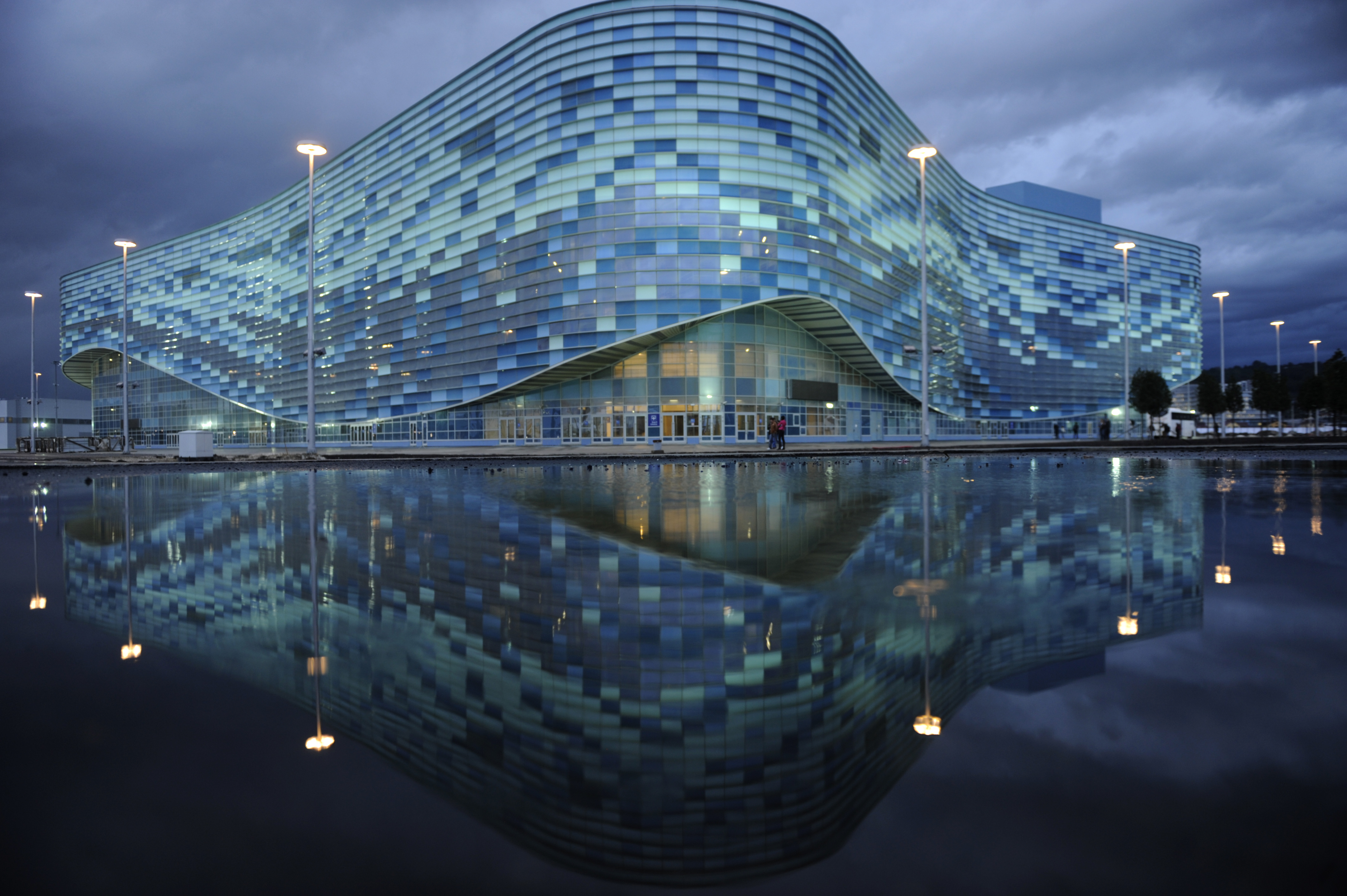
(Photo: A picture taken on September 25, 2013 shows the figure-skating and speed-skating arena at the Olympic Park in Sochi. Sochi will host the 2014 Winter Olympics starting on February 7, 2014. By Mikhail Mordasov/AFP/Getty Images)
 The Dish