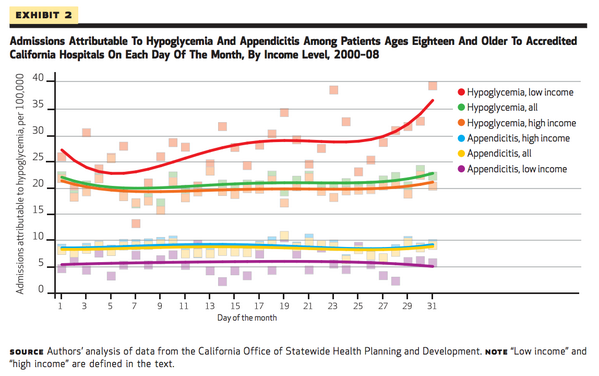
The basic idea is that people struggling to make it paycheck-to-paycheck (or benefits-to-benefits) might run out of money at the end of the month—and have to cut back on food. If they have diabetes, this hunger could turn into an even more severe health problem: low blood sugar. So we should expect a surge of hypoglycemia cases at the end of each month for low-income people, but not for anybody else.
That’s what researchers found when they looked at the numbers for California between 2000 and 2008. As you can see in their chart [seen above], low-income people (red line) were <27 percent more likely to be hospitalized for hypoglycemia in the last week of the month than in the first. There was no week-to-week difference for high-income people (orange line). …
Okay, but isn’t it possible that poorer people just tend to be less healthy in general?
Sure. That’s why the researchers also looked at when people go the hospital for appendicitis, which doesn’t depend on diet. So there shouldn’t be any end-of-the-month increase for low-income people if tight budgets are the problem. There wasn’t. As you can see above, appendicitis cases were flat across the month for both high (blue) and low (purple) income people. In other words, poorer people don’t need more care at the end of the month for every kind of condition. Just the ones that get worse when you don’t have enough to eat.
Adrianna McIntyre sees this study as an example of what gets ignored in our health policy debate:
Policy wonks have a terrible habit of focusing on insurance and health system design (and here I count myself, because health care financing is the research I find most interesting, so it’s what I write about). This gives short shrift to the “social determinants” of health—upstream factors related to lifestyle, environment, and socioeconomic status—that cannot be corrected by medical interventions. We’re fond of highlighting how much more the United States spends on health services, but an idiosyncrasy that receives less attention is how much less we spend on other social services.
 The Dish