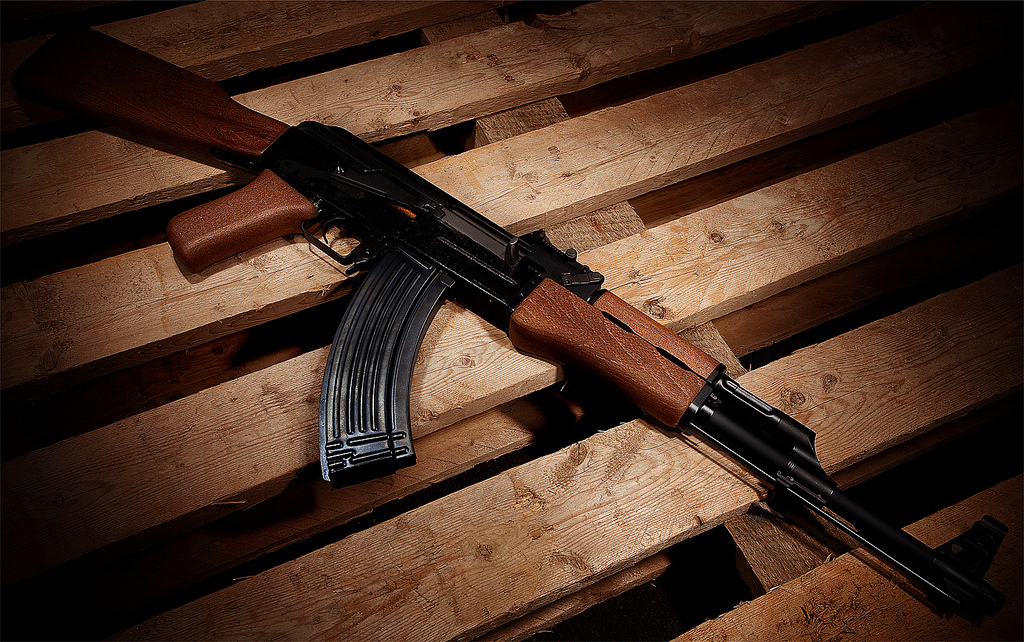
The designer of the AK-47, who died last month, had serious misgivings about his invention:
In 2010 Kalashnikov wrote the Russian Orthodox Church to ask if all the blood shed by the wildly popular weapon over the years was on his hands. It’s quite poignant. “My spiritual pain is unbearable,” he wrote. “I keep having the same unsolved question: if my rifle claimed people’s lives, then can it be that I… a Christian and an Orthodox believer, was to blame for their deaths?”
He’s not the first weapon inventor to feel pangs of regret. Alfred Nobel—yep, the guy the Nobel Peace Prize is named after—created dynamite hoping it would help achieve peace, but instead it wreaked havoc throughout WWI. The inventor of pepper spray was horrified when police used it violently against protesters. The group of nuclear scientists that developed the first atomic bomb then pleaded with the president not to drop it.
The church told him not to worry:
The press secretary for the Russian Patriarch, Cyril Alexander Volkov, told the paper the religious leader had received Kalashnikov’s letter and had written a reply.
“The Church has a very definite position: when weapons serve to protect the Fatherland, the Church supports both its creators and the soldiers who use it,” Mr Volkov was quoted as saying. “He designed this rifle to defend his country, not so terrorists could use it in Saudi Arabia.”
Dreher agrees with this position:
The Russian Church’s judgment is wise, I think; it responded that Kalashnikov created his weapon to defend his country against the Nazi invaders. It is hard to see where he bears real fault for the subsequent misuse of it.
John Michael McGrath considers the millions the gun has killed:
Because history is sometimes funny, Kalashnikov didn’t get his design approved for manufacture until two years after the Red Army took Berlin—it started rolling off the lines in 1947, hence the world’s most ubiquitous weapon, the AK-47. It was put to use killing people in large numbers beginning in the 1950s, and even in comparatively quiet times is now estimated to be killing a quarter of a million people a year.
But he doesn’t blame Kalashnikov:
If we take it out of the world of morality and put it in the world of economics, you could say the AK-47 permanently increased the cost of war—it’s like a peculiar form of inflation. But war was already, almost everywhere and always, a terrible idea before 1947. (Look at the countries that started World War II. It didn’t end well for any of them.) Despite the examples of the 20th, and now the 21st century, it still seems only the dead have seen the end of war. But it’s not Kalashnikov’s fault he lived on a planet of slow learners.
Lastly, The Economist looks at why the AK-47 remains so popular:
The gun is nothing special. Its controls are unsophisticated; it is not even particularly accurate. But this simplicity is a reason for its success. Compared with other assault rifles, the AK-47 has generous clearance between its moving parts. That is bad for accuracy, but it means that the mechanism is unlikely to jam, no matter how clogged it gets with Sudanese sand or Nicaraguan mud. Designed to be operated by Soviet soldiers wearing thick winter gloves, it is simple enough for untrained recruits (including children) to use. These features explain why the gun has remained in demand. But its success is also down to supply. The Soviet Union wanted to standardise military equipment among its allies, and so shipped giant caches of the weapons to friendly states, where it also established factories to churn out the rifles by the hundreds of thousand. (The USSR was unconcerned with copyright, too, meaning that knock-offs proliferated.) The gun has spread all over the world. But where the Soviet Union had less influence, the AK-47 was less popular. To this day, bandits in the Philippines are more likely to use variants on the M16, an American-made assault rifle supplied to the Philippine army by the United States.
(Photo by Flickr user zomgitsbrian)
 The Dish