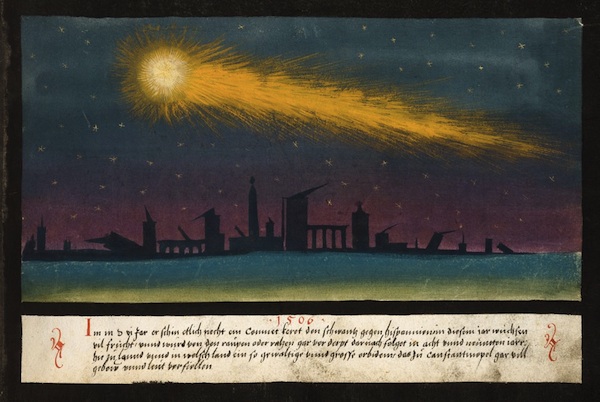
Ben Marks details the story behind 16th-century depictions of “Biblical miracles, flaming comets, multi-headed beasts, and apocalyptic chaos that fill the pages of the ‘Augsburg Book of Miraculous Signs,'” recently reproduced in Taschen’s Book of Miracles:
[T]he Protestant citizens of Augsburg, Germany, were enthusiastic and active collectors of portrayals of portentous signs, as well as written descriptions of ancient and astrological prophecies. … In part, their passion stemmed from a collector’s fascination with such topics, but Germany’s 16th-century Protestants were also motivated by religious antipathy toward the Catholic church, whose Pope they derided as the Antichrist. Some took the epithet for fact: For them, since the end was nigh, it behooved one to pay attention to the signs.
As Joshua Waterman of the Germanisches Nationalmuseum in Nuremberg writes … “The late fifteenth century had witnessed a surge of interest in miraculous signs which steadily increased in the decades that followed, ultimately reaching a high point toward the end of the sixteenth century, especially in Protestant territories. This development coincided with the rise of illustrated broadsheets and printed pamphlets as news media that spread reports of prodigies and portents, and with the religious and political upheavals of the Protestant Reformation, which fostered special concern for signs of God’s wrath and the coming end of days.”
Marks calls these broadsheets the “Buzzfeeds of their day, featuring woodcut artwork and sensationalist headlines and text designed to capture the imagination of the common man.”
(Image of 16th-century depiction of comet via Collectors Weekly and Taschen)
 The Dish