Gary May pays tribute:
Looking back on King’s life and career, some would say that he had died at the right moment, that martyrdom rescued him from an equally serious blow: irrelevancy. The Voting Rights campaign had clearly been his greatest achievement and, as it turned out, his last. But the 1964 Civil Rights Act and the 1965 Voting Rights Act are a testament to his leadership and commitment to achieving change through nonviolent protest. Nearly 50 years after his death it is King’s words and deeds that live on in the American memory — not that of the racists who hated him or the Black Power advocates who scorned him.
King left us a rich legacy. Nonviolence became an effective tool in the hands of reformers throughout the world as well as the United States, which experienced the end of segregation in a relatively bloodless revolution. Despite his self-doubts and the attacks of critics in his own camp, he persevered, committed always to nonviolence and to the fulfillment of American democracy however long it would take. That is what we should be celebrating on this day.
Jenee Desmond-Harris urges us to refrain from asking “What would MLK think?” when it comes to today’s politics, emphasizing that his views could be difficult to pin down during his own lifetime:
“He was constantly evolving in his thoughts, and that evolution would have continued to impact his politics,” says Hasan Jeffries, professor of history at Ohio State University.
Jeffries points to the way King “trailed his wife, who’d already participated in anti-war protests years earlier” before finally making the Riverside Church declaration against the Vietnam War, getting himself cut off from more-conservative civil rights activists. It’s evidence that neither King’s positions nor his alliances were static. … Naturally, as his reality and his adversaries changed, so did his positions and his goals.
And even when it comes to people who are living today, it’s not as if everyone on the left, everyone who was active in the civil rights movement or all black politicians or activists are of the same mind when it comes to contemporary issues. Where would he stand on education reform? The Affordable Care Act? What about President Obama’s responsibility to African Americans in an environment that could be seen as the embodiment of King’s dreams but that goes hand in hand with racialized political potholes he couldn’t have imagined? Scandal? Your guess is as good as mine.
Meanwhile, Aura Bogado casts a critical eye at The GAP’s “MLK Event” sale, adding that she never “lets the day go by without reading King’s ‘Letter from a Birmingham Jail.'” Drawing on Taylor Branch’s Parting the Waters, Paul Elie details the “strange circumstances” of how the “Letter” was written:
What strange circumstances? That King, prompted to set out his views after reading a newspaper article in which white liberal clergymen denounced nonviolence as an incitement to “violence and hatred,” started to write the letter in the margins of the newspaper. That he developed his argument (Branch reports) among “pest control ads and garden club news,” drawing arrows and loops to connect one insight to another — such as the point that “time is neutral” and so “we must use time creatively.” That once he got some note paper from his SCLC associate Clarence Jones, he crafted a three-hundred-word sentence explaining “why we find it so difficult to wait” for justice. … That a New York publisher suggested that an expression from the letter, simplified, should be the title of a book, King’s third: Why We Can’t Wait.
Ellen Blum Barish recommends listening to a 1958 speech given at her synagogue in Evanston, Illinois. MLK’s Nobel Prize acceptance speech can be viewed here. Update from a reader:
Your post missed what I thought would have resonated with you today: how much Pope Francis sounds like MLK. From the 1956 sermon “Letter From St. Paul to American Christians“:
They tell me that one tenth of one percent of the population controls more than forty percent of the wealth. Oh America, how often have you taken necessities from the masses to give luxuries to the classes. If you are to be a truly Christian nation you must solve this problem. You cannot solve the problem by turning to communism, for communism is based on an ethical relativism and a metaphysical materialism that no Christian can accept. You can work within the framework of democracy to bring about a better distribution of wealth. You can use your powerful economic resources to wipe poverty from the face of the earth. God never intended for one group of people to live in superfluous inordinate wealth, while others live in abject deadening poverty. God intends for all of his children to have the basic necessities of life, and he has left in this universe “enough and to spare” for that purpose. So I call upon you to bridge the gulf between abject poverty and superfluous wealth.
Previous Dish on MLK here, here, and here.
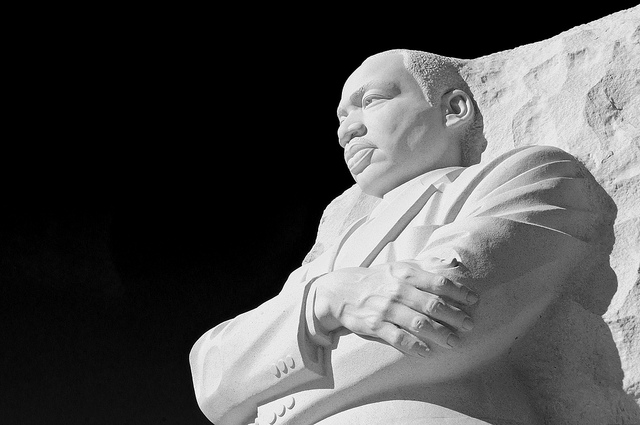
(Photo of Martin Luther King, Jr. memorial in Washington DC via Flickr user InSapphoWeTrust)
 The Dish