In a review of Sarah Churchwell’s Careless People — a “lavish excavation of the real-life milieu whose scandals, frolics and gaudy personalities gave F. Scott Fitzgerald the raw material for The Great Gatsby” — Tom Carson reflects on the utility of such literary history:
[H]ow much does this sort of whack-a-mole scholarship add to our understanding of
either Fitzgerald or Gatsby? A fair amount, I’d say. Even when Churchwell’s specific guesses may be dead wrong, she’s given us a raft of plausible speculations on the interplay between a novelist’s mind and the hurly-burly around him, meanwhile reminding readers of one of Fitzgerald’s greatest gifts: selectivity. Nonetheless, it’s telling that one reason reviewers in 1925 couldn’t see past Gatsby‘s surface was that its plot struck them as little more than a pastiche version of the sort of sensationalistic, sordid affair they read about in the papers every day. Because Fitzgerald transmuted dross into gold and the dross has grown fairly obscure almost 90 years later, Churchwell has done us a favor by evoking how his imagination was stimulated by all sorts of trifling current events. Better yet, her own writing is so spirited that you want her to be right about everything, even when you suspect otherwise—and come to think of it, that’s a kind of susceptibility Nick Carraway knew all about.
In another review of Careless People, Joanna Scutts observes:
Amid all the suggestive fragments of history that Churchwell uncovers, the most memorable are the counterintuitive details that remind us that nostalgia isn’t the same as memory. As asides to the main story, she tells us (often by means of illustrations and photographs) that in 1922 skirts were still ankle-length; that it was unlikely that anyone danced the Charleston at Gatsby’s parties; that the swastika was a benign symbol that a bootlegger could use to distinguish his fleet of taxicabs; and that the phrase “American dream” wasn’t invented until 1931, six years after “Gatsby” was published.
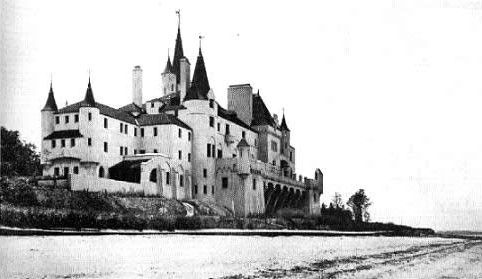
(Image of Beacon Towers in Sands Point, New York, 1920, the property that partly inspired the fictional Gatsby mansion, via Wikimedia Commons)
 The Dish
