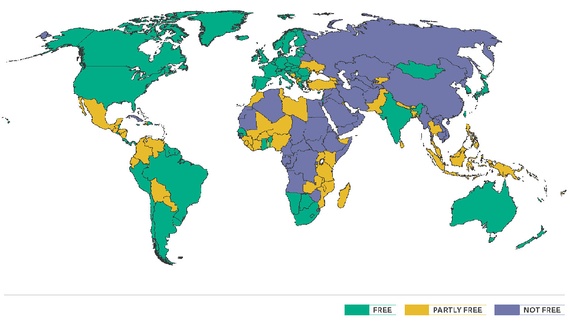
For the eighth straight year, Freedom House’s “Freedom in the World” report has registered a global decline in civil liberties:
“There just haven’t been any really significant breakthroughs in the important authoritarian powers that resisted democratization in the past 30 years—Russia, the other Eurasia countries, the Middle East, China, Iran, Venezuela,” Arch Puddington, vice president for research at Freedom House, told me.
The leaders of these countries, Puddington added, have learned from the collapse of the Soviet Union not to make major, uncontrollable reforms, and from the Color Revolutions in Ukraine and Georgia not to permit a pro-democracy, oppositional civil society to flourish. They are “modern authoritarians,” according to the report’s terminology, who “[d]evote full-time attention to the challenge of crippling the opposition without annihilating it, and flouting the rule of law while maintaining a veneer of order, legitimacy, and prosperity.”
Despite these setbacks, Ulfelder points out that democracy is not in retreat:
Freedom House looks at the data from a different angle than I do, calling out the fact that the number of declines in scores on its Political Rights or Civil Liberties indices outstripped the number of gains for the eighth year in a row. This is factually true, but I think it’s also important to note that many of those declines are occurring in countries in the former Soviet Union and the Middle East that we already regard as authoritarian. In other words, this eight-year trend is not primarily the result of more and more democracies slipping into authoritarianism; instead, it’s more that many existing autocracies keep tightening the screws.
Keating sees little movement in either direction:
I think it’s true that what we’re seeing is more a matter of fluctuation within countries that are long-standing members of one category or another. There hasn’t been a major trend toward countries either fully adopting democracy or abandoning it for quite some time. But as my old colleague Christian Caryl argued in a recent debate on this subject sponsored by the Economist, the important thing to remember is that “many citizens do not see democracy as an end in itself. People want freedom, to be sure, but they also yearn for economic growth, social justice and security. When elected leaders fail to produce these public goods, voters can hardly be blamed for their disillusionment.”
 The Dish