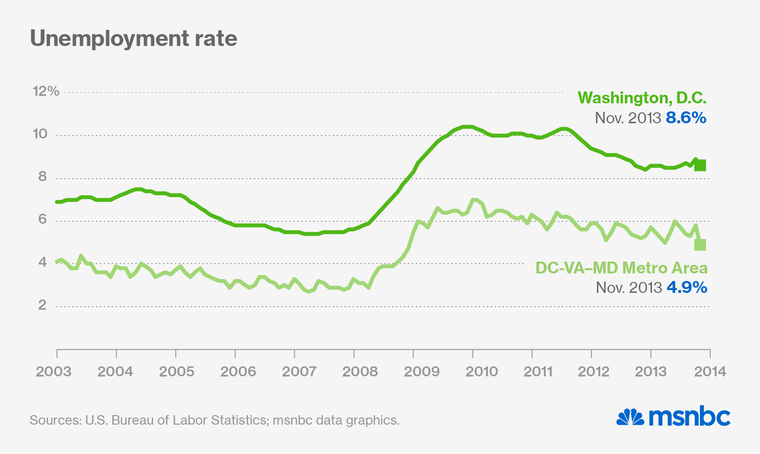
Suzy Khimm points out the staggering inequality in Congress’s backyard:
The gap between low- and high-income households in D.C. is one of the biggest in the country—the third-highest of the 50 largest cities in the U.S., according to the D.C. Fiscal Policy Institute. While the D.C. metro area was spared the worst of the recession, the downturn and subsequence recovery have exacerbated the long-standing differences between the area’s rich and poor.
Between 2007 and 2012, 18.5% of D.C.’s residents were in poverty, compared to 8.4% in the entire metro region, which includes six of the 10 richest counties in the U.S. The massive growth in federal contracting dollars—hitting $80 billion in 2010 alone—helped push the median household income to nearly $120,000 in Virginia’s Loudoun County. But the disparities aren’t just in terms of income. While the region’s unemployment rate has dipped to just 4.9%—far below the national rate—it’s stuck at 8.6% in the District. Within the city itself, the differences are even starker: The jobless rate in Ward 8, one of the city’s poorest neighborhoods is 18.6 percent; in Ward 3, it’s 1.8 percent.
Alex Leary examines the demographic shifts driving these changes:
Washington, which boasts one of the most educated workforces in the country, has gotten younger. The “millennials” — those 18 to 29 — now account for 35 percent of the population, while the same group is only 23 percent of the national population. It also has gotten whiter.
The black middle class began to leave after riots that followed the assassination of Dr. Martin Luther King Jr., leaving 14th Street, Columbia Heights and other parts of the city in ruins. In 1970, African-Americans made up 70 percent of the city’s population. In 2010, it was down to 51 percent and many of those left are among the poorest and least educated, concentrated in neighborhoods east of the Anacostia River that have been untouched by revitalization.
 The Dish