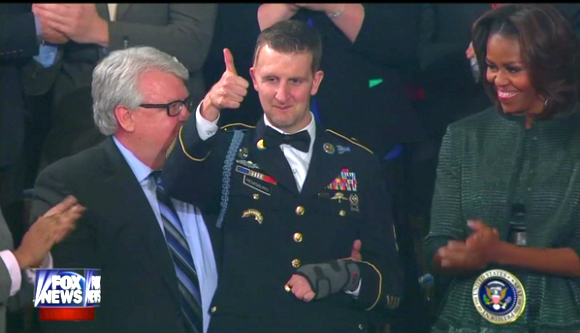
Fallows’ feelings about the SOTU featuring a wounded veteran:
[W]hile that moment reflected limitless credit on Sgt. Remsburg, his family, and others similarly situated; and while I believe it was genuinely respectful on the president’s part, I don’t think the sustained ovation reflected well on the America of 2014. It was a good and honorable moment for him and his family. But I think the spectacle should make most Americans uneasy.
The vast majority of us play no part whatsoever in these prolonged overseas campaigns; people like Sgt. Remsburg go out on 10 deployments; we rousingly cheer their courage and will; and then we move on. Last month I mentioned that the most memorable book I read in 2013 was Billy Lynn’s Long Halftime Walk, by Ben Fountain. It’s about a group of U.S. soldiers who barely survive a terrible encounter in Iraq, and then are paraded around in a halftime tribute at a big Dallas Cowboys game. The crowd at Cowboys Stadium cheers in very much the way the Capitol audience did last night—then they get back to watching the game.
Beinart weighs in:
The entire reason Democrats and Republicans came together so unreservedly was that Obama didn’t use Remsburg’s ordeal to say anything about the war in Afghanistan, or about how America should conduct itself on matters of war and peace. The only lesson he drew was that Remsburg, like America itself, “never gives up and he does not quit.”
Which was, frankly, bizarre.
Because while Remsburg himself has clearly shown incredible determination in the face of almost unimaginable obstacles, when it comes to the war in which he fought, quitting is exactly what the United States plans to do. Obama said as much earlier in his speech. In lauding America’s exits from Afghanistan and Iraq, he didn’t cite a single thing the United States has accomplished in either country. How could he have? Parts of central Iraq are today in the hands of jihadists, and the carnage there has never been worse. When the U.S. and its allies leave Afghanistan, one expert recently predicted, “the likely outcome is a civil war, much more fierce and widespread than the one fought during recent years.”
The harsh reality is that America did not leave Iraq, and is not leaving Afghanistan, because we accomplished our goals there. We are leaving because we decided our goals of defeating the Taliban and fostering Iraqi democracy weren’t important enough to justify spending billions of dollars and losing more American lives.
 The Dish