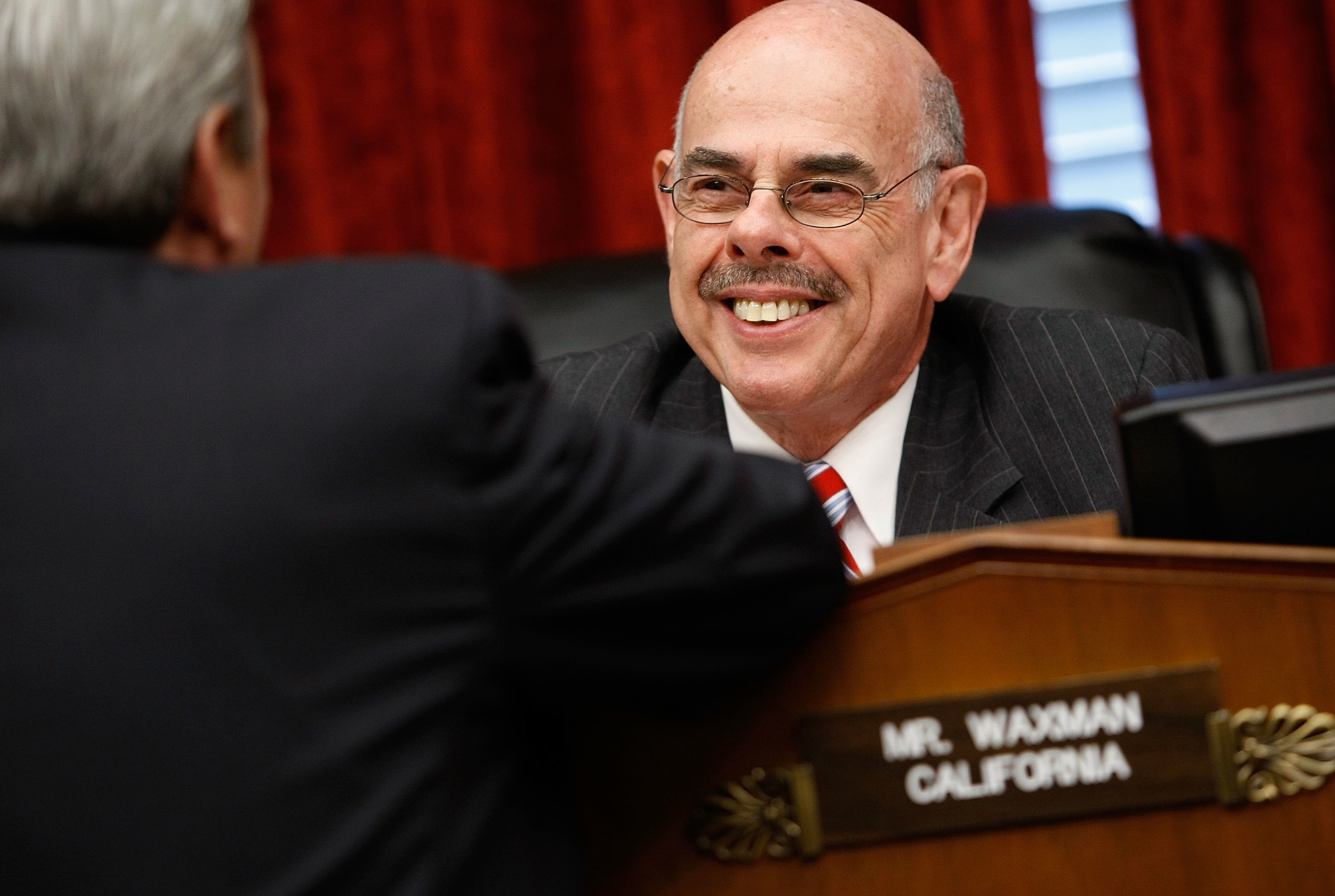
Kilgore will miss Henry Waxman, who is retiring from Congress after 40 years as a Democratic party stalwart:
As a legislative craftsman, Waxman was sort of a rumpled, uncharismatic 5-foot-5-inch version of Ted Kennedy, and the comparison might actually slight (no pun intended) the Californian. There’s hardly any significant health or environmental legislation enacted during his long tenure in the House that doesn’t have his fingerprints all over it. But personally, I’ll always identify Waxman with his long, heroic effort to turn the twisted and inadequate federal-state Medicaid program into something that actually served as a safety net, particularly for kids. I’m sure the Affordable Care Act, and particularly its Medicaid expansion, were especially sweet accomplishments for Waxman.
Although he was a staunch liberal, Joshua Green points out that most of Waxman’s legislative achievements were bipartisan:
That Waxman’s most productive years occurred while the White House was controlled by the opposing party makes his example all the more notable today. It’s astonishing that Republicans don’t study him and emulate his methods.
Those methods are essentially the opposite of the ones that lawmakers such as Ted Cruz have employed—the refusal to compromise, the sweeping attempt to impose an entire agenda immediately through force. “You have to be willing to be at it, look for compromises, build coalitions, and get public opinion behind you so you can finally get to the point when legislation can be passed,” Waxman said.
Harold Meyerson recalls the congressman’s distinctive style:
Getting things done the Waxman way didn’t involve the bonhomie that politicians characteristically employ. He didn’t persuade his fellow congressmen by schmoozing. “Henry never entertains his colleagues,” his longtime aide Howard Ellison told me when I wrote a profile of Waxman for the Los Angeles Times Sunday Magazine in 1995. “He does no sports. His staff would say, ‘You should play golf with John Dingell [then chair of Waxman’s committee].’ Fat chance.”
Rather, as I wrote at the time, Waxman “persuades by argument, not by humor or force of personality. Where Ralph Nader unleashes a torrent of indignation, Barney Frank stings with wit and Tom Hayden still taps into a vein of adolescent anger, Waxman simply makes his case point by point. He is not liberalism’s man for all seasons. He is only its legislative genius.”
Masket highlights his role in building the Democratic power base in West LA:
To some, at least, the Waxman-[Howard] Berman machine would represent a form of political corruption. That is, they used money, influence, and technical skills to limit voters choices in elections and advance issues they felt were important. And they could certainly be competitive and cutthroat in their approaches, doing as much to hurt their opponents as help their friends. But it’s hard to find much evidence of graft or pettiness in their efforts. As much for his other accomplishments, Waxman deserves to be praised for building a serious political organization that affected dozens of political careers and literally millions of constituents.
Ben Adler explores Waxman’s environmental legacy:
Environmental advocates point to one major legislative accomplishment in particular: his role in writing the powerful 1990 amendments to the Clean Air Act. As the Times explains, “He is also credited with laying the foundation for many of the executive actions that Mr. Obama, during his State of the Union address on Tuesday, pledged to pursue. One involves the Clean Air Act, which Mr. Waxman helped write and which gives the Environmental Protection Agency the authority it is now exercising to regulate power plant emissions of greenhouse gases. Mr. Waxman saw to it that the bill would allow the president, on his own, to order improvements in automobile fuel efficiency and other energy saving efforts.”
Reflecting on Waxman and George Miller, who both entered the legislature as young men, Bernstein considers what a geezer Congress we have today:
There’s nothing wrong with people coming to politics, and Congress, later in life. But if we don’t get 30-somethings (and some 20-somethings) in the mix, we are going to have an overly geriatric legislature. That is increasingly the case.
I’m not sure exactly why it’s happening. It could be because more individual wealth is needed for House campaigns these days. It could be, in part, because the field of candidates has opened up to include women, and maybe others who were excluded in the past and take a little longer to stake their political claim. So there may be good and bad reasons. Still, we could use a few more House careers like those of George Miller and Henry Waxman.
And Sam Baker notes that Waxman’s retirement is just the latest in an exodus of Obamacare architects and Democratic health care experts from Congress:
Including Waxman, four of the five committee chairmen who helped write the law are gone or leaving. Democratic leaders and committed liberals can and will still defend Obamacare politically, along with the basic idea of universal coverage. But there aren’t many Democrats left who—like Waxman and some of his departing Congressional colleagues—are truly invested in the ins and outs of the Affordable Care Act as well as other nitty-gritty health care issues. (Waxman, along with Republican Sen. Orrin Hatch, essentially created the generic-drug industry.)
(Photo: House Energy and Commerce Committee Chairman Henry Waxman (D-CA) prepares to hear testimony from Obama Administration cabinet members on Capitol Hill April 22, 2009. By Chip Somodevilla/Getty Images)
 The Dish