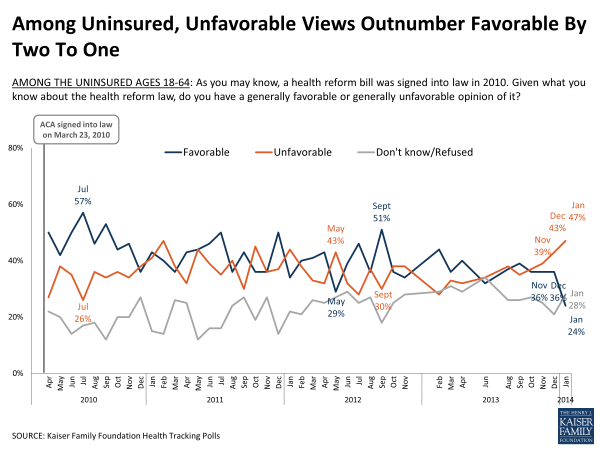
Suderman parses Kaiser’s latest numbers:
[T]he [above] latest monthly tracking poll from the Kaiser Family Foundation finds that opposition to the law amongst the uninsured has actually increased since December … This is the group of people the law was, in theory, supposed to benefit most. And yet even as the most prominent benefits start to kick in, their support is dropping. It’s possible, of course, that this could turn around at any time. But it’s not a very good sign for the future popularity of the law.
I too was gobsmacked by this result. But then you look and ask what the respondents actually think Obamacare is. And you get this result:
Roughly four in ten adults overall, and about half of the uninsured, are not aware that the law provides financial help to low- and moderate-income Americans to help them purchase coverage, gives states the options of expanding their Medicaid programs, and prohibits insurance companies from denying coverage based on pre-existing conditions.
That is such a massive indictment of the president’s messaging it beggars belief. Half of the uninsured have no idea that Obamacare offers them money to buy health insurance! WTF? No wonder the popularity of the law remains mired.
Look: the cognitive dissonance is real. But so is the ignorance. Obama’s approach to selling the ACA has been that of a classic defensive-crouch liberal. He sees the low popularity and decides not to tout the law so much. And by failing to tout the law effectively, relentlessly, persistently and clearly, he simply enables the ignorance-based opposition to grow.
Kliff notes how the media have also simply responded to this mood, rather than explaining the fuller story:
For many Americans – particularly the 68 percent who get coverage through their work, Medicare and Medicaid — the launch of the exchanges probably doesn’t affect their coverage situation. … So what’s driving the negative opinions of Obamacare? The Kaiser survey does point to one potential culprit: negative news coverage. More Americans say they’ve seen stories about people having bad experiences with the Affordable Care Act than good ones.
Waldman puts these numbers in perspective:
We spend so much time talking about politics that it’s easy to forget that politics are not an end in themselves, they’re a means to an end. Liberals advocated for comprehensive health insurance reform for so many decades not because it was politically advantageous (at some times it was, and at other times the voters didn’t seem to care), but because it was right. The fact that so many millions of Americans had no health security up until now was a moral obscenity. The ACA is beginning to fix things—slower and less completely than we might like, but it is a beginning. And if it never becomes the political boon you were hoping for, it was still the right thing to do.
Drum’s analysis:
27 percent now say that Obamacare has “negatively affected” someone in their family. That’s crazy. Even if you subtract the baseline of 18-19 percent who have been saying this all along, that’s an increase of nearly ten points over the course of 2013. Unless you take an absurdly expansive view of “affected,” this is all but impossible. Obamacare simply doesn’t have that kind of reach.
But we’ve been though a recent period in which every co-pay increase, every premium increase, and every narrowing of benefits has been blamed on Obamacare. These things have happened every year like clockwork for the past couple of decades, but this year it was convenient to blame them on Obamacare. Combine that with the PR disaster from the website rollout, and a whole lot of people now believe that Obamacare is hurting them.
 The Dish