Miriam Elder examines how the changing political landscape in Russia and sudden international renown have changed Pussy Riot and the lives of its two most famous members, Nadezhda Tolokonnikova and Maria Alyokhina:
Nadya and Masha entered prison at the height of a promising era. Moscow had risen up against Vladimir Putin. Protest was alive; change appeared to be around the corner. Pussy Riot took this further than anyone, adopting striking visuals and a form of protest Russia had rarely seen. Wearing bright clothes and masks, they would storm sites — Red Square, churches, fashion
runways — and shout and dance around while someone filmed. Though often referred to as a band, they never actually played instruments during these guerrilla performances. They never had plans to put out an album — that would be against their anti-capitalist ethos, they said. Their arrest signaled the beginning of the end. But they don’t seem to have realized this. In the two years since they were arrested, a small handful of opposition activists have issued reports on corruption, environmental catastrophe, and decline in freedoms, upping their output in the lead-up to the Sochi Olympics. It lands in a void.
“I don’t know where this apathy comes from,” Nadya told me the day before the Barclays Center show, standing in fresh slush outside the the U.S. mission to the United Nations, where they held a closed-door meeting with envoy Samantha Power. Usually, Nadya speaks in slogans, short and clipped statements full of unflagging determination, always on, playing the part of the professional revolutionary. Now she was confused. In prison they fought the system — writing endless complaint letters, going on hunger strikes, trying to publicize the horrific conditions within. “If you’re apathetic in jail, that’s it, that’s the end.” Masha added: “There’s some apathy in society, we have to admit. [Putin] achieved that. Our task is to turn that around.”
There is no such disinterest abroad. Abroad, Masha and Nadya are rock stars. They are surrounded by hangers-on and handlers. At home, they are opposition activists and wacky performance artists. At home, things are more complicated.
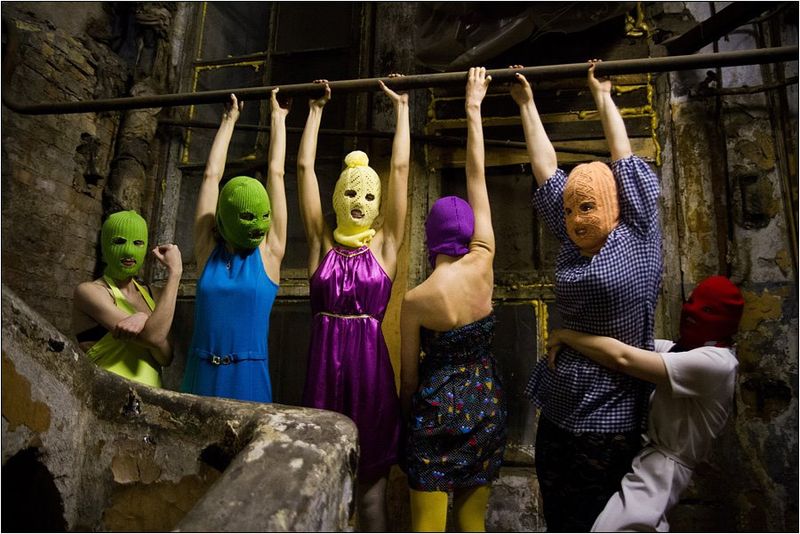
(Photo: Pussy Riot – Denis Bochkarev, 2012. Via Wiki.)
 The Dish