Linda Besner considers the appeal of Disneyland’s design:
In Charles Montgomery’s book Happy City: Transforming our Lives through Urban Design, Montgomery talks to John Hench, a former leader of Disney’s Imagineering
team, who says, “There’s some nostalgia involved, of course, but nostalgia for what? There was never a main street like this one. But it reminds you of some things about yourself that you’ve forgotten about.” The idea is that architecture and urban design play a powerful role not only in how people use a public space but in how they feel, about themselves and about other people, while they’re there. Montgomery visits Disneyland with a neuroscientist who points out how the fudge-scented air and pedestrian-friendly boulevards make people more relaxed and outgoing. Nursing-home designers have taken a leaf from Disney’s book and replicated some of the architectural features of Main Street in elder care environments.
Disneyland is about evoking innocence, and embedded deep in our collective memory is the association between innocence and the long period of peace between the Napoleonic wars and World War I; a time when there had been just enough technological innovation to improve people’s lives (electricity, the telephone, better agricultural techniques) but not enough to cause mass destruction of people and the environment (machine guns, the car, industrial farming). The late Victorian era is close enough to make us feel comfortable but distant enough to make us feel safe from the anxieties of the modern world.
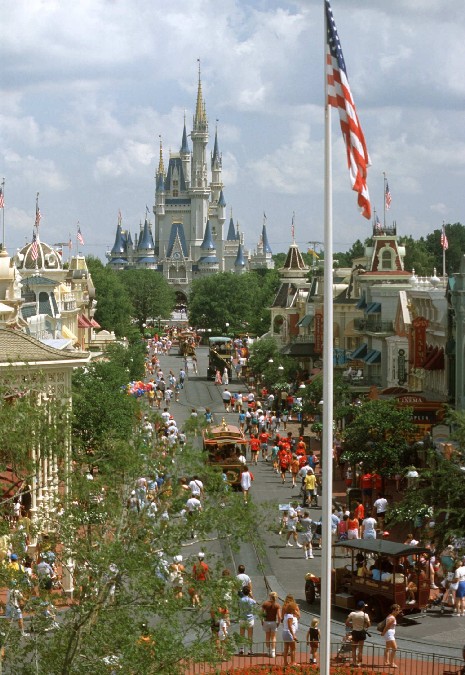
(Image of Main Street, USA at the Magic Kingdom, Walt Disney World Resort in Florida via Wikimedia Commons)
 The Dish
