Alexander Kasterine urges countries to reconsider their wildlife trade bans:
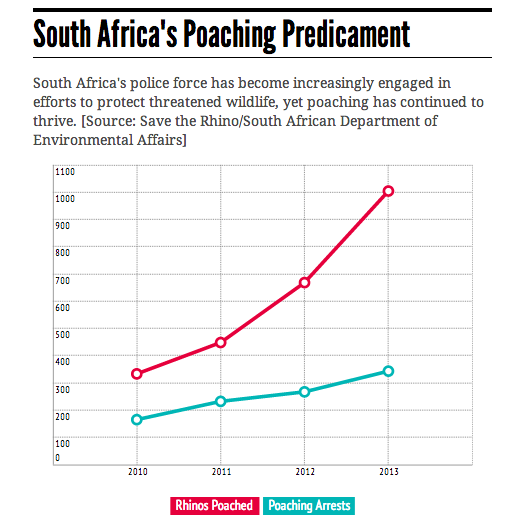
In South Africa, police and national defense forces have become increasingly engaged in efforts to
protect threatened wildlife, and the government has earmarked roughly $7 million in extra funding to ramp up security in its national parks. Yet poaching there has continued, just as it has throughout the continent. Last year alone, poachers killed a total of 22,000 elephants, the majority for tusks that were sold to feed rising demand in Asia.
Through the Convention on International Trade in Endangered Species of Flora and Fauna (CITES), an international agreement among 179 countries, governments can vote to ban the trade of products from species threatened with extinction. But such trade bans are failing in large part because they have run into the same basic problem as the war on drugs. Prohibitions on trading wildlife products such as tusks and timber have ultimately made them more valuable. And criminal organizations have moved in and taken over the market, imposing high costs – through violence and corruption – on weak societies.
Kasterine’s proposal? Legalize it:
[T]he South African government plans to propose lifting the ban on trading rhino horn at the next CITES meeting in 2016. South African officials argue that a legal trade would take profits away from criminal syndicates. Just as taxes on cigarettes fund education and health programs in the United States, similar levies would also provide ample funds for campaigns to combat poaching and reduce demand. Meanwhile, regular de-horning of the animals would increase the global horn supply, lowering prices and the attraction of poaching. Rhinos produce nearly one kilogram of horn each year, which can easily be harvested through a simple veterinary procedure. Farming the animals ethically, moreover, would allow consumers to demand horn products from sustainably managed sources.
But environmental blogger Adam Welz argues that legalization would backfire:
Legalizing the trade in rhino horn will incentivize everyone from producers/rhino custodians to sellers to maintain a high price on it. This, of course, will maintain the incentive to poach rhinos, which in turn will incentivize rhino custodians to maintain them in small areas that can be affordably defended (the current wave of rhino poaching is already causing this to happen). Trade might ‘work’ in the sense that it’ll incentivize the creation of high-density rhino farms, and thus perpetuate the existence of rhinos, but as little more than expensive feedlot cattle. Is this what we want?
Previous Dish on the wildlife trade here, here, here, here, and here.
 The Dish