Juan Cristobal Nagel looks at the state of Venezuela’s economy:
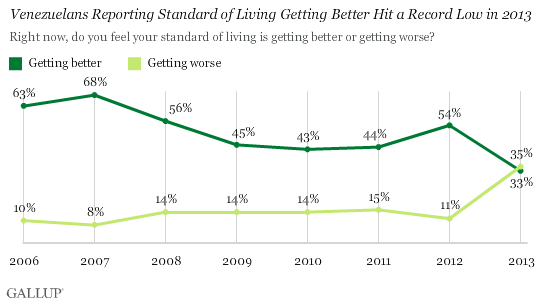
I think we are underestimating the extent to which economic expectations took a hit in the last few months. Venezuela’s economy is not yet officially in a recession, but people are, increasingly, sharply worried about their future. According to surveys conducted around early October, the Gallup organization found Venezuelans increasingly concerned about their future well-being.
Max Ehrenfreund argues that Venezuela’s socialism has been relatively ineffective:
While the gap between rich and poor is smaller than in many other Latin American countries, it is still quite large. And while Venezuela is wealthier than some of its neighbors, the economy has performed badly since Chávez took office fifteen years ago, according to data from the World Bank. The economy has expanded by less than 3 percent per year on average, despite an oil boom, and is now in crisis. Shortages of staples and basic commodities are now routine, and Maduro’s government nationalized a major manufacturer of toilet paper last year in a desperate effort to keep shelves stocked. The official inflation rate is now at 56 percent per year, and the true rate might be much higher. (A tip of the hat to David Frum.)
A useful contrast is with Uruguay, where the economy has expanded at a rate of more than 5 percent per year since 2008 and less than 10 percent of the population is living in poverty, according to the World Bank. No one could accuse Uruguayan President José Mojica, who took office in 2010, of being a fascist — he rides around in an old Volkswagen, and his government passed laws legalizing gay marriage and marijuana last year. Yet Mojica is focused on managing the country effectively, not on curtailing the freedoms of his political opponents.
But Raul Gallegos bets against Venezuela’s government collapsing the way Ukraine’s did:
Opposition leaders may gain political capital from the current discontent. But only broad unrest among the poorest members of society could shake Maduro’s control. Former presidential candidate Henrique Capriles Radonski made that clear when he declined to support the recent opposition led protests earlier this month: “Where are the poor in all of this? There’s none, and we won’t participate because we won’t fall for this, we won’t let ourselves be carried away” by events.
 The Dish